Discussions and banter of Northern Virginia's Wildlife and Large-Scale Trail Camera Projects
Showing posts with label sterling. Show all posts
Friday, May 1, 2015
Virginia is For Fox Lovers
Nothing strikes the hearts of Northern Virginia's suburbanites more than baby red foxes. It's incredible how much interest there is in these animals.
Foxes are cool, and lots of people are enthusiastic about seeing red foxes in their neighborhood, but when the bright eyed, curious babies come out in late April, people go absolutely wild for these things like you wouldn't believe.
It was a bit of a goal of mine to capture some of them of, at least one of my camera traps this year, as I did fairly well with footage last year (The Best Fox Kit Pictures So Far- 2014 ). Emails have been pouring in with unconfirmed leads of the whereabouts of fox dens, and I have worked so hard with landowners, parks staff, and other naturalists to try to provide everyone with some interesting photos (and video!). One lead from Northern Virginia was clearly the best one that I have ever had. It's amazing, it's a secret location, and I can't thank the colleague and friend of mine who led me down the right path to this one, enough.
As previously stated in an earlier blog post (Fooled and Fooled Again), the amount of groundhog dens that were fooling me and my colleagues was getting high.
Discouraging, might be the best word to describe this whole situation of not finding any fox dens.
Amazed, would be the word to describe my thoughts when first seeing this footage.
It's only fitting that I release these now on the blog.
These were posted on Facebook, and one specific video almost went viral, being shared many times, and generating a huge interest in camera trapping and wildlife.
I have seen both the mother and father on camera and in person. 4 individual kits (fox babies) have been identified, so in total, they are a family of 6. Each kit has a different personality, and it is quite an experience watching the videos of all of them nursing, playing, fighting, and yelling.
As you can see in the second picture above, the kits are only eating the milk provided by their mother. This will last for a little while, until eventually they ween themselves onto a diet of rodents, birds, snakes, berries, carrion, and much, much more.
Pictures like these are ones that a Northern Virginia naturalist and camera trapper dreams of, and I thank you for visiting this site to enjoy them as well.
Thursday, April 9, 2015
Why Did the Turkey Cross the Road?
Just a few days before "spring gobbler season" opens up to licensed hunters in Virginia, and with youth turkey hunting already upon us, this one might really got me going yesterday.
Sometime in the early afternoon yesterday, one of my buddies sent me a text saying "There's a turkey by the Toys R Us parking lot just walking around".
A few minutes later, I got multiple emails and Facebook notifications saying similar things. I was hooked immediately and was watching the situation unfold from my phone and Facebook newsfeed.
I used to work for that Toys "R" Us store in Loudoun County during my high school years, and though I do not hang my hat there anymore, I try to still keep in touch with some of my old friends and coworkers there.
It's a good way of not burning bridges and once in a while, some interesting wildlife information is spread between all of us.
This was a perfect example of that spreading of wildlife information. It's important to know and I find it fascinating.
I get texts and emails similar to this (though usually with different species) every few days or so from various friends and contacts all over northern Virginia. Usually I just refer them to various wildlife agencies to ask for advice, but for this one, I knew it seemed to be under control already and had an idea of where the turkey had come from nearby.
For wild turkeys, it is basically breeding season right now. They are fluttering all over with the males starting to really "strut their stuff" during the day. The one pictured and in question is most likely a female (also called a hen). She lacks a beard (bristled feathers near her neck and breast) that would usually be a giveaway that it is a male.
So why did the turkey cross the road? Well, who knows. Maybe she wandered off farm land and wooded land too far and just go lost. Maybe she was being chased by male suitors all day. I like to think that maybe she was going in the general direction of the Total Wine store very close to grab a six-pack of her favorite brew, but that's probably not the case.
Either way, I do not know the exact outcome of what happened to her but hope to find out shortly.
As for the multiple friends and former coworkers who tipped me on this information, I say a very big thank you for keeping in touch with me and for sharing this.
![]() |
| "Gobble gobble" |
Sometime in the early afternoon yesterday, one of my buddies sent me a text saying "There's a turkey by the Toys R Us parking lot just walking around".
A few minutes later, I got multiple emails and Facebook notifications saying similar things. I was hooked immediately and was watching the situation unfold from my phone and Facebook newsfeed.
I used to work for that Toys "R" Us store in Loudoun County during my high school years, and though I do not hang my hat there anymore, I try to still keep in touch with some of my old friends and coworkers there.
It's a good way of not burning bridges and once in a while, some interesting wildlife information is spread between all of us.
This was a perfect example of that spreading of wildlife information. It's important to know and I find it fascinating.
I get texts and emails similar to this (though usually with different species) every few days or so from various friends and contacts all over northern Virginia. Usually I just refer them to various wildlife agencies to ask for advice, but for this one, I knew it seemed to be under control already and had an idea of where the turkey had come from nearby.
For wild turkeys, it is basically breeding season right now. They are fluttering all over with the males starting to really "strut their stuff" during the day. The one pictured and in question is most likely a female (also called a hen). She lacks a beard (bristled feathers near her neck and breast) that would usually be a giveaway that it is a male.
So why did the turkey cross the road? Well, who knows. Maybe she wandered off farm land and wooded land too far and just go lost. Maybe she was being chased by male suitors all day. I like to think that maybe she was going in the general direction of the Total Wine store very close to grab a six-pack of her favorite brew, but that's probably not the case.
Either way, I do not know the exact outcome of what happened to her but hope to find out shortly.
As for the multiple friends and former coworkers who tipped me on this information, I say a very big thank you for keeping in touch with me and for sharing this.
Wednesday, February 25, 2015
Where the Bear Was
Ed Felker joined me on a short hike to track a bear through the woods yesterday. Ed is another outdoor blogger with a great site at http://dispatchesfromthepotomac.com/ . He's got some amazing pictures and a fantastic way of writing about what he sees. We've been conversing about hunting stories, coyote sightings, and hikes lately, so it was only fitting that we'd get the chance to meet up on the trail. We pussyfooted around logs and dense brush, while throwing in all sorts of outdoorsmen lingo to make it a great day.
I took him directly to where a nice black bear was frequenting in Loudoun County, Virginia. In some spots, 4-6 inches of snow was still on the ground. With the extremely cold temps that we've been experiencing lately, the fresh tracks barely melted away at all. The definitions of toe pads, palm pads, and even claws were incredibly preserved.
Pictures and measurements were taken.
I'll share this one, but if you want to see more, check out Ed's blog post about it here: Bear Tracks.
I took him directly to where a nice black bear was frequenting in Loudoun County, Virginia. In some spots, 4-6 inches of snow was still on the ground. With the extremely cold temps that we've been experiencing lately, the fresh tracks barely melted away at all. The definitions of toe pads, palm pads, and even claws were incredibly preserved.
Pictures and measurements were taken.
I'll share this one, but if you want to see more, check out Ed's blog post about it here: Bear Tracks.
![]() |
| Black bear tracks in Sterling, Virginia. |
Sunday, February 15, 2015
Bears and Batteries
When the cold sets in like it is right now, most of my camera traps don't work. This happens for various reasons, but mostly because some kinds of batteries tend to freeze up a bit and the fact the even the camera's internal electronics get frozen if there's a trace of moisture inside of them.
Regardless, they usually kick right back in when there's a bit of a thaw. For now though, it's just a sort of waiting game until the batteries continue to work again.
In other Northern Virginia wildlife news, there has been a huge increase in the amount of bear related sightings, emails, and inquiries to me in the past two weeks.
Mostly, this has happened in Loudoun County, specifically Potomac Falls, Sterling, Lowes Island, Cascades, and the Great Falls Forest neighborhoods. So here's a little bear information for everyone.
Whether or not this is the same bear as what people have been asking about, is still a bit of a mystery to me. Either way, it's exciting to see bears roaming around.
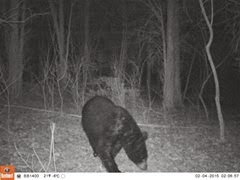
I caught one of them on a camera trap recently. Take a look!
In typical "bear fashion", it came near the camera, sniffed around, got a bit curious, and went on as usual. That's what I like to see though. The bear just seemed to get curious about the camera, my human scent, and whatever I touched. There was no food put down. In this way, the bear was never rewarded for just coming by and there was barely (bearly?) any human interaction other than a trail camera being around. Feeding this bear would not only have been illegal, but also wrong on many levels. Doing so may have led to unhealthy behaviors and unwanted human/wildlife interactions.
It didn't just leave pictures though. It left some scat in a very obvious place, and I had to take a picture to send to various naturalists and biologists to identify.
There's no doubt in my mind that this is bear scat. It's large (over 8 inches long with a large mass), not human-like, seems to contain seed/nuts, and is the biggest piece of s*** that I've seen in this general area in a long time. I've seen dog, human, coyote, and various other scats around, but nothing really compares to this one in Sterling.
So why is there a dollar bill in the picture? Well, a dollar bill, in a pinch can act as a sort of ruler or object to compare to. Other people may use knives, pens, and their shoes, but I like to use dollar bills. They are almost exactly 6 inches long and when you don't have an actual ruler, they can easily be used as a measuring tool.
Regardless, they usually kick right back in when there's a bit of a thaw. For now though, it's just a sort of waiting game until the batteries continue to work again.
In other Northern Virginia wildlife news, there has been a huge increase in the amount of bear related sightings, emails, and inquiries to me in the past two weeks.
Mostly, this has happened in Loudoun County, specifically Potomac Falls, Sterling, Lowes Island, Cascades, and the Great Falls Forest neighborhoods. So here's a little bear information for everyone.
Whether or not this is the same bear as what people have been asking about, is still a bit of a mystery to me. Either way, it's exciting to see bears roaming around.
I caught one of them on a camera trap recently. Take a look!
In typical "bear fashion", it came near the camera, sniffed around, got a bit curious, and went on as usual. That's what I like to see though. The bear just seemed to get curious about the camera, my human scent, and whatever I touched. There was no food put down. In this way, the bear was never rewarded for just coming by and there was barely (bearly?) any human interaction other than a trail camera being around. Feeding this bear would not only have been illegal, but also wrong on many levels. Doing so may have led to unhealthy behaviors and unwanted human/wildlife interactions.
It didn't just leave pictures though. It left some scat in a very obvious place, and I had to take a picture to send to various naturalists and biologists to identify.
There's no doubt in my mind that this is bear scat. It's large (over 8 inches long with a large mass), not human-like, seems to contain seed/nuts, and is the biggest piece of s*** that I've seen in this general area in a long time. I've seen dog, human, coyote, and various other scats around, but nothing really compares to this one in Sterling.So why is there a dollar bill in the picture? Well, a dollar bill, in a pinch can act as a sort of ruler or object to compare to. Other people may use knives, pens, and their shoes, but I like to use dollar bills. They are almost exactly 6 inches long and when you don't have an actual ruler, they can easily be used as a measuring tool.
Tuesday, January 13, 2015
Camera-Trapping Program
I'll make this one short and sweet!
In March of this year, Loudoun Wildlife Conservancy will be hosting program titled "Wildlife Camera-Trapping Program and Field Trip".
Location: Morven Park, Leesburg, Virginia
Date: March 7, 2015
Time: 2 P.M.
What to bring: Hiking boots or shoes that can get muddy.
You are all invited come to this FREE program where I will be speaking about local camera-trapping projects, ecology, citizen science, and northern Virginia's natural world.
There will of course be an outdoor field portion of this program.
Did I mention it's FREE?!
You can sign up here : Wildlife Camera-Trapping Program .
Hope to see you there!
In March of this year, Loudoun Wildlife Conservancy will be hosting program titled "Wildlife Camera-Trapping Program and Field Trip".
Location: Morven Park, Leesburg, Virginia
Date: March 7, 2015
Time: 2 P.M.
What to bring: Hiking boots or shoes that can get muddy.
You are all invited come to this FREE program where I will be speaking about local camera-trapping projects, ecology, citizen science, and northern Virginia's natural world.
There will of course be an outdoor field portion of this program.
Did I mention it's FREE?!
You can sign up here : Wildlife Camera-Trapping Program .
Hope to see you there!
Wednesday, September 24, 2014
Bear Broken Camera
It's always a fight against the black bears when you've got cameras in the woods.
They get a lot more curious then some other animals, and their natural curiosity can be a problem.
This camera was torn down and ripped apart by a black bear. Its casing was broken, the screen cracked, and batteries torn out.
All that was left at the scene was a single, decent bear print, and leaves thrown all over where the bear sat around or dug up something to eat.
Labels:
animals,
ashburn,
bear,
bears,
biology,
black bear,
brambleton,
burke,
fairfax,
great falls,
herndon,
leesburg,
loudoun,
sterling,
vienna,
wildlife
Wednesday, July 9, 2014
The Ants Go Marching
A coworker helped me with some cameras today and found one completely covered in ants.
Upon closer inspection, ants had completely invaded the entire interior of the camera-trap. We spent a good hour opening up the camera, unscrewing screws, cleaning it out, and putting it back together.
We completed our "Camera-Trap Surgery" in the field as we swatted away maybe 25 mosquitoes and picked off ticks of our legs. The ants had made an entire food storage type of room in the camera along with an egg holding cell. It was rough, but we managed to save the camera and found that no electrical components had been badly damaged.
We checked the SD card on a laptop in the field as well, but only found a few pictures of a red fox and raccoons.
But hey, you can't win with bears, coyotes, and other "crowd pleasers" every day. It was still a good day out on the trails, and I thank him greatly for helping me today.
Labels:
animal. animals,
ashburn,
bluemont,
brian balik,
camera,
camera trap,
deer,
fox,
game camera,
leesburg,
loudoun county,
red fox,
red fox pictures,
sterling,
technology,
trail camera,
wildlife,
wildlife fever
Tuesday, April 8, 2014
Cardinal on Camera
A few days ago, I had a special guest from WAMU 88.5 (Washington, D.C.'s NPR Station) come out and set cameras with me. I've been out with a NPR reporter before doing a story, and I enjoying showing these representatives of the media what I do and what camera-trapping is all about.
Chris came to a local park and hiked around in the mud and trails while asking questions. It was a good day to be out and about. We set up 5 cameras along deer trails, near fox dens, and a few other places.
I had to take one of the cameras down right away because I was told that somebody already found it in the woods. I didn't want it stolen, so it came down that day. The other cameras though have been up for a few days and continue to be up. I took one down today and checked the SD card.
Results were not phenomenal, but I was happy to see a Northern Cardinal fly down in front of the camera for a few seconds.
Cardinals are very common in Virginia and always seem to be the delight of nature watchers, families, and anyone who comes to local parks to hike or picnic. They are a such a vibrant bird and the males are very hard to miss in any season.
These birds do not lose their summer feathers or molt into a completely different color when seasons change. The males usually stay a bright red, while females almost always contain reds, grays, and browns.
The cardinal in the camera-trap video was not baited in or scented in at all. It just happened by pure luck that a camera was there when the cardinal landed on the ground.
Tuesday, March 25, 2014
Red Fox Rendezvous
Results include current living foxes, foxes that have been hit by cars (or died by other means), foxes that have moved out of the area, and fox kits
Here is a very watered-down and simplistic version of my data:
In a 24 acre plot, there were 3 individual red foxes
In a 60 acre plot, there were 4 individual red foxes.
In a 350 acre plot, I've found that there were at least 7 individual red foxes.
In a 430 acre plot, there were 9 individual red foxes.
In a 600 acre plot, there were 9 individual red foxes.
I get this data by comparing camera-trap images of different cameras set up in each park. A red fox that appears at one camera (under normal circumstances) cannot be the same red fox that appears at another camera 1 mile away, 30 seconds later. BAM! That's two individual foxes. Some red foxes look completely different from eachother, others are a little more difficult to recognize. Figure in more parks and a heck of a lot more cameras, and results like this pour in to my computer on a daily basis.
Labels:
centreville,
Chantilly,
fairfax,
fox,
fox count,
fox survey,
herndon,
leesburg,
loudoun,
manassas,
northern virginia,
parks,
red fox,
sterling,
too many foxes?,
vienna,
Virginia,
wildlife
Wednesday, March 5, 2014
Denning Season
It's denning season for the canids of Virginia. That means that I'll be spending some time tracking fox, coyote, and other footprints through the mud and snow to help me find these dens. When I find one, a camera will be going up.
Here's a good one that I found yesterday. You can tell by the amount of footprints and kicked dirt around it that it is very active.
I used extreme care and caution not to get too close or disturb the animals that may be living in there.
Here's to hoping for pups or kits of fox or coyote this spring!
Here's a good one that I found yesterday. You can tell by the amount of footprints and kicked dirt around it that it is very active.
I used extreme care and caution not to get too close or disturb the animals that may be living in there.
Here's to hoping for pups or kits of fox or coyote this spring!
Wednesday, February 12, 2014
Rat-Tail
Fairfax County has the famous fox that we all call "White Legs" (see previous post on White Legs here: A Friend of White Legs" but what famous fox does Loudoun County have?
The answer: Loudoun County is home to a red fox that we'll call "Rat-Tail".
Rat-Tail is a unique red fox with a tail that is not bushy at all. It is unknown why this fox looks like this. It could be mange, disease, parasites, genetics, injury, or self-inflicted, we just don't know yet.
Rat-Tail first appeared on camera-trap images last year, then went A.W.O.L. for months, until now. Rat-Tail could be a male or a female, there's no telling yet.
This fox could have a mate, since we have seen it romping around with another red fox lately. It came across this camera in the daytime, just trotting by in a very canine-like fashion with its nose down. It didn't stop at all by the camera, and continued on quickly.
The answer: Loudoun County is home to a red fox that we'll call "Rat-Tail".
Rat-Tail is a unique red fox with a tail that is not bushy at all. It is unknown why this fox looks like this. It could be mange, disease, parasites, genetics, injury, or self-inflicted, we just don't know yet.
Rat-Tail first appeared on camera-trap images last year, then went A.W.O.L. for months, until now. Rat-Tail could be a male or a female, there's no telling yet.
This fox could have a mate, since we have seen it romping around with another red fox lately. It came across this camera in the daytime, just trotting by in a very canine-like fashion with its nose down. It didn't stop at all by the camera, and continued on quickly.
Labels:
animals,
disease,
fairfax,
fairfax county,
fox,
injured,
loudoun,
loudoun county,
mange,
rat tail,
red fox,
sick,
skinny tail,
sterling,
wildlife
Thursday, February 6, 2014
Wildlife Experiences
In the past two weeks I've been experiencing wildlife in incredible ways. I've been trying to blog but have not had much time to check as many cameras as usual, but that short break of blogging ends now, and I'll be checking at least 12 cameras tomorrow.
During this little break, I've had some amazing wildlife experiences. Here's a little list of what I've done and seen in the past 2 weeks.
- Saw a coyote on a deer kill in Reston, Virginia.
- Presented at the Virginia Chapter Meeting of The Wildlife Society.
- Compared data and conversed with the leading biologist of the Smithsonian about camera traps that he had in Virginia.
- Camera-trapped some kind of weasel. I am still in the process of identifying it but will post about it shortly.
- Talked with other camera-trappers of Virginia Tech, Ferrum College, and Radford University.
- Saw a bald eagle pick off a Canada goose on the Potomac River. The fight only lasted a few seconds.
- Got a new camera-trap location in Falls Church, Virginia
- Supposedly had another bear attack a camera yesterday. I'll be checking that camera tomorrow to see the damage.
It's crazy to think how all of these wildlife experiences all started with me putting up a single camera in a local park, just over a year ago.
Saturday, January 11, 2014
A Real Stinker
Let's all take a minute to appreciate the skunks of Northern Virginia.
One of my biggest surprises so far in my experiences of camera-trapping has actually been a lack of skunks. This is only my third event of getting a skunk on camera in all of northern Virginia, ever.
I know there are many of them around because I see them walking in the daytime, see them dead on the road, smell them in the air frequently, and see them at least once a week in my backyard in the summer,
So why are skunks so camera shy? Well, I don't really know. I never thought it would be this hard to get a skunk on camera in the woods at night.
One of my biggest surprises so far in my experiences of camera-trapping has actually been a lack of skunks. This is only my third event of getting a skunk on camera in all of northern Virginia, ever.
I know there are many of them around because I see them walking in the daytime, see them dead on the road, smell them in the air frequently, and see them at least once a week in my backyard in the summer,
So why are skunks so camera shy? Well, I don't really know. I never thought it would be this hard to get a skunk on camera in the woods at night.
Tuesday, December 3, 2013
A 4 Month Long Wait
I've been doing a little bit of a test to see what happens when I leave a camera up for a long time. This was to test the camera, the batteries, water-resistance, and my own human scent near the camera.
Usually I'll leave a camera up for a week to three weeks before checking it.
The test camera was left alone for 4 months and 2 days. It sat through the hot days at the end of summer, through heavy rains, and recently, flurries of snow.
I gave volunteers the GPS coordinates, trail description, and a description of the camera. They were then sent them off to find it in the wilder parts of Fairfax County, Virginia.
It was a fun game for them to try to see who would be the one to locate it first.
The best part though, was getting the emails of the pictures after they checked the camera's SD card.
We were hoping for foxes and coyotes, because in theory, our human scent should have been at an extreme minimum since it was there for 4 months.
No coyotes or foxes were photographed, but the favorite animals photographed seemed to be the wild turkeys.
The pictures were taken near the end of September.
There's no word yet on whether or not these turkeys made it to Thanksgiving.
Usually I'll leave a camera up for a week to three weeks before checking it.
The test camera was left alone for 4 months and 2 days. It sat through the hot days at the end of summer, through heavy rains, and recently, flurries of snow.
I gave volunteers the GPS coordinates, trail description, and a description of the camera. They were then sent them off to find it in the wilder parts of Fairfax County, Virginia.
It was a fun game for them to try to see who would be the one to locate it first.
The best part though, was getting the emails of the pictures after they checked the camera's SD card.
We were hoping for foxes and coyotes, because in theory, our human scent should have been at an extreme minimum since it was there for 4 months.
No coyotes or foxes were photographed, but the favorite animals photographed seemed to be the wild turkeys.
The pictures were taken near the end of September.
There's no word yet on whether or not these turkeys made it to Thanksgiving.
Labels:
animals,
birding,
birds,
fairfax,
fairfax county,
forest,
great falls,
herndon,
loudoun,
reston,
sterling,
turkeys,
wild turkey,
wild turkeys,
wildlife,
woods
Sunday, December 1, 2013
Walmart Birding
"Walmart" and "birding" aren't two words usually put together in the same sentence, but that was different today.
In between periods of pushing my way through half-dressed shoppers and tripping over trash in the aisles, I noticed a bird in the rafters.
I identified it as a Cooper's Hawk.
Maybe next time I want to go birding, I'll go here instead of my favorite parks and nature preserves.
What birds have you seen in your local Walmart lately?
In between periods of pushing my way through half-dressed shoppers and tripping over trash in the aisles, I noticed a bird in the rafters.
I identified it as a Cooper's Hawk.
It just proves that sometimes you don't have to go far to go birding. I've also seen chickadees, sparrows, and grackles in this store.
Maybe next time I want to go birding, I'll go here instead of my favorite parks and nature preserves.
What birds have you seen in your local Walmart lately?
Labels:
bird,
birding,
cooper,
cooper's,
coopers,
coopers hawk,
hawk,
loudoun,
loudoun county,
sterling,
Virginia,
walmart
Saturday, November 30, 2013
Beavers on the Goose
"The Goose". It's how a few of us who camera-trap refer to Goose Creek.
Goose Creek is a state scenic river that runs through Leesburg, Va and flows into the Potomac River.
I put a few cameras up last week right near the banks of Goose Creek near beaver chewed trees.
The results are great.
Goose Creek is a state scenic river that runs through Leesburg, Va and flows into the Potomac River.
I put a few cameras up last week right near the banks of Goose Creek near beaver chewed trees.
The results are great.
As you can see, the beavers are hard at work.
For now, the cameras have been taken down. They were just to0 visible to have there for too long.
Wednesday, November 27, 2013
Happy Thanksgiving!
There's no way this blog is having a Thanksgiving themed post without a picture of a camera-trapped, wild turkey.
Happy Thanksgiving, folks.
Tuesday, October 8, 2013
Log Travelers
Let's get the gross facts out of the way first. This log was a place for marking for many species of animals. Fox, raccoon, and other unidentifiable mammalian scat was all over this log. Animals do this to mark their own territory, and it really can just pile up after time.
I found it just by walking around the woods in Sterling, Virginia while doing a few wildlife surveys months ago.
So what was a nature-oriented person with multiple camera-traps going to do?
You guessed it, I put a camera up to it and left it out for months. I checked it today and was happy with the results. These are all videos and can be started by just clicking.
I found it just by walking around the woods in Sterling, Virginia while doing a few wildlife surveys months ago.
So what was a nature-oriented person with multiple camera-traps going to do?
You guessed it, I put a camera up to it and left it out for months. I checked it today and was happy with the results. These are all videos and can be started by just clicking.
Raccoon
Red Fox
Gray Squirrel
Another Red Fox
Thursday, September 5, 2013
Surveying Places for Surveying Owls
![]() |
| Small mammal skulls found in Silo #1. |
The dirty work comes from dangers of being in old barns and silos. Steel-toed boots, masks, rubber gloves, and hardhats were put on, and we headed to work today in Leesburg, Virginia.
The first site we hit is a place that I am now calling Silo #1. Silo #1 is full of owl pellets and the remains of thousands of shrews, moles, mice, and voles. The bottom of it really is a place of death for small mammals.
Barn owl feathers also blanketed the lowest parts of the inside of the silo.
![]() |
| Barn owl feather found in Silo #1. |
A camera-trap was placed at the bottom of the silo to photograph owls (and other animals) that may be coming in or out. As the camera was being placed, a pair of barn owls flew in from the top of the silo. The camera is way out of the way of any nesting site used by the owls so as to not disturb them, but I am hoping I get at least a few shots of them flying by or perching somewhere.
The next destination was a small shed where owls had been seen perching in the past few months. There were no visible signs of owls there now though.
After the small shed, we decided that we would head to was a barn that I am calling on this blog, The Widow-Maker Barn. The Widow-Maker Barn gave me the uncomfortable feel of being way to dangerous to get near. Some parts of it had collapsed, and swarms of bees were entering through a small opening at the bottom. You won't find me inside of this barn anytime soon. A camera-trap was placed outside of the barn, about 12 feet up in a tree that faces a large hole at the top of the barn. Any owls that go in or out should still be camera-trapped.
So there you have it, the first two owl survey areas are Silo #1 and The Widow-Maker Barn.
Saturday, August 17, 2013
Bear Blogging
Black bears are roaming around all the time. It's hard for me to tell exactly where they'll be since they move so quickly and can cover a huge area of land in just a day.
Today, it was obvious that a bear had been around one of my cameras. There were scratches and paw prints all over the area. Walnuts from a nearby tree were smashed open and I could just tell the area was messed with by something big.
Of course the time stamp is wrong. Even if I switch the camera to the correct date, it still seems to go wrong when the camera enters "sleep" mode.
Today, it was obvious that a bear had been around one of my cameras. There were scratches and paw prints all over the area. Walnuts from a nearby tree were smashed open and I could just tell the area was messed with by something big.
Of course the time stamp is wrong. Even if I switch the camera to the correct date, it still seems to go wrong when the camera enters "sleep" mode.
Subscribe to:
Posts (Atom)