Showing posts with label herndon. Show all posts

Friday, May 1, 2015

Virginia is For Fox Lovers


Nothing strikes the hearts of Northern Virginia's suburbanites more than baby red foxes.  It's incredible how much interest there is in these animals.

Foxes are cool, and lots of people are enthusiastic about seeing red foxes in their neighborhood, but when the bright eyed, curious babies come out in late April, people go absolutely wild for these things like you wouldn't believe.

It was a bit of a goal of mine to capture some of them of, at least one of my camera traps this year, as I did fairly well with footage last year (The Best Fox Kit Pictures So Far- 2014 ).  Emails have been pouring in with unconfirmed leads of the whereabouts of fox dens, and I have worked so hard with landowners, parks staff, and other naturalists to try to provide everyone with some interesting photos (and video!).  One lead from Northern Virginia was clearly the best one that I have ever had.  It's amazing, it's a secret location, and I can't thank the colleague and friend of mine who led me down the right path to this one, enough.

As previously stated in an earlier blog post (Fooled and Fooled Again), the amount of groundhog dens that were fooling me and my colleagues was getting high.

Discouraging, might be the best word to describe this whole situation of not finding any fox dens.

Amazed, would be the word to describe my thoughts when first seeing this footage.

It's only fitting that I release these now on the blog.

These were posted on Facebook, and one specific video almost went viral, being shared many times, and generating a huge interest in camera trapping and wildlife.

I have seen both the mother and father on camera and in person.  4 individual kits (fox babies) have been identified, so in total, they are a family of 6.  Each kit has a different personality, and it is quite an experience watching the videos of all of them nursing, playing, fighting, and yelling.

As you can see in the second picture above, the kits are only eating the milk provided by their mother.  This will last for a little while, until eventually they ween themselves onto a diet of rodents, birds, snakes, berries, carrion, and much, much more.

Pictures like these are ones that a Northern Virginia naturalist and camera trapper dreams of, and I thank you for visiting this site to enjoy them as well.

Sunday, February 15, 2015

Bears and Batteries

When the cold sets in like it is right now, most of my camera traps don't work.  This happens for various reasons, but mostly because some kinds of batteries tend to freeze up a bit and the fact the even the camera's internal electronics get frozen if there's a trace of moisture inside of them.

Regardless, they usually kick right back in when there's a bit of a thaw.  For now though, it's just a sort of waiting game until the batteries continue to work again.

In other Northern Virginia wildlife news, there has been a huge increase in the amount of bear related sightings, emails, and inquiries to me in the past two weeks.

Mostly, this has happened in Loudoun County, specifically Potomac Falls, Sterling, Lowes Island, Cascades, and the Great Falls Forest neighborhoods.  So here's a little bear information for everyone.

Whether or not this is the same bear as what people have been asking about, is still a bit of a mystery to me.  Either way, it's exciting to see bears roaming around.

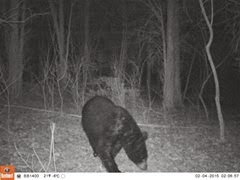
I caught one of them on a camera trap recently.   Take a look!


In typical "bear fashion", it came near the camera, sniffed around, got a bit curious, and went on as usual.  That's what I like to see though.  The bear just seemed to get curious about the camera, my human scent, and whatever I touched.   There was no food put down.  In this way, the bear was never rewarded for just coming by and there was barely (bearly?) any human interaction other than a trail camera being around.   Feeding this bear would not only have been illegal, but also wrong on many levels.   Doing so may have led to unhealthy behaviors and unwanted human/wildlife interactions.

It didn't just leave pictures though.  It left some scat in a very obvious place, and I had to take a picture to send to various naturalists and biologists to identify.

There's no doubt in my mind that this is bear scat.  It's large (over 8 inches long with a large mass), not human-like, seems to contain seed/nuts, and is the biggest piece of s*** that I've seen in this general area in a long time.  I've seen dog, human, coyote, and various other scats around, but nothing really compares to this one in Sterling.


So why is there a dollar bill in the picture?  Well, a dollar bill, in a pinch can act as a sort of ruler or object to compare to.  Other people may use knives, pens, and their shoes, but I like to use dollar bills.  They are almost exactly 6 inches long and when you don't have an actual ruler, they can easily be used as a measuring tool.

Tuesday, January 13, 2015

Camera-Trapping Program

I'll make this one short and sweet!

In March of this year, Loudoun Wildlife Conservancy will be hosting program titled "Wildlife Camera-Trapping Program and Field Trip".

Location:  Morven Park,  Leesburg, Virginia
Date:  March 7, 2015
Time:  2 P.M.
What to bring:  Hiking boots or shoes that can get muddy.

You are all invited come to this FREE program where I will be speaking about local camera-trapping projects, ecology, citizen science, and northern Virginia's natural world.

There will of course be an outdoor field portion of this program.

Did I mention it's FREE?!

You can sign up here :  Wildlife Camera-Trapping Program .

Hope to see you there!

Wednesday, September 24, 2014

Bear Broken Camera

It's always a fight against the black bears when you've got cameras in the woods.

They get a lot more curious then some other animals, and their natural curiosity can be a problem.

This camera was torn down and ripped apart by a black bear.  Its casing was broken, the screen cracked, and batteries torn out.


All that was left at the scene was a single, decent bear print, and leaves thrown all over where the bear sat around or dug up something to eat.

Tuesday, March 25, 2014

Red Fox Rendezvous


I am putting the final touches on some graphs, charts, and tables that show the results (and how-to's) of my red fox survey between the months of this March, 2013 and March, 2014 in park lands and private lands of Northern Virginia.

Results include current living foxes, foxes that have been hit by cars (or died by other means), foxes that have moved out of the area, and fox kits

Here is a very watered-down and simplistic version of my data:

In a 24 acre plot, there were 3 individual red foxes

In a 60 acre plot, there were 4 individual red foxes.

In a 350 acre plot, I've found that there were at least 7 individual red foxes.

In a 430 acre plot, there were 9 individual red foxes.

In a 600 acre plot, there were 9 individual red foxes.


I get this data by comparing camera-trap images of different cameras set up in each park.  A red fox that appears at one camera (under normal circumstances) cannot be the same red fox that appears at another camera 1 mile away, 30 seconds later.  BAM!  That's two individual foxes.  Some red foxes look completely different from eachother, others are a little more difficult to recognize.  Figure in more parks and a heck of a lot more cameras, and results like this pour in to my computer on a daily basis.


Wednesday, March 5, 2014

Denning Season

It's denning season for the canids of Virginia.  That means that I'll be spending some time tracking fox, coyote, and other footprints through the mud and snow to help me find these dens.  When I find one, a camera will be going up.

Here's a good one that I found yesterday.  You can tell by the amount of footprints and kicked dirt around it that it is very active.

I used extreme care and caution not to get too close or disturb the animals that may be living in there.

Here's to hoping for pups or kits of fox or coyote this spring!

Saturday, February 8, 2014

Snowy Owling

The snowy owls are all over now.  They've come from Canada and other places in the extreme north to visit for the winter.
Photo credit:  Hayley Ake
This year, the owls have come more south than in the past few years.  It's all part of the Snowy Owl Irruption.

I've seen a few of these owls in the past few months, and have been on the hunt to view them with my girlfriend since we heard of the first sighting around here.

These beasts hang out at local airports because the mowed grass and vast fields of airport lands are VERY similar to the landscape of the tundra where these owls come from.

They are experts at living in this weather and above lands with short vegetation.

Springfield Mall, Fairfax County, Virginia was the most recent place where we went to go see a Snowy.  People were lined up with binoculars and scopes, trying to peer at the owl.  It made for a great experience, especially when mall shoppers, children, and joggers came by and asked about what everyone was looking at.  The expert birders told them, and everyone seemed to have an extreme interest in these birds

These owls should be around for another month or so before they venture back towards Canada.  I'll be looking for them during this whole time.

Thursday, February 6, 2014

Wildlife Experiences

In the past two weeks I've been experiencing wildlife in incredible ways.  I've been trying to blog but have not had much time to check as many cameras as usual, but that short break of blogging ends now, and I'll be checking at least 12 cameras tomorrow.

During this little break, I've had some amazing wildlife experiences.  Here's a little list of what I've done and seen in the past 2 weeks.

  • Saw a coyote on a deer kill in Reston, Virginia.
  • Presented at the Virginia Chapter Meeting of The Wildlife Society.
  • Compared data and conversed with the leading biologist of the Smithsonian about camera traps that he had in Virginia. 
  • Camera-trapped some kind of weasel.  I am still in the process of identifying it but will post about it shortly.
  • Talked with other camera-trappers of Virginia Tech, Ferrum College, and Radford University.
  • Saw a bald eagle pick off a Canada goose on the Potomac River.  The fight only lasted a few seconds.
  • Got a new camera-trap location in Falls Church, Virginia
  • Supposedly had another bear attack a camera yesterday.  I'll be checking that camera tomorrow to see the damage.
It's crazy to think how all of these wildlife experiences all started with me putting up a single camera in a local park, just over a year ago.

Tuesday, December 3, 2013

A 4 Month Long Wait

 
I've been doing a little bit of a test to see what happens when I leave a camera up for a long time.  This was to test the camera, the batteries, water-resistance, and my own human scent near the camera. 

Usually I'll leave a camera up for a week to three weeks before checking it.

The test camera was left alone for 4 months and 2 days.  It sat through the hot days at the end of summer, through heavy rains, and recently, flurries of snow.

I gave volunteers the GPS coordinates, trail description, and a description of the camera.  They were then sent them off to find it in the wilder parts of Fairfax County, Virginia.

It was a fun game for them to try to see who would be the one to locate it first.

The best part though, was getting the emails of the pictures after they checked the camera's SD card.

We were hoping for foxes and coyotes, because in theory, our human scent should have been at an extreme minimum since it was there for 4 months.

No coyotes or foxes were photographed, but the favorite animals photographed seemed to be the wild turkeys. 

The pictures were taken near the end of September.

There's no word yet on whether or not these turkeys made it to Thanksgiving.


Wednesday, November 27, 2013

Happy Thanksgiving!

There's no way this blog is having a Thanksgiving themed post without a picture of a camera-trapped, wild turkey.

Happy Thanksgiving, folks.

A Puddle with A Purpose

A small puddle at the edge of a pond does a lot for the local wildlife.

Great blue herons use it to find their food...


Fox squirrels walk near it... Look at the size of those arms and muscles!  I cropped the image so you could be see the little guy.


White-tailed deer drink from the puddle...


And raccoons also use it to find their food.
 
The puddle offers a lot to the animals.  For now though, the camera is being moved to a new location.  I'll revisit the puddle with cameras in another month or so.


Thursday, October 10, 2013

Rainy Day Picture Viewing

It's a typical rainy, fall day here in northern Virginia.  I've been up all morning homeworking and getting things done.  Now, it's time to blog!

I've had a bit of time to catch up on viewing the camera-trap images from the past few months. 

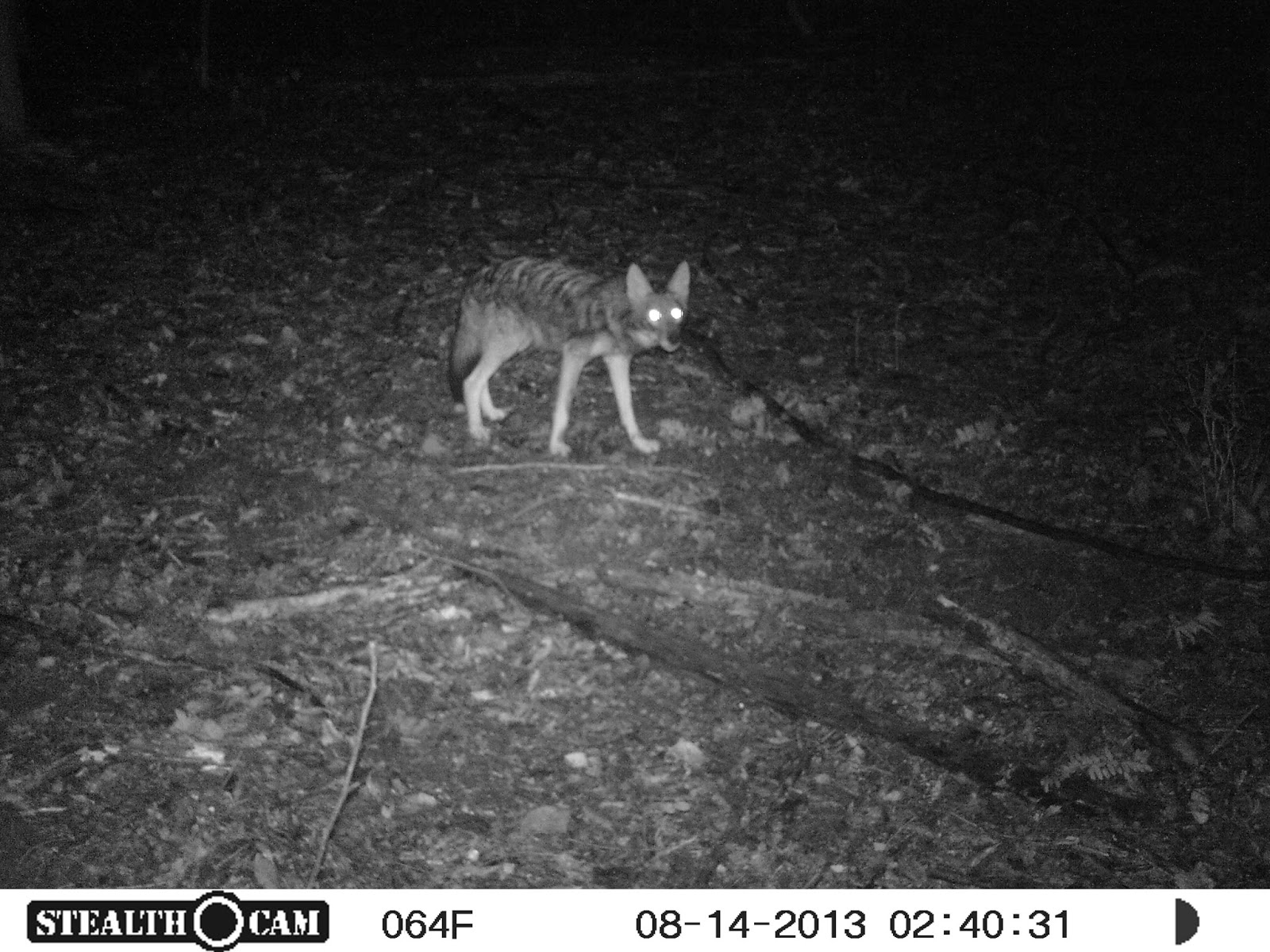
Here's one that's a bit tough.  This image comes from the town of Great Falls, Virginia.

I think it's a coyote because of the size, the lighter-colored legs, the presence of thick fur, and because of the short, black-tipped tail.

Here's an image of a raccoon in the same, general area.  Use this for the size comparison.

What do you think?

I'm pretty confident with my coyote answer, but I could be wrong.

Thursday, August 15, 2013

Fairfax Coyote

 This post isn't about the writing or the experiences, but rather just the pictures.  All you really need to know is that the animal is a definite coyote, the place is in Great Falls, Virginia, and that I am really excited.


Wednesday, August 14, 2013

Landscapes of Leesburg, Moving Cameras, and Bear Claw Marks

The pictures below show some of the landscapes and habitats that make up the wildest parts of Leesburg, Virginia located in Loudoun County.

One area in particular (which I will keep somewhat a secret for now) offers grasslands full of shrubs, deep forests, and meadows that contain beautiful goldenrod flowers.


It really is a cam-trappers and wildlife enthusiast's heaven.  There are bears that filter in an out, coyotes screaming across the meadows, and hawks that patrol the skies.

I've got a lot of cameras in these areas and have had a few there for some time now.  Hopefully more animals will get a photo or two taken of them.

The cameras that were up here were taken to different spots today to see if that makes any difference in the results.  While placing the cameras in their newest spots, I found myself staring at this beech tree.
Yeah, those are bear claw markings!  Although it is the same species of tree and in the same general area as a tree that I posted about months ago (see: Bear Claw Markings ), it is definitely a different tree with a different set of black bear marks on it.

Results from the cameras that I put all over Leesburg should pour in shortly, but for now, it's time for me to get some rest for tomorrow when I do it all over again in a different place.

Sunday, August 11, 2013

White Legs

I've named this particular red fox, "White Legs".  How I came up with this name should be obvious.  I blew up and cropped some of the photos of White Legs so you could better see the coloration of its fur.


Those legs are just so incredibly bright!  What does this mean exactly?  Well, for me, it means that this fox is going to be very easy to identify every time it comes up on camera.  I can estimate the populations of foxes even better when the animals vary this much in color.

Take a look at the picture below of another red fox and notice the different colors of fur on its legs.


White Legs resides in Fairfax County and cannot yet be identified as male nor female.

I hope we'll all be seeing more of White Legs shortly.


Wednesday, August 7, 2013

Camera-Trapping in a Tick Safari

Ticks are somewhere on the very top of my list of the most annoying animals on the planet.  Those blood suckers are crawling all over the woods around Virginia this time of year.  They're out in the millions.  It's incredibly annoying to get to some of my camera-trap sites now because when I come back from them, I know a good chunk of time will be spent checking my body for ticks.

Half of the time, I just feel them crawling on me, but the other half can be anywhere on my skin.  It really is bad around here this time of year.  The woodiest and most natural areas turn into something that I have been known to call "Tick Safaris".

Even with the ticks attacking, cameras still need to be checked.

A few days ago, I went out with one of the volunteers and did some good wildlife research by camera-trap. She didn't seem to be too bothered by the crazy number of ticks around us.  I admit though, I was a bit bothered.

We moved into some swarming patches of Japanese stiltgrass and got to work.   The typical acts of checking and changing things in the camera were done.  Results were checked on the computer.  One of my favorites came from one that we placed near a stream where rocks had been place to dampen the effects of faster water.  Red foxes seemed to like this spot, and of course, had built a den near it a few months ago.


In other news, I saw a black bear today in Fairfax County.  I'll do a blog post on that shortly but I'm first waiting for cameras in that area to be checked to see if it came up on any of them.  Also today, I saw 3 fox kits playing on a baseball field and a pair of pileated woodpeckers bolting from tree to tree in Sterling, Virginia.