Showing posts with label red fox. Show all posts

Tuesday, April 7, 2015

Fooled and Fooled Again

While a lot of the camera traps that I use are for scientific surveys and owned by parks, nature preserves, and various parks/wildlife agencies, I tend keep a bunch for myself that are owned by me.

These ones are moved often, as they do not fit into a scientific proposal or specific project.  It's a sort of freedom that I really enjoy.  With these though, I like to challenge myself to get really cool stuff coming across the cameras.

This year, I've been all about the fox dens.  Last year's fox kit pictures and blog posts turned out phenomenal and I'm really hoping I can get something similar this year.  It takes a lot of work and time to search for fox dens, but it could prove to be really useful in the end.  Emails and messages have been flying around like crazy and many miles have been walked, in search for the holes made by these small canids.

There always seems to be a bit of a debate as to whether a hole or den site belongs to a fox or a groundhog, and while I've spent the past few years studying them, reading up on them, and tagging along with others in the field with various animal dens, I still have not perfected the art of determining what is a fox den and what is a groundhog den.

The phrase "Brian, you should know this stuff."  commonly pops up into my head, upon visiting each den site.  It's interesting though and makes this sort of fun.

Young groundhog in a "prairie dog" type of stance in Lovettsville, VA.
Don't worry though, I know the "textbook" definition of a fox den and a groundhog den, but that is just what it is.  Generally, groundhog dens are a bit differently shaped than fox dens and dirt may be thrown out of each hole in a different pattern with each species.  They both can be commonly built on berms or small hillsides either in the middle of the woods or in meadows.

To me, the easy way to tell if a fox has been in a den is to put my face near it and take a whiff of the air.  If it smells like fox urine (a pungent smell that is similar to skunk spray), a fox has usually been there.  To make this even more complicated though, is to add the fact that a fox could have been hunting a baby groundhog, co-habitating (living with) the groundhog, or just marking the territory nearby.

I've been fooled with this time after time.  This year has been the epitome of me getting fooled by foxes and groundhogs, and just when I think I've got an active den with fox kits, a groundhog will appear.

It's a bit discouraging, but it's all part of camera trapping.
Resident groundhog from Loudoun County, VA from this past March.

Thursday, March 19, 2015

New Dens

Newly dug fox hole.
The better part of this afternoon was spent working and scouting locations for where I should put up camera traps next.

Through some dense brush and "the thick stuff", I stumbled across a new den site, of the fox variety.

One impressive entrance hole was made deep into the little berm where the dens were being made.  An exit hole was only just beginning though, and was no more than 3 days old.

Hopefully we'll be seeing some fox kits within the next two months.

Camera traps will tell us all this though, but for now, I'm going to stay away from this den so I do not disturb the animals that are building it.

Last year brought some incredible results from fox dens that not only helped estimate the canid population, but gave me a great opportunity to educate the public on what some cute northern Virginia baby foxes looked like.

See the link here to view some results from last year's red fox den and its activity:
Red Fox Kits 2014

There's no telling what will happen though.  Time will tell, and that is the beauty of all this.

Partially dug out exit or entrance hole to a new fox den.

Sunday, July 13, 2014

Fox and Go Pro

Just like the title says, see what happens when I put one of the Go Pro cameras down for a few minutes near a red fox.

It definitely gets a bit too curious for my comfort, and am glad it didn't run off with the camera.


No bait, scent, or lure was used at all.

Wednesday, July 9, 2014

The Ants Go Marching

A coworker helped me with some cameras today and found one completely covered in ants.

Upon closer inspection, ants had completely invaded the entire interior of the camera-trap.  We spent a good hour opening up the camera, unscrewing screws, cleaning it out, and putting it back together.

We completed our "Camera-Trap Surgery" in the field as we swatted away maybe 25 mosquitoes and picked off ticks of our legs.  The ants had made an entire food storage type of room in the camera along with an egg holding cell.  It was rough, but we managed to save the camera and found that no electrical components had been badly damaged.

We checked the SD card on a laptop in the field as well, but only found a few pictures of a red fox and raccoons.

But hey, you can't win with bears, coyotes, and other "crowd pleasers" every day.  It was still a good day out on the trails, and I thank him greatly for helping me today.

Thursday, June 5, 2014

The Piebald Fox Returns

The fox that is called, "White Legs" has not shown up on any Great Falls, VA cameras in a long time.

White Legs has been one of my favorite individual red foxes around for a long time now, and it has been a pleasure watching he/she romping around the forest.

It's been some time since White Legs last showed, many  months actually, but today I checked a camera and realized I finally got an image of the white-legged predator in May.


It's not the perfect image, by any means, but it's enough to prove that it's the fox that I know.

It has grown to be extremely elusive.  This could be a good thing though, as red foxes are naturally afraid of humans and should not be fed or petted by people who live nearby.


Wednesday, May 21, 2014

The Best Fox Kit Pictures So Far


The red fox kits in Fairfax County are still as active as ever and are growing fast. These are the same ones that I've been blogging about in the past few weeks.

Like human children, their daily activities consist of eating, pooping, and playing, without a care in the world. Must be nice!

They've been eating on their own and don't seem to be with their mother as much already.

Here's some stills of the red fox kits of Great Falls, Virginia. . .


. . . and of course videos!


One thing to take note of though is that one of the kits has a fairly large rash on its throat and neck.  It's a patch of red without fur (picture below).  Look closely at its neck to see what I mean. 

What do you think caused this?  Possible explanations that I (and other biologists, naturalists, and friends) have thought of is heat rash, scratching, mange, mites, fungus, disease, foul play between foxes, the mother red fox carrying the kit, or another predator.

I'll be watching these kits closely, and hope you will too.

Thursday, May 1, 2014

Fox Kits, Fox Kits, Fox Kits

There are now two cameras at the active fox den in Great Falls, Va.  One camera is for pictures and one is for video.  That's right VIDEO of the bundles of joy!

Immerse yourself in a maximum level of furry cuteness.


Don't worry, there will be more to come.  I'm keeping a close eye on these kits.

Monday, April 28, 2014

Red Fox Irony

Ironic how a day after I write a post titled "Where are the fox kits?", I check a camera and get some decent pictures of fox kits.

These were taken in Great Falls, Virginia and seem to be the first time the kits have ever ventured outside their den.  There has been a camera here for about 2 weeks, but yesterday, the babies came out to enjoy some good weather.

The date/time stamp was set wrong (my fault, sorry fellow blog readers), but I can assure you that these were taken yesterday, April 27th, 2014.


These kits are red foxes but they don't look resemble their parents completely.  Through the next weeks and months, their fur will become more orange, their bodies will fill out, and the entire animal will become an efficient machine that excels at catching mice and voles.

These ones are no bigger around the size of my shoe (size 10 in case you were wondering).

Another camera was put up in the opposing direction of the den to get more photos.

Sunday, April 27, 2014

Where are the fox kits?

Everyone seems to absolutely love and enjoy all of the red fox photos from the trail-cams, and one question has been asked (and answered) in great amounts in the past week or so.

You guys (the wildlife interested, the northern Virginia citizen, or the general blog reader) have all inquired about when fox kits will be coming out of the dens.

The answer is that there should be a few more weeks until they come out, but I really can't tell exactly when for sure.

One thing is for sure though----  the fact that there has been a heck of a lot of den activity recently.


These were taken in Loudoun County a few weeks ago.

Here's to hoping kits will show up soon!

Tuesday, March 25, 2014

Red Fox Rendezvous


I am putting the final touches on some graphs, charts, and tables that show the results (and how-to's) of my red fox survey between the months of this March, 2013 and March, 2014 in park lands and private lands of Northern Virginia.

Results include current living foxes, foxes that have been hit by cars (or died by other means), foxes that have moved out of the area, and fox kits

Here is a very watered-down and simplistic version of my data:

In a 24 acre plot, there were 3 individual red foxes

In a 60 acre plot, there were 4 individual red foxes.

In a 350 acre plot, I've found that there were at least 7 individual red foxes.

In a 430 acre plot, there were 9 individual red foxes.

In a 600 acre plot, there were 9 individual red foxes.


I get this data by comparing camera-trap images of different cameras set up in each park.  A red fox that appears at one camera (under normal circumstances) cannot be the same red fox that appears at another camera 1 mile away, 30 seconds later.  BAM!  That's two individual foxes.  Some red foxes look completely different from eachother, others are a little more difficult to recognize.  Figure in more parks and a heck of a lot more cameras, and results like this pour in to my computer on a daily basis.


Wednesday, March 5, 2014

Denning Season

It's denning season for the canids of Virginia.  That means that I'll be spending some time tracking fox, coyote, and other footprints through the mud and snow to help me find these dens.  When I find one, a camera will be going up.

Here's a good one that I found yesterday.  You can tell by the amount of footprints and kicked dirt around it that it is very active.

I used extreme care and caution not to get too close or disturb the animals that may be living in there.

Here's to hoping for pups or kits of fox or coyote this spring!

Wednesday, February 12, 2014

Rat-Tail

Fairfax County has the famous fox that we all call "White Legs" (see previous post on White Legs here: A Friend of White Legs" but what famous fox does Loudoun County have?

The answer:  Loudoun County is home to a red fox that we'll call "Rat-Tail".

Rat-Tail is a unique red fox with a tail that is not bushy at all.  It is unknown why this fox looks like this.  It could be mange, disease, parasites, genetics, injury, or self-inflicted, we just don't know yet.

Rat-Tail first appeared on camera-trap images last year, then went A.W.O.L. for months, until now.  Rat-Tail could be a male or a female, there's no telling yet.

This fox could have a mate, since we have seen it romping around with another red fox lately.  It came across this camera in the daytime, just trotting by in a very canine-like fashion with its nose down.  It didn't stop at all by the camera, and continued on quickly.


Friday, January 24, 2014

Foxes During the Day


Even though this part of Virginia has been facing temperatures in the single digits lately, the red fox foxes are jumping in front of the cameras in the daytime more than ever before.

Why is this? Well, I think there are two reasons.  

Here's the first reason:

Foxes don't like to be around humans, at least for the most part.  They tend to shy away from us and that's the way it should be.  

Since there are less people walking around parks (or other places that I have cameras) during the winter, foxes may be more comfortable with coming out in the day.  

More foxes out during the day means more chances of camera-trap images of them in the day.

Here's the other reason:

Winter this year has been cold.  Very cold. For the past few days, temperatures have barely been able to make it higher than the 20 degree fahrenheit mark.  

These temperatures have been warmer than nighttime temperatures, which have gotten as low as 2 degrees. 
Foxes would prefer to be out in the warmer part of each day than out in the middle of the night.  This increases the chances of getting red foxes on camera in the daytime as well.


Saturday, January 4, 2014

Taking Chances in the Snow


Snow is on the ground and hope is in my mind for more "Fox in Snow" camera-trap images.  See a previous example of a "Fox in the Snow" image in White Snow for White Legs .

The better part of yesterday was spent hiking, birding, and camera-trapping around in the white stuff.  I was in search of more places to set up the cams.  The big problem with this though, is that I put up expensive equipment in the middle of the woods, out of view of anybody, with my footprints very well defined in the snow.

It's a risk, I know.

If somebody really wants to follow me off trail to see what I was doing, they can.  I tried to be good about it though.  When possible I rerouted myself, walked across logs, and walked on places of high grass so that my footprints would be harder to track.

In addition to this, windy conditions last night blew up the "dry" powdery snow and hopefully covered my tracks a little better. 

If I didn't risk these cameras often to poachers, off-trail walkers, teenagers, bears, rising waters, and the weather, then I probably would have very few pictures and this blog wouldn't exist. 

Thursday, December 12, 2013

White Snow for White Legs

The bright orange of a red fox aganst the white blanket of snow makes for some really great pictures.  I was really hoping some of my cameras would pick up this kind of scene recently since there has been some snow on the ground.

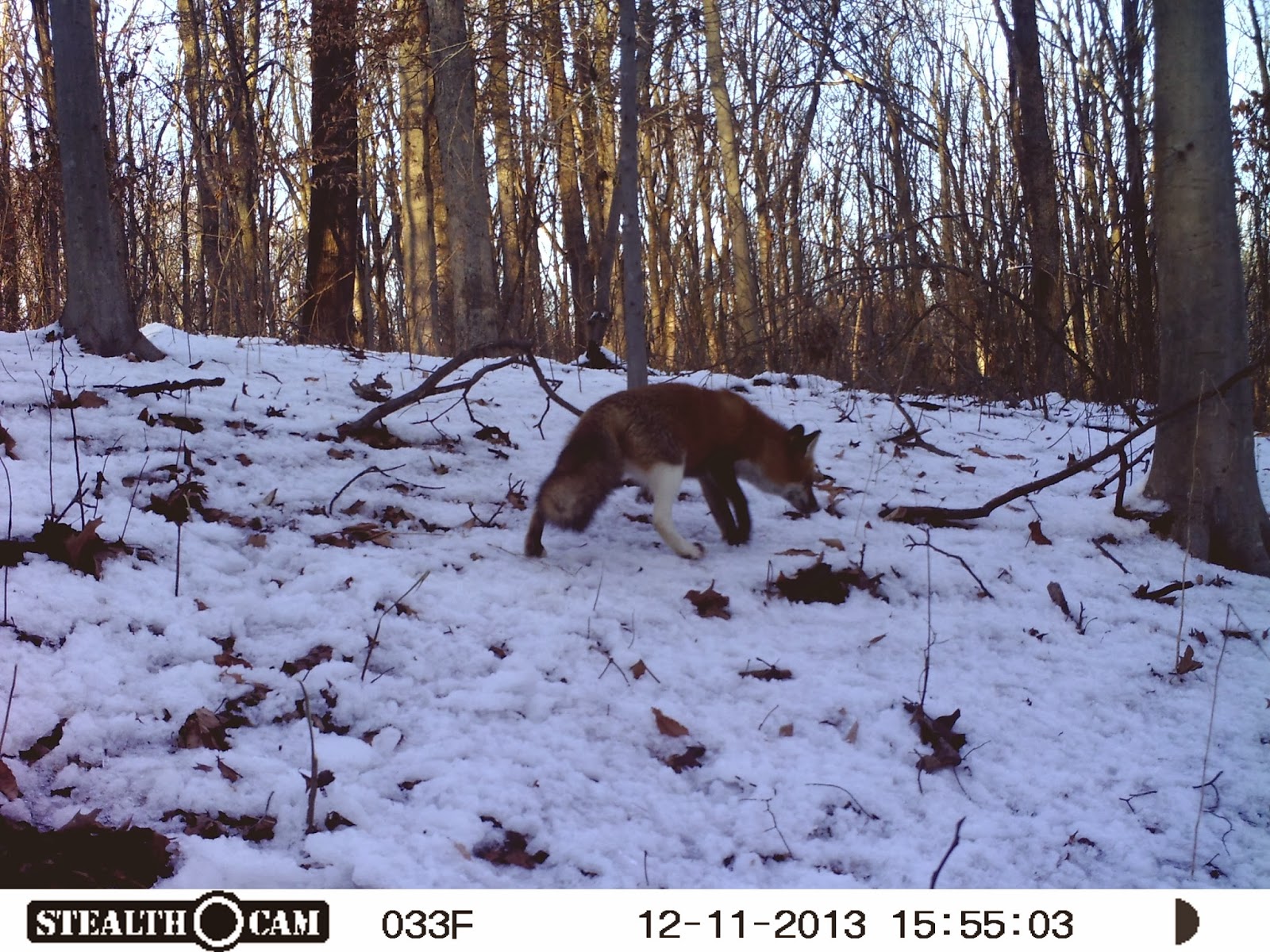
White Legs, the famous fox of Great Falls, Virginia made more appearances in the daytime than ever.  He didn't seem to mind the snow too much.


It's still unclear where the den of White Legs is located, but I have a good idea of where, now that I've seen tracks going back and forth to one specific area.

Those tracks might be of another red fox though, such as this one that also came by Camera Set 58.

One thing that I have noticed in the past few weeks though is that all of the foxes that have been on camera recently have been sporting their winter coats. 

The winter coat of White Legs is typical of a red fox with the orange and grays, but with the exception of the hind legs.

The winter coat of this other fox in the above picture is a little different.  Most of its body is a burnt orange while its rump and hind legs are more of a golden color.  The tail remains a bit orange but with a grayish underside.

Red foxes can vary a bit in color, and it is fairly common for them to have reds, oranges, blacks, grays, golds, and silvers, in their coat.

Friday, October 11, 2013

A Friend of White Legs

"We got white legs!!!!" was the text I received from another fellow camera-trapper in Great Falls, Virginia.  Excitement was evident.

We had in fact, camera-trapped White Legs, the red fox.  The saga continues!

Read the other posts about White Legs here:  White Legs . White Legs Returns

This time, White Legs met up with a friend.  You can see another fox there in the background.  Could this be just a friendly meet up?  Or is one of the foxes a female, pushing our chances of fox kits up this upcoming spring?

White Legs made a good amount of appearances at the camera this time.  Everyone seems to know and love this fox.

My co-workers enjoy the images, my volunteers and interns love checking the camera where it always seems to be, and the human neighbors just can't seem to get enough of White Legs. 

Everyone is under strict orders not to feed this fox to see it.  It's illegal to feed foxes in Virginia anyway, but everyone around the home of White Legs still has gone through a 2 minute long speech on why they shouldn't feed it.

This one is one of my favorites so far.

Enjoy your Friday, folks!

Tuesday, October 8, 2013

Log Travelers

Let's get the gross facts out of the way first.  This log was a place for marking for many species of animals.   Fox, raccoon, and other unidentifiable mammalian scat was all over this log.  Animals do this to mark their own territory, and it really can just pile up after time.

I found it just by walking around the woods in Sterling, Virginia while doing a few wildlife surveys months ago.

So what was a nature-oriented person with multiple camera-traps going to do?

You guessed it, I put a camera up to it and left it out for months.  I checked it today and was happy with the results.  These are all videos and can be started by just clicking.

Raccoon
Red Fox
Gray Squirrel
Another Red Fox

Sunday, August 11, 2013

White Legs

I've named this particular red fox, "White Legs".  How I came up with this name should be obvious.  I blew up and cropped some of the photos of White Legs so you could better see the coloration of its fur.


Those legs are just so incredibly bright!  What does this mean exactly?  Well, for me, it means that this fox is going to be very easy to identify every time it comes up on camera.  I can estimate the populations of foxes even better when the animals vary this much in color.

Take a look at the picture below of another red fox and notice the different colors of fur on its legs.


White Legs resides in Fairfax County and cannot yet be identified as male nor female.

I hope we'll all be seeing more of White Legs shortly.


Wednesday, August 7, 2013

Camera-Trapping in a Tick Safari

Ticks are somewhere on the very top of my list of the most annoying animals on the planet.  Those blood suckers are crawling all over the woods around Virginia this time of year.  They're out in the millions.  It's incredibly annoying to get to some of my camera-trap sites now because when I come back from them, I know a good chunk of time will be spent checking my body for ticks.

Half of the time, I just feel them crawling on me, but the other half can be anywhere on my skin.  It really is bad around here this time of year.  The woodiest and most natural areas turn into something that I have been known to call "Tick Safaris".

Even with the ticks attacking, cameras still need to be checked.

A few days ago, I went out with one of the volunteers and did some good wildlife research by camera-trap. She didn't seem to be too bothered by the crazy number of ticks around us.  I admit though, I was a bit bothered.

We moved into some swarming patches of Japanese stiltgrass and got to work.   The typical acts of checking and changing things in the camera were done.  Results were checked on the computer.  One of my favorites came from one that we placed near a stream where rocks had been place to dampen the effects of faster water.  Red foxes seemed to like this spot, and of course, had built a den near it a few months ago.


In other news, I saw a black bear today in Fairfax County.  I'll do a blog post on that shortly but I'm first waiting for cameras in that area to be checked to see if it came up on any of them.  Also today, I saw 3 fox kits playing on a baseball field and a pair of pileated woodpeckers bolting from tree to tree in Sterling, Virginia.

Wednesday, July 24, 2013

Most Likely a Fox, Right?

17 out of 19 people so far say that this young mammal is a fox.  The other 2 people say a young coyote in its summer coat.  These people are all wildlife biologists, wildlife conservation specialists, or outdoor park managers who have lots of experience with both animals, so I enjoy their input and find it very interesting.

Personally, I've got my money on it being a young fox.  The tail does seem to have darker edges and a dark tip, which is common of a coyote though.  An attempt to persuade me to calling it a coyote was made based on the size and shape of the ears, and how a coyote would be this skinny in summer due to it losing a lot of its winter coat, but I hold my ground and still call it a fox.

Whatever it is, its a skinny one and was captured on camera in Fairfax County, Virginia.  The camera was reset and is still at the exact same spot.


Do you agree with me and say that this animal is a fox? Or do lean towards it being a coyote?