Trail cameras are still running heavy in Purcellville and other parts of Western Loudoun by two of my favorite volunteers, Paige and Peter. We've been getting all sorts of results, though bobcat and coyote activity have seemed to slow down recently out there.
The biggest excitement with the Purcellville cameras has been images of "Tank". He's a white-tailed deer buck that has been growing an impressive set of antlers. Peter named him, of course, and the name is not only fitting, but has stuck well for the past month or so.
Here is "Tank", one of the biggest bucks around this year. It's hard to tell from this image, but there are (what we think and have seen in other images) 12 points on his antlers. It'll be interesting to see if Peter is able to hunt this beast this year.
Tank is the closest deer, followed by two other impressive bucks behind him.
Discussions and banter of Northern Virginia's Wildlife and Large-Scale Trail Camera Projects
Showing posts with label deer. Show all posts
Thursday, August 27, 2015
Saturday, June 20, 2015
Watch Them Grow
Antlers are one of the most fascinating things to watch grow on camera traps. Each week, the deciduous growths on white-tailed deer bucks get bigger and bigger, sometimes growing more points as the summer goes on.
My buddy Peter and I have been using camera traps recently to do a bit of a deer survey on his property in Loudoun County. We'll be counting deer for at least the next few weeks, and hopefully we will capture a coyote or two on camera as well.
The antlers almost never look the same in spring as they do the following winter. They just grow so fast, in all sorts of shapes and directions. I'm fascinated by that.
Peter was really excited to get this buck on camera, as he is both an avid conservationist and a hunter. If we keep recapturing the same individual, I hope to put a video compilation together of all the images, showing the growth of the antlers throughout the summer.
That's a bit far in advance though, and completely depends on this buck coming up at least once a week, but you never know what could happen.
We also captured a fawn (baby white-tailed deer) on camera a few times, though it has only been photogenic once or twice during the day.
Labels:
a case of wildlife fever,
antler,
blog,
deer,
fairfax,
growth,
loudoun,
nature,
northern virginia,
site,
summer,
trail cam,
trail camera,
website,
white tailed deer,
whitetail,
wildlife,
wildlife fever
Tuesday, January 27, 2015
Antler Shedding
It's that time of year again for our white-tailed deer. The bucks are starting to shed their antlers and they are available for mice to chew on, for dogs to play with, and for some of us to collect.
So why do antlers drop in January, February, and March? Well, to answer that question, we've got to think back to the previous year.
In late October, most of November, and early December the deer here are in rut. This means that they capable of mating with females. Antlers are used to display dominance and to fight off other bucks that may provide competition to the mating "rights" of a group of does.
The rut ends before the New Year starts and the antlers become less of a necessity for bucks. Since they take extra energy to grow and walk around with, deer shed or drop their antlers to save energy and because they really aren't needed any more.
New antlers begin to grow and the process is repeated, year after year.
It's legal in Virginia to collect them and possess them (as long as you have landowner permission to do so), so I always like to find a few to collect. Maybe I'll even make some new knife handles again this year
There is an importance to leave some for the animals though. Mice, squirrels, and other rodents chew on antlers to sharpen their teeth and to gain important vitamins and minerals that can become extremely scarce in the winter from their regular food sources.
So why do antlers drop in January, February, and March? Well, to answer that question, we've got to think back to the previous year.
In late October, most of November, and early December the deer here are in rut. This means that they capable of mating with females. Antlers are used to display dominance and to fight off other bucks that may provide competition to the mating "rights" of a group of does.
The rut ends before the New Year starts and the antlers become less of a necessity for bucks. Since they take extra energy to grow and walk around with, deer shed or drop their antlers to save energy and because they really aren't needed any more.
New antlers begin to grow and the process is repeated, year after year.
It's legal in Virginia to collect them and possess them (as long as you have landowner permission to do so), so I always like to find a few to collect. Maybe I'll even make some new knife handles again this year
There is an importance to leave some for the animals though. Mice, squirrels, and other rodents chew on antlers to sharpen their teeth and to gain important vitamins and minerals that can become extremely scarce in the winter from their regular food sources.
Labels:
antler,
antler sheds,
antlers,
buck,
clarke,
deer,
doe,
fairfax,
hunting,
loudoun,
shed,
Virginia,
white-tailed,
white-tailed deer,
whitetail
Monday, December 29, 2014
Fight! Fight! Fight!
Like two fat kids fighting over the last piece of pie, these two hawks were all about getting the last bite of a good meal. This meal was that of a dead deer though, in Leesburg, VA.
The real point of putting the camera-trap over a deer body was to see if any coyotes were around. They were not.
Black vultures, crows, ravens, and hawks filled up multiple SD cards here though with over 25,000 images taken over a period of three weeks.
Check out the hawk acrobatics below!
In usual "Brian Fashion" the time/date stamp was set incorrectly.
The real point of putting the camera-trap over a deer body was to see if any coyotes were around. They were not.
Black vultures, crows, ravens, and hawks filled up multiple SD cards here though with over 25,000 images taken over a period of three weeks.
Check out the hawk acrobatics below!
In usual "Brian Fashion" the time/date stamp was set incorrectly.
Labels:
a case of wildlife fever,
blog,
brian balik,
camera trap,
deer,
hawk,
leesburg,
loudoun,
scavenge,
scavenger,
trail cam,
trail camera,
Virginia,
white tail,
white tailed deer,
wildlife,
wildlife camera,
wildlife fever
Monday, December 1, 2014
One Antlered Deer
Here's an interesting white-tailed deer missing one of his antlers.
It's early for bucks to be losing their deciduous antlers. Really early. In most cases around here, they drop their antlers during the last week of January to the last week of March. It's interesting, for sure, but stranger things have happened in the outdoors.
Labels:
animals,
antler,
buck,
deer,
doe,
fairfax,
hunt,
hunting,
loudoun,
management,
single antler,
solo,
tailed,
tysons,
vienna,
white,
white tail,
white tailed,
white-tailed deer,
wildlife
Tuesday, November 11, 2014
'Tis the Season
The fall rut has started in Fairfax and Loudoun Counties in Virginia. What this means is that the deer are biologically ready to start mating and bucks are chasing does all day long.
What this also means is that deer are moving around a hell of a lot, and are getting creamed on the roads. This deer was (at least I presume) hit by a car and dropped dead. Of course I did the only thing I could think of, and put a camera-trap up to it.
Foxes, raccoons, and possums picked at it at night, and birds had their way with the meat during the day.
I really enjoy looking at images of hawks that scavenge on the dead deer, and was lucky enough to get images of them during this camera-trap stakeout.
Ignore those time/date stamps. I forgot to set them correctly.
Enjoy!
Hawks can scavenge on carcasses during anytime of the year, but on my cameras, the show up a lot more on deer carcasses during the winter than on deer carcasses of the hot months.
'Tis the season for deer carcass cameras, birding, hunting, the deer rut, and winter sports. We're in for it until April, folks.
Labels:
blog,
camera,
camera trap,
deer,
fairfax,
hawk,
hawks,
loudoun,
northern va,
northern virginia,
nova,
rut,
trail camera,
va,
Virginia,
white tail deer,
white tailed deer,
wildlife
Wednesday, September 24, 2014
"10 Point"
I commonly give nicknames to wildlife. I've been told not to do this for the point of becoming attached to a specific individual and also because I'll most likely see their dead bodies splattered on the paved roads of Northern Virginia, but hey, nicknames make wildlife viewing a bit more exciting.
"White Legs", "Scarface", and "1 Stripe" are just a few of the nicknames given to individual animals that either come up on trail cameras or are commonly seen by coworkers in my parks and wildlife jobs.
Here's another one for everyone that's been called "10 Point". 10 Point is an impressive male, white-tailed deer. It's easy to identify him because of his impressive rack that contains 10 tines.
Who knows whether or not he'll make it to the end of Northern Virginia's extensive hunting seasons.
"White Legs", "Scarface", and "1 Stripe" are just a few of the nicknames given to individual animals that either come up on trail cameras or are commonly seen by coworkers in my parks and wildlife jobs.
Here's another one for everyone that's been called "10 Point". 10 Point is an impressive male, white-tailed deer. It's easy to identify him because of his impressive rack that contains 10 tines.
Who knows whether or not he'll make it to the end of Northern Virginia's extensive hunting seasons.
Wednesday, August 20, 2014
Why Do White-Tailed Deer Fawns Have White Spots?
Someone asked me this at one of my parks/wildlife jobs a few days ago, and I thought it would also be nice to put the answer on this blog.
Fawns (baby deer) have white spots on their backs. Take a look at the picture below from this past month.
The answer to this question is that fawns have spots because it helps them camouflage better in the woods.
Fawns spend a lot of time laying down in grass and leaves that are under canopies of trees. Sunlight comes through these trees in beams that make bright splotches on the forest floor. The brown color of the deer's fur and the white splotches look similar to brown leaves and dirt mixing in with the sunlight that hits the forest bottom.
Labels:
?,
baby,
baby deer,
camo,
camouflage,
color,
deer,
dots,
fawn,
forest,
spots,
white,
white dots,
white spots,
white tail,
white tailed,
white tails,
why do?
Wednesday, July 9, 2014
The Ants Go Marching
A coworker helped me with some cameras today and found one completely covered in ants.
Upon closer inspection, ants had completely invaded the entire interior of the camera-trap. We spent a good hour opening up the camera, unscrewing screws, cleaning it out, and putting it back together.
We completed our "Camera-Trap Surgery" in the field as we swatted away maybe 25 mosquitoes and picked off ticks of our legs. The ants had made an entire food storage type of room in the camera along with an egg holding cell. It was rough, but we managed to save the camera and found that no electrical components had been badly damaged.
We checked the SD card on a laptop in the field as well, but only found a few pictures of a red fox and raccoons.
But hey, you can't win with bears, coyotes, and other "crowd pleasers" every day. It was still a good day out on the trails, and I thank him greatly for helping me today.
Labels:
animal. animals,
ashburn,
bluemont,
brian balik,
camera,
camera trap,
deer,
fox,
game camera,
leesburg,
loudoun county,
red fox,
red fox pictures,
sterling,
technology,
trail camera,
wildlife,
wildlife fever
Thursday, July 3, 2014
Summer Fawn
Spring is done and summer is upon the people and wildlife of Virginia. We've had a couple of really hot and humid days here already, and today wasn't much of an exception.
The heat has begun, and the white-tailed does are out in full force eating grasses in meadows and tomato plants in your suburban garden.
That's alright though because the does are working hard to produce enough nourishment for the fawns that have recently been born.
Even though northern Virginia has a ridiculous amount of white-tailed deer, it still is always satisfying to see fawns growing up throughout the rest of the year.
Labels:
animals,
baby,
blog,
buck,
camera,
camera trap,
county,
deer,
fairfax,
fawn,
loudoun,
northern virginia,
trail cam,
trail camera,
Virginia,
white tail,
white tailed,
white-tailed,
wildlife
Tuesday, June 3, 2014
Antler Growing Season
It's antler growing season (and will be for the next couple of months) for white-tailed deer. They'll grow them out, shed their velvety coat, and use them for battle in the winter. Like spears, the antlers on the tops of white-tailed bucks heads are used for display and fighting.
Proper nutrition and genetic makeup is necessary for growing the biggest pair.
Here's one little buck starting that has been already growing his antlers since a few weeks ago.
Proper nutrition and genetic makeup is necessary for growing the biggest pair.
Here's one little buck starting that has been already growing his antlers since a few weeks ago.
Labels:
antlers,
buck,
county,
deer,
doe,
fairfax,
fawn,
loudoun,
northern virginia,
Virginia,
white tail,
white tailed
Friday, May 9, 2014
Deer Carcassing
Dedicated blog readers should know that I love a good deer carcass- for camera-trapping purposes of course.
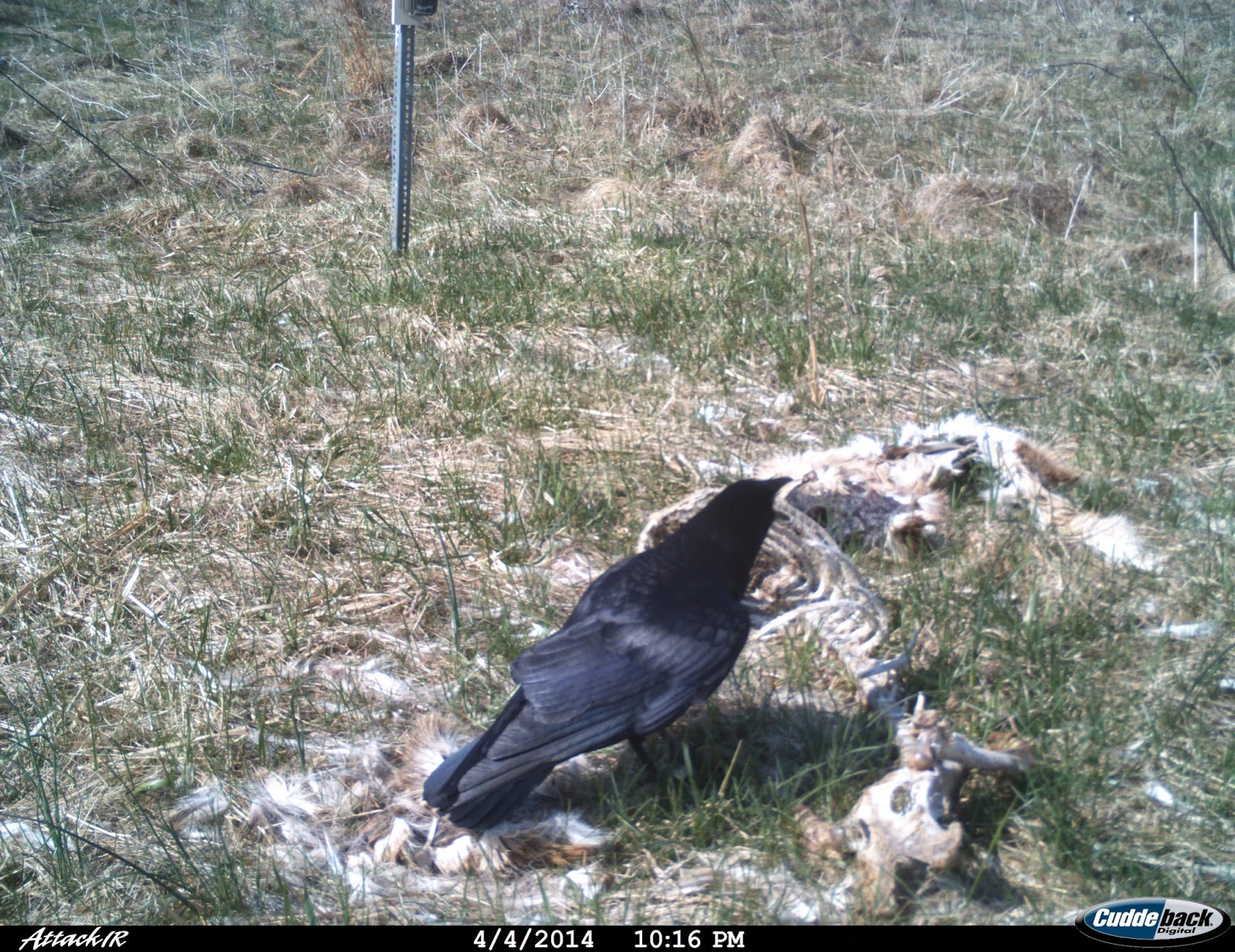
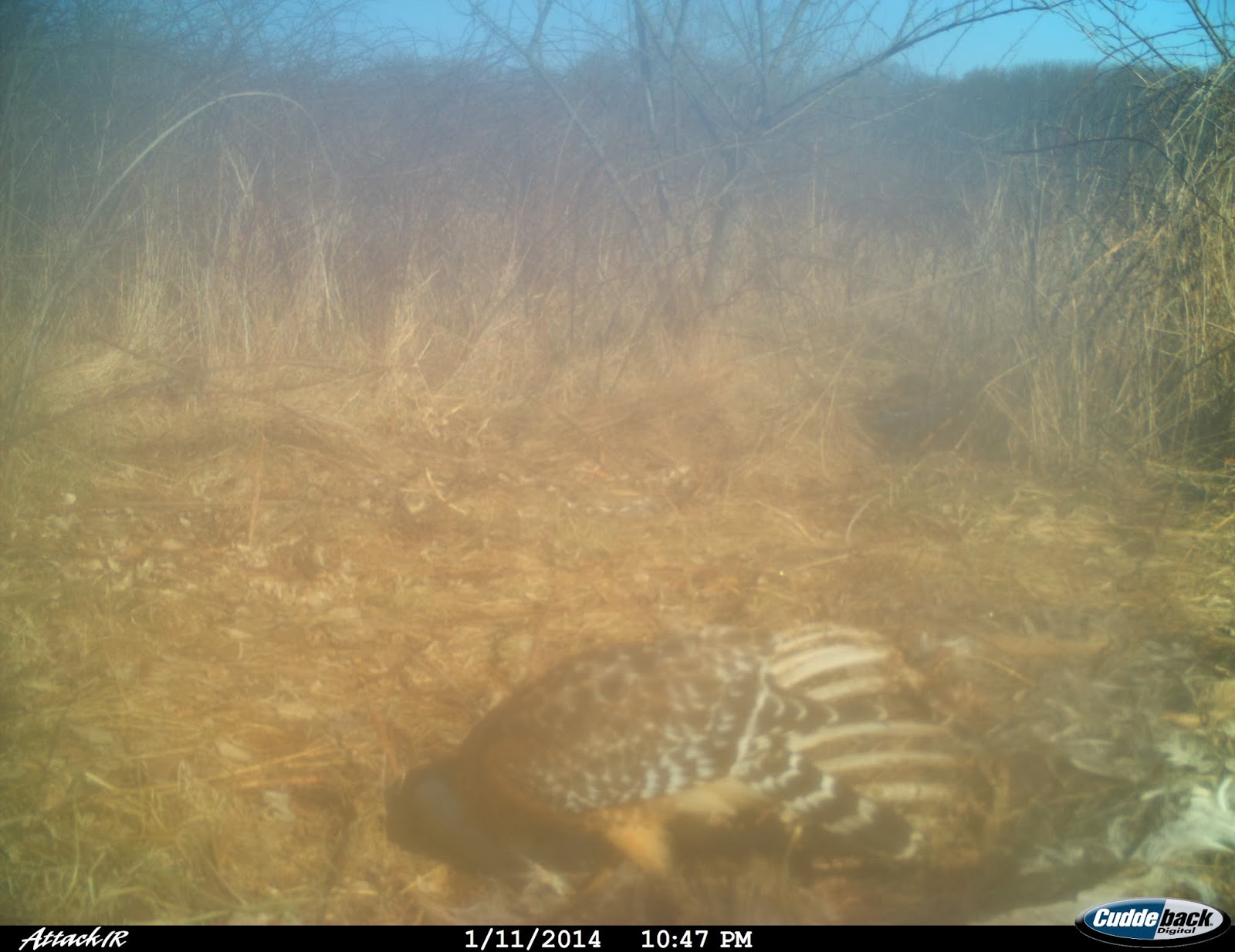
The deer carcass in Leesburg, VA has been out for months and is STILL getting amazing results from scavenging critters. Here's a few photos from the last batch that you should see.
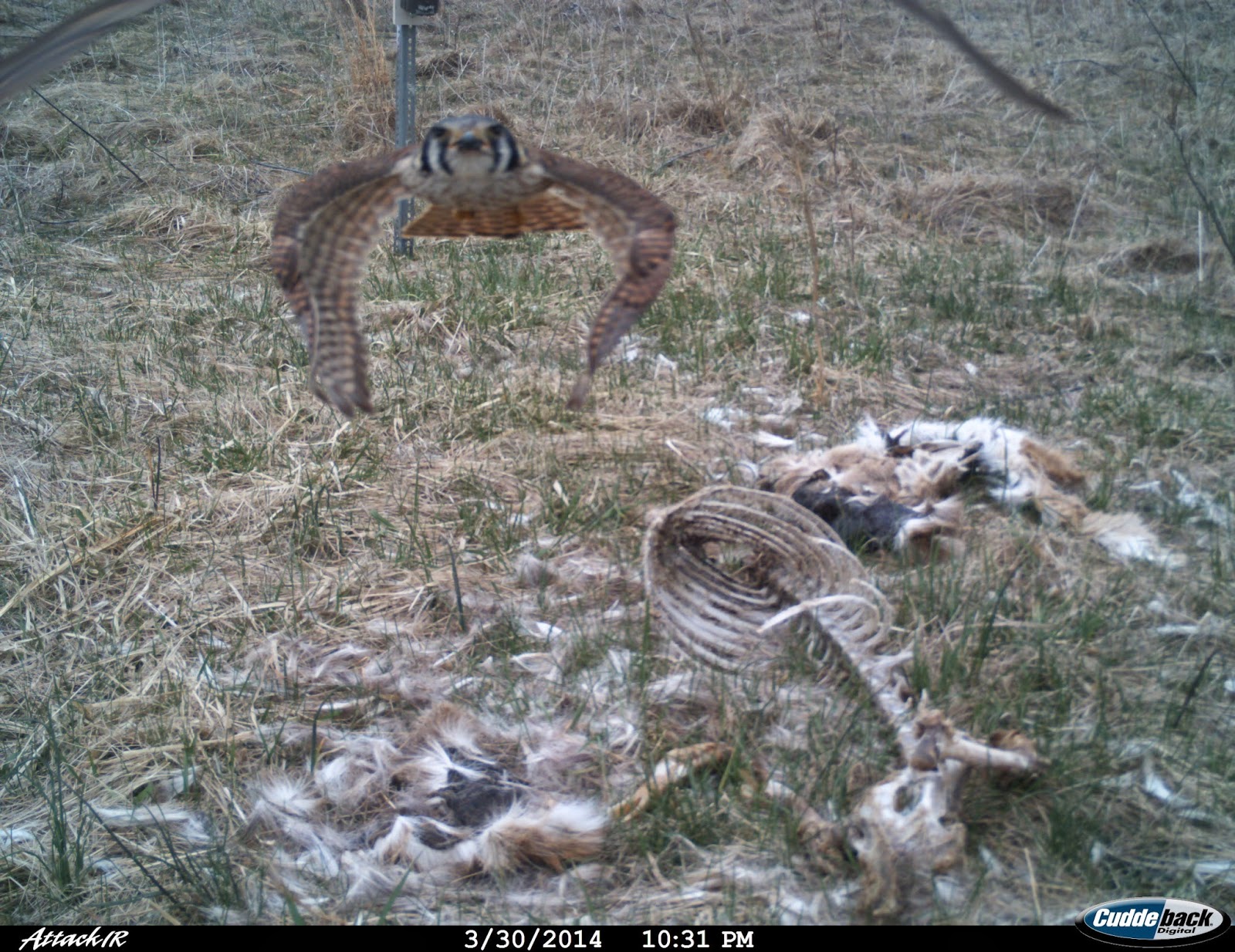
Crows, ravens, vultures, and american kestrels are gorging on not only the remains, but also on the beetles that are feasting on the deer.
Sunday, February 23, 2014
Deer Exodus
The melting snow in the Shenandoah Valley from last week and rain all around have made the Potomac River rise to "Flood Stage". It's raging and is a dangerous monster when this happens.
Flowing on top of the water is a scattered garbage dump full of what I call "River Nonsense". River nonsense is mostly made up of pieces of lumber, sticks, oil barrels, and general trash. It's all the stuff that gets moving when the river floods its own banks. It's not pretty, but sort of interesting in a weird way.
With the flowing water and garbage also comes another interesting sight. Deer (the white-tailed variety of course) are swimming all over the place. They're swimming to islands, from islands, to the mainland, and all over.
They do this because some of them live on the islands of the Potomac River across from Great Falls, Virginia. There are islands big and small, and when the river water rises this high, it makes for a very crammed problem for these deer.
So what do these deer do? The move, and to move away, they start swimming.
I saw this today and have only seen it once before during Hurricane Sandy's wrath.
I couldn't get a good picture of the deer since they were maybe around 300-400 yards away, but it was quite a sight.
Sunday, January 19, 2014
Do Hawks Scavenge In Winter?
The simple answer to the title question is: Yes, hawks scavenge in winter. In fact, winter is the only time that I have gotten camera-trap images of hawks scavenging.
I'm not saying that hawks don't ever scavenge in other times of the year, but I find it really interesting how often they do in the winter months.
This red-shouldered hawk is just absolutely beautiful. It came up to a deer carcass and didn't seem to mind the crows that were also there. The crows didn't seem to mind the hawk there, and they all ate without fighting at all.
The above picture is another red-shouldered hawk at a different camera that I put out. These cameras were about a quarter mile apart. Could this be the same hawk?
Here are a few other pictures of it. The pictures are a bit blurry due to condensation on the lense.
I'm not saying that hawks don't ever scavenge in other times of the year, but I find it really interesting how often they do in the winter months.
This red-shouldered hawk is just absolutely beautiful. It came up to a deer carcass and didn't seem to mind the crows that were also there. The crows didn't seem to mind the hawk there, and they all ate without fighting at all.
The above picture is another red-shouldered hawk at a different camera that I put out. These cameras were about a quarter mile apart. Could this be the same hawk?
Here are a few other pictures of it. The pictures are a bit blurry due to condensation on the lense.
Labels:
camera,
camera trap,
carcass,
deer,
eat,
feed,
food,
hawk,
hawks,
red,
red shoulder,
red shouldered,
red shouldered hawk,
scavenge,
scavenger,
trail camera
Thursday, December 26, 2013
Fur Bearer Mystery
What animal does this brownish, gray fur belong to?
It's from a camera in Virginia a few weeks ago.
Raccoon, deer, squirrel, coyote, domestic dog, and domestic cat are my top suspects. What do you think?
Tuesday, November 12, 2013
Piebald Deer Again
Everyone seems to enjoy looking at the video that I posted recently of the piebald buck. People have emailed and told me that they want to see more.
Also, in some workplace environments, streaming video online is not allowed or blocked completely. I figured I would take some snapshots of the video and put them in this post so that more people could enjoy them.
Thursday, November 7, 2013
Piebald Buck
Undisclosed Location, Loudoun County, Virginia.
A piebald buck is a male deer that has a different colored coat than most other white-tailed deer. It contains white splotches, patches, or markings and sticks out like a sore thumb in the woods. It is a rarity among most white-tailed deer populations.
I've dedicated a few cameras to get photographs of piebald deer in locations where they have been seen in Great Falls, Virginia, but did not expect to see one at all when I checked a camera in Loudoun County.
Such a beautiful deer!
A piebald buck is a male deer that has a different colored coat than most other white-tailed deer. It contains white splotches, patches, or markings and sticks out like a sore thumb in the woods. It is a rarity among most white-tailed deer populations.
I've dedicated a few cameras to get photographs of piebald deer in locations where they have been seen in Great Falls, Virginia, but did not expect to see one at all when I checked a camera in Loudoun County.
Such a beautiful deer!
Monday, September 30, 2013
No Shortage of Virginia Bucks
I'm not tired of big antler pictures yet, and hope you aren't either. It's hunting season where I live and a lot of folks around here are excited to see my buck pictures.
I can't tell you, the hunters, or most other people where exactly the bucks are or where they'll be, but one thing for sure is that I've seen so many of them this year.
These were taken in Fauquier County, Virginia with the help of a friend and colleague. We're going for the bears, bobcats, and coyotes specifically, but white-tailed deer pictures are always welcomed.
This blog will be seeing more of this camera's pictures pretty soon. It's a new county of camera-trapping for me, and I'm excited to be able to use this camera out there.
Tuesday, September 24, 2013
Buck in the Sun
Usually it's bad to face a camera-trap into the sun. Pointing it west or east will give you a lot of washed out pictures due to the sun. I made the mistake of pointing one camera this way, and only 1 picture was worth me taking the time to blog about.
I just thought this picture was cool and different. The early morning sun behind the white-tailed buck isn't something I get to see often in camera-trap images.
There were still over 800 pictures of deer that were washed out and invaded by a rising or setting sun. More thought was taken when resetting the camera.
It is now at the edge of this field in a shadier spot, not facing any sun.
I just thought this picture was cool and different. The early morning sun behind the white-tailed buck isn't something I get to see often in camera-trap images.
There were still over 800 pictures of deer that were washed out and invaded by a rising or setting sun. More thought was taken when resetting the camera.
It is now at the edge of this field in a shadier spot, not facing any sun.
Saturday, August 3, 2013
Ms. Deer's Parasitic Problem
Ms. Deer walked by a camera a while back. She was showing off her summer coat dotted with unidentifiable insects and ticks on it.
Look carefully at her back, and you should be able to see tons of them.
Those parasites must be happy. There's no word yet of what Ms. Deer thinks about her parasitic problem, but one can assume that she must be itching like crazy.
It is only assumed that this white-tailed deer is a female due to its lack of antlers.
Look carefully at her back, and you should be able to see tons of them.
Those parasites must be happy. There's no word yet of what Ms. Deer thinks about her parasitic problem, but one can assume that she must be itching like crazy.
It is only assumed that this white-tailed deer is a female due to its lack of antlers.
Labels:
acaseofwildlifefever,
animals,
brian balik,
chiggers,
deer,
deer blog,
deer parasites,
northern virginia,
ticks,
Virginia,
white-tailed deer,
whitetail deer,
wild,
wildlife,
wildlife blog,
wildlife fever,
woods
Subscribe to:
Posts (Atom)


.png)
.png)
.png)
.png)