Showing posts with label fairfax county. Show all posts

Saturday, July 2, 2016

Paige and the Bears

If there is anyone who knows how to get Northern Virginia's bears on camera, it is Paige.

Mother bear and cub. Photo: Paige Critchley
Paige Critchley contacted me over a year ago about trail camera advice.  At that time,  she was taking on the task of using a trail camera to help a person locate a missing dog in her area.  I forwarded her some tips and told her to keep in contact with me.  What she probably didn't realize then, was that she was at the beginning of a new hobby and an addicting habit called camera trapping (using remote-sensored trail cameras).  It's a very healthy habit, and one that she has become an expert in.

Critchley is a local entrepreneur, a horse enthusiast, and a wildlife lover.  To me, she has also become a great friend and someone who shares the passion of photographing wildlife with trail cameras.  She spends a lot of her free time with her dog outdoors and with friends, but always seems to have trail cameras in the back of her mind.  "Using trail cameras always builds excitement," Critchley says "It's an activity that takes my mind off work."

She volunteered some of her time to run cameras for me in Loudoun County, Virginia and I got to see her interest rise.  Growing with her passion for this, is the number of cameras she personally owns and uses.  It started as one but has grown to 12 cameras now.
Black Bear.  Photo: Paige Critchley

While she describes coyotes as being her favorite animal to capture on camera, Critchley has gotten an incredible amount of bear photographs lately.

Bears aren't rare here in the suburbs of Northern Virginia, but they exist mostly in western Loudoun, parts of Fauquier, and parts of Prince William Counties. During certain times of the year, bear activity may greatly increase in more suburban areas, leading to problems in traffic.  This is due to an interest in new territory and mating habits of young males. With these trail cameras, we are able to keep records on bears and do small population surveys based on the photos.

"I have about 7 or 8 bears coming through 2 different trail camera locations, at the moment." Critchley says.  She adds "I even captured two bears in combat, possibly a mating ritual or territorial fight."

These black bears are not something to be fearful of in our area, but rather something to be aware of. They are omnivorous, meaning that both plants and animals make up their meals. Right now, black bears are feeding on ripened raspberries, wineberries, roots, and insects.  Throughout the year, their diet changes, but usually keeps with a mostly plant based diet, mixed in with a few animals.

Capturing an image of a bear tells a lot.  It can tell researchers where bears are, how many are in a certain area, and daytime patterns of an individual.  Capturing behavior is another thing, and tells a whole story.  The trail cameras have captured the combatting bears, young bears ripping down Critchley's cameras, different bear postures, and even bears stealing her cameras and using them to take their own selfies.
Every time another black bear touches this log, it adds a tiny bit of scent.  The scent draws in more bears and the cycle continues, sometimes for months.  Photo: Paige Critchley.
Critchley's fondness of wildlife doesn't just stop at bears.  In just over a year, she has captured a plethora of images, recording everything from deer to coyotes, and even bobcats.  All of her images are from the Washington D.C. metropolitan area and people are sometimes astounded by the fact that these animals are so close to our Nation's Capital.
A bobcat of Northern Virginia.  Photo: Paige Critchley

Wednesday, July 29, 2015

Wood Turtles

I was going to write up a detailed post about wood turtles a little bit ago from one of my little side adventures, but figured this even shorter post would be a lot better.

I'll post this link to Ed Felker's website called Dispatches from the Potomac.  It's a great blog, has phenomenal photos, and even better writing.  I could be biased though, as it's operated by my buddy and fellow conservationist, Ed Felker.  Either way,  I think his works and writings always are top of the line for what him and I do.   It really is great stuff!

Ed and I did some wood turtle finding this summer, read all about it and about wood turtles here: Virginia's Threatened Wood Turtle .

Sunday, April 12, 2015

Wildflowers of Northern Virginia's Early Springtime

I left for a short hike today to check a camera trap (with minimal results) and eventually found myself taking a detour on some trails where I knew there were some interesting wildflowers.

Yesterday before work, I did the same and found a plethora of beautiful photo opportunities.  Although I have only been using my cell phone's camera to capture these, I feel that the photos have turned out pretty well.

These flowers are mostly ephemeral, which means that they only bloom and "come out" for a very short time.  It really depends on the species, but some of them are only in bloom for a period of multiple days to a few weeks.  There are so many more than the ones that I have seen and posted on here, but those will have to wait for another day.

I hope you all enjoy looking at these.


Virginia bluebells nearing peak bloom.  Fairfax County, VA
Virginia Bluebells (Mertensia virginica) are just about in full bloom in various locations in Loudoun and Fairfax counties.  They seem to be a real staple for people doing wildflower walks along the Potomac River and other flowing water bodies.  In some places, they come out in the tens of thousands (or more!) and can be a breathtaking sight. 

To see them in Northern Virginia, look near sandy/muddy areas in parks or private lands (with permission, of course).

Dutchman's Breeches.  Fairfax County, Virginia


Dutchman's Breeches  (Dicentra cuccularia) are some of the most interesting ones in the area.  Look at the shape of those blooms!

It's not a complete rarity in the area, as some people may believe, but to find it can be a bit tricky.

In a general sense, an easy way of finding these may be to look where bluebells are also blooming, as they tend to prefer similar soils and forests.  They can be found in other places though.  The "breeches" in the common name refers to the similar shape of sort of pants worn years ago.

Northern Virginia's beautiful sessile trillium.
Sessile Trillium (Trillium sessile) is another really interesting looking flower that inhabits Virginia. 

To me, it's interesting to see brown in a flower (pictured in the center of the flower), as a lot of other flower species on the ground that people commonly see are brightly colored.

I found a few here and there along the Potomac River a few days ago, but came upon a few large patches eventually after looking for a while.


Spring Beauty (Claytonia virginica)  is one that never seems to get past my eyes when I'm out and about in the woods this time of year.

It's all over un-mowed lawns, deep forests, and even near the Potomac River.  It can be hard to miss in places, as there are patches of it where individual flowers range in the thousands.  It's no wonder that it's called "spring beauty" as it is a wonderful sight to see after a long winter like the one we had this past year.  Each petal is streaked with a darker pink or purple color, and it can be fairly easy to identify.  Look for these in basically any wooded area in Loudoun or Fairfax, and you have a decent chance of finding them. 


Spring beauty flowers in bloom in Sterling, VA.

Monday, January 26, 2015

White Legs in 2015

White Legs is still alive and seems well in 2015.  The familiar face and white legs on this red fox are always a welcomed sight.

Red foxes are in their mating season right now in Virginia.  Their normal mating season here occurs in mostly January and February.  Will White Legs be the proud parent of another piebald red fox?


Tuesday, July 29, 2014

That "Old Lady Getting Murdered" Kind of Noise

Cicadas, other insects, and frogs make up a good percentage of the natural noise that a person might hear outside at night around Northern Virginia.  Owls, domestic cats, bats, and other birds are also common.

BUT, There are two very specific animals that might make a person cringe or wonder at night though.  These animals are foxes and coyotes.  We have both here in Northern Va, and they are all over the place.  I highly doubt there is a single town or city in Loudoun, Fairfax, Prince William, or Arlington where both of these animals do not exist.

They have come up on trail cameras, people have put videos of them on YouTube, 911 calls are made when some people see them, and early morning commuters sometimes catch a quick glimpse of both of these critters.

So at night, how do you tell the difference between a coyote noise and a fox noise?  

Well, it can be tricky, but for the most part a coyote will yip and howl with an extremely high pitched noise for a mammal.  They sound like they are singing to each other.  Coyotes will "let loose" a noise that is incredibly loud and may sound similar to domestic dogs howling with high notes.  They can also bark, howl, and whine. 

Foxes usually do a noise around here that I've heard described to me as an "Old lady getting murdered".  I agree, although I have never heard an old lady getting murdered.  While foxes do bark, howl, and whine, the noise that I usually hear is a raspy whine that is close to a scream. 

Speaking of foxes, here's a recent one that came up on a trail camera that I set up in Leesburg, VA. 

 I wonder if this one whines like an old lady getting murdered.


Wednesday, June 18, 2014

Copperhead

I went to check one of my Fairfax County camera-traps today, but was stopped suddenly when I realized a snakes tail flicking in some leaves.  Natural curiosity made me inch closer to the sight, and I could tell already that it was a copperhead about 4 feet from one of my cameras.

With most snakes, I usually try to get a closer look and possibly ID it to see if it is a male or a female, but there's one snake that calls Fairfax County its home, that I will not do this with.

Copperhead near the Potomac River, Fairfax County, Virginia.
Copperheads are somewhat common in Fairfax and Loudoun Counties, and usually live around the Potomac River, floodplains, and stream valleys.  They are venomous, so let's get that fact out of the way, but from what I've heard and read, a bite on an healthy adult human will usually not lead to death.  Paralysis and other symptoms may occur though, and that's definitely enough to keep me at bay.


Thursday, May 1, 2014

Fox Kits, Fox Kits, Fox Kits

There are now two cameras at the active fox den in Great Falls, Va.  One camera is for pictures and one is for video.  That's right VIDEO of the bundles of joy!

Immerse yourself in a maximum level of furry cuteness.


Don't worry, there will be more to come.  I'm keeping a close eye on these kits.

Monday, April 28, 2014

Red Fox Irony

Ironic how a day after I write a post titled "Where are the fox kits?", I check a camera and get some decent pictures of fox kits.

These were taken in Great Falls, Virginia and seem to be the first time the kits have ever ventured outside their den.  There has been a camera here for about 2 weeks, but yesterday, the babies came out to enjoy some good weather.

The date/time stamp was set wrong (my fault, sorry fellow blog readers), but I can assure you that these were taken yesterday, April 27th, 2014.


These kits are red foxes but they don't look resemble their parents completely.  Through the next weeks and months, their fur will become more orange, their bodies will fill out, and the entire animal will become an efficient machine that excels at catching mice and voles.

These ones are no bigger around the size of my shoe (size 10 in case you were wondering).

Another camera was put up in the opposing direction of the den to get more photos.

Sunday, April 27, 2014

Where are the fox kits?

Everyone seems to absolutely love and enjoy all of the red fox photos from the trail-cams, and one question has been asked (and answered) in great amounts in the past week or so.

You guys (the wildlife interested, the northern Virginia citizen, or the general blog reader) have all inquired about when fox kits will be coming out of the dens.

The answer is that there should be a few more weeks until they come out, but I really can't tell exactly when for sure.

One thing is for sure though----  the fact that there has been a heck of a lot of den activity recently.


These were taken in Loudoun County a few weeks ago.

Here's to hoping kits will show up soon!

Saturday, March 22, 2014

Cold-Weather Blues

It's been one rough winter with snow still on all of our minds here in Virginia.  Spring is here though, and fishing season has already started for me.

The Potomac River has blue catfish.  These things are monster bottom feeder that bite well in March and April.  I've never caught a big one before, so going last week was something that I was really looking forward to.

Blue catfish are a non-native species here and were stocked in Virginia in the 1970's  (source: Virginia Department of Game and Inland Fisheries).  They can get big.  Really big.  They feast on herring, shad, bass, crawfish, and other marine species.

The section of the Potomac River where we were fishing is also prime bald eagle and osprey territory, and even they seemed excited about the fish that we were catching.  Other notable birds that were seen from the boat were wood ducks, grebes, coots, and canvasbacks.

This fishing trip kicked off my "official" start of spring.  Camera-traps, canoeing, and sunshine are now on my mind, and summer better come quick.

As for the camera-traps,  I've got them still out and taking photos.  Recent results from them have been more coyotes, red foxes mating, and the usuals (raccoons, deer, squirrels).

Monday, March 10, 2014

A Shenandoah Hike and a Fairfax County Camera Check

Today was a great day for hiking and camera checking.  The trails of Shenandoah National Park were calling my name and I had to get out there on this day off of work and school.  There was still some snow on the ground from previous storms but today was about 58 degrees and decently sunny.

It was a great hike that led us down the trail to a great basalt rock formation. . .

. . .and a large ice formation left over from this winter's coldest days.

It was a good day to just get out and enjoy the outdoors.

Another highlight of the day came from when checking a camera-trap in Chantilly after the hike.

Cats, dogs, coyotes, cardinals, humans, red foxes, and raccoons all came by the camera.

Here's the best picture of a Chantilly Coyote.


Sunday, February 23, 2014

Deer Exodus

The melting snow in the Shenandoah Valley from last week and rain all around have made the Potomac River rise to "Flood Stage".  It's raging and is a dangerous monster when this happens.

Flowing on top of the water is a scattered garbage dump full of what I call "River Nonsense".  River nonsense is mostly made up of pieces of lumber, sticks, oil barrels, and general trash.  It's all the stuff that gets moving when the river floods its own banks.  It's not pretty, but sort of interesting in a weird way.

With the flowing water and garbage also comes another interesting sight.  Deer (the white-tailed variety of course) are swimming all over the place.  They're swimming to islands, from islands, to the mainland, and all over.  

They do this because some of them live on the islands of the Potomac River across from Great Falls, Virginia.  There are islands big and small, and when the river water rises this high, it makes for a very crammed problem for these deer. 

So what do these deer do?  The move, and to move away, they start swimming.

I saw this today and have only seen it once before during Hurricane Sandy's wrath.

I couldn't get a good picture of the deer since they were maybe around 300-400 yards away, but it was quite a sight.

Sunday, February 16, 2014

Skunks in the Snow

The Centreville skunks have been out and about in the snow.  Like the raccoons around here, skunks are a lot more active in the night than in the day.

I was surprised that I didn't smell the noxious odor of a skunk when checking the camera on a large plot of land in Centreville, Virginia yesterday. I usually do smell it first.

We can clearly see here that there are two individuals walking in front of the camera.  One is a lot darker than the other, with most of its coat being black.  The other contains lots of white.

The coats of skunks vary greatly in color, but they all stink terribly.

Wednesday, February 12, 2014

Rat-Tail

Fairfax County has the famous fox that we all call "White Legs" (see previous post on White Legs here: A Friend of White Legs" but what famous fox does Loudoun County have?

The answer:  Loudoun County is home to a red fox that we'll call "Rat-Tail".

Rat-Tail is a unique red fox with a tail that is not bushy at all.  It is unknown why this fox looks like this.  It could be mange, disease, parasites, genetics, injury, or self-inflicted, we just don't know yet.

Rat-Tail first appeared on camera-trap images last year, then went A.W.O.L. for months, until now.  Rat-Tail could be a male or a female, there's no telling yet.

This fox could have a mate, since we have seen it romping around with another red fox lately.  It came across this camera in the daytime, just trotting by in a very canine-like fashion with its nose down.  It didn't stop at all by the camera, and continued on quickly.


Saturday, February 8, 2014

Snowy Owling

The snowy owls are all over now.  They've come from Canada and other places in the extreme north to visit for the winter.
Photo credit:  Hayley Ake
This year, the owls have come more south than in the past few years.  It's all part of the Snowy Owl Irruption.

I've seen a few of these owls in the past few months, and have been on the hunt to view them with my girlfriend since we heard of the first sighting around here.

These beasts hang out at local airports because the mowed grass and vast fields of airport lands are VERY similar to the landscape of the tundra where these owls come from.

They are experts at living in this weather and above lands with short vegetation.

Springfield Mall, Fairfax County, Virginia was the most recent place where we went to go see a Snowy.  People were lined up with binoculars and scopes, trying to peer at the owl.  It made for a great experience, especially when mall shoppers, children, and joggers came by and asked about what everyone was looking at.  The expert birders told them, and everyone seemed to have an extreme interest in these birds

These owls should be around for another month or so before they venture back towards Canada.  I'll be looking for them during this whole time.

Friday, January 24, 2014

Foxes During the Day


Even though this part of Virginia has been facing temperatures in the single digits lately, the red fox foxes are jumping in front of the cameras in the daytime more than ever before.

Why is this? Well, I think there are two reasons.  

Here's the first reason:

Foxes don't like to be around humans, at least for the most part.  They tend to shy away from us and that's the way it should be.  

Since there are less people walking around parks (or other places that I have cameras) during the winter, foxes may be more comfortable with coming out in the day.  

More foxes out during the day means more chances of camera-trap images of them in the day.

Here's the other reason:

Winter this year has been cold.  Very cold. For the past few days, temperatures have barely been able to make it higher than the 20 degree fahrenheit mark.  

These temperatures have been warmer than nighttime temperatures, which have gotten as low as 2 degrees. 
Foxes would prefer to be out in the warmer part of each day than out in the middle of the night.  This increases the chances of getting red foxes on camera in the daytime as well.


Monday, January 6, 2014

Arctic Camera Trapping in Virginia

It's cold out in Virginia (and will be for the next two days).  Tomorrow's wind-chill will make it feel somewhere around -16 degrees Fahrenheit.

What this means for camera-trapping is that the cameras might not even be working.  The components within the camera may freeze, electric circuits may short out, and the batteries may freeze up.  We'll see.  It's hit or miss when it comes to the batteries of trail cameras working in real cold.  Sometimes they work fine, sometimes not at all.

Recently, a lot of batteries have "frozen up", which is why there are no trail camera results pictures in this post.  So you'll have to manage with a picture of what a camera-trapper (or any sane person that spends a lot of time in the outdoors) will look like tomorrow.

Saturday, January 4, 2014

Taking Chances in the Snow


Snow is on the ground and hope is in my mind for more "Fox in Snow" camera-trap images.  See a previous example of a "Fox in the Snow" image in White Snow for White Legs .

The better part of yesterday was spent hiking, birding, and camera-trapping around in the white stuff.  I was in search of more places to set up the cams.  The big problem with this though, is that I put up expensive equipment in the middle of the woods, out of view of anybody, with my footprints very well defined in the snow.

It's a risk, I know.

If somebody really wants to follow me off trail to see what I was doing, they can.  I tried to be good about it though.  When possible I rerouted myself, walked across logs, and walked on places of high grass so that my footprints would be harder to track.

In addition to this, windy conditions last night blew up the "dry" powdery snow and hopefully covered my tracks a little better. 

If I didn't risk these cameras often to poachers, off-trail walkers, teenagers, bears, rising waters, and the weather, then I probably would have very few pictures and this blog wouldn't exist. 

Friday, December 20, 2013

Geese-a-Laying and Swans-a-Swimming

A break from all the data-entry and work of the wildlife cameras was needed today.  Another kind of wildlife adventure was in store.

It was birding galore at Mason Neck State Park, Mason Neck N.W.R., and Pohick Bay Regional Park.

Here's a list of what was seen today in all three of these areas:

10 Bald Eagles
200+ Tundra Swans
500+ Canada Geese
Pied-Billed Grebes
Canvasback Ducks
Ruddy Ducks
Mallard Ducks
Northern Pintail Ducks
Bufflehead Ducks
Red-tailed Hawks
American Robins
American Crows
Great Blue Herons
Pileated Woodpeckers
Northern Cardinals
Black-backed Gulls
Green-winged Teal

The biggest hits for me were the amount of bald eagles, seeing a bald eagle dive into the cold water to catch a fish, and seeing hundreds of tundra swans.

I tried to take a few pictures of the swans with my cell-phone's camera, through my binoculars.


Not the best picture quality, but it'll do.

Thursday, December 12, 2013

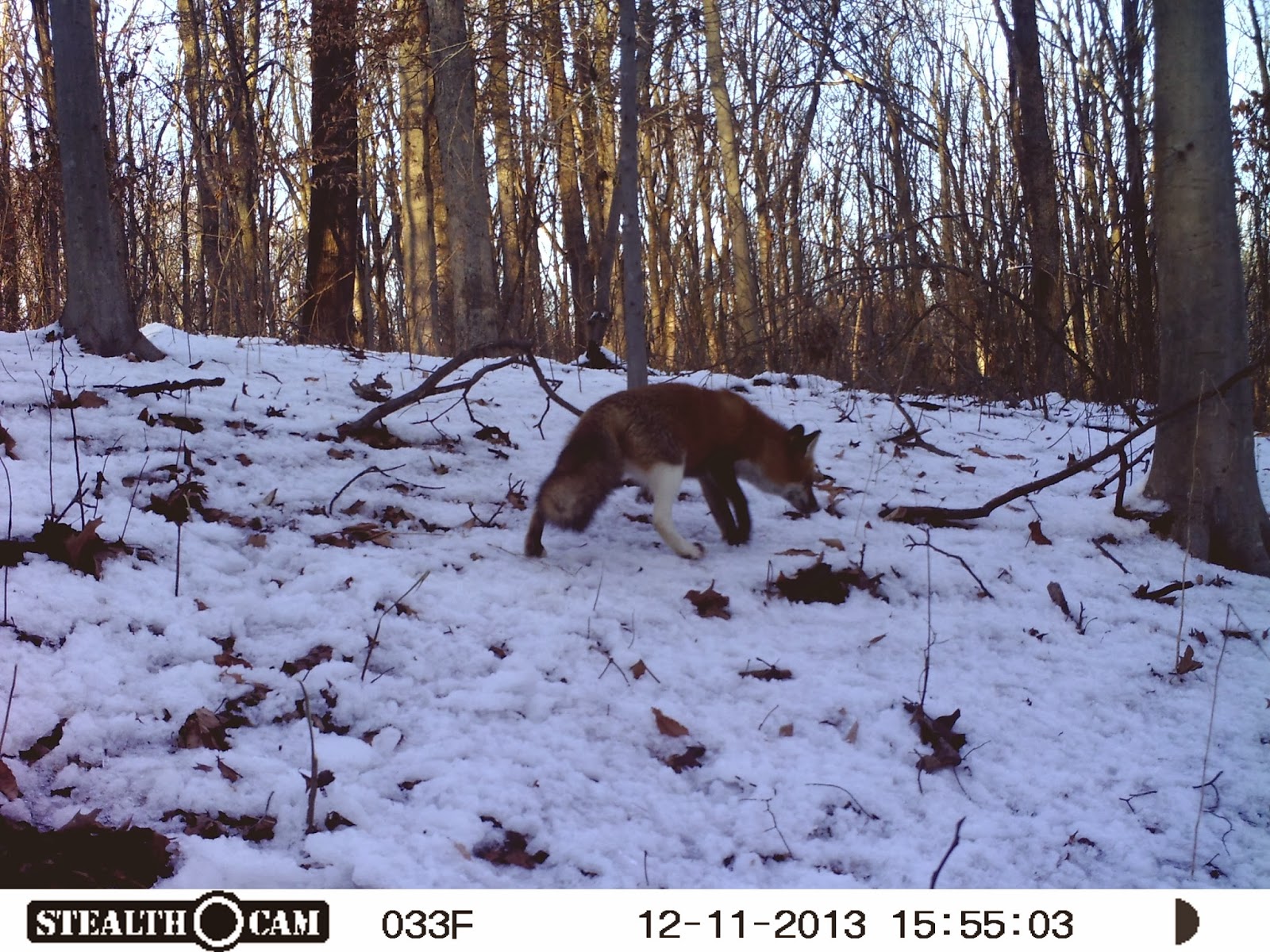
White Snow for White Legs

The bright orange of a red fox aganst the white blanket of snow makes for some really great pictures.  I was really hoping some of my cameras would pick up this kind of scene recently since there has been some snow on the ground.

White Legs, the famous fox of Great Falls, Virginia made more appearances in the daytime than ever.  He didn't seem to mind the snow too much.


It's still unclear where the den of White Legs is located, but I have a good idea of where, now that I've seen tracks going back and forth to one specific area.

Those tracks might be of another red fox though, such as this one that also came by Camera Set 58.

One thing that I have noticed in the past few weeks though is that all of the foxes that have been on camera recently have been sporting their winter coats. 

The winter coat of White Legs is typical of a red fox with the orange and grays, but with the exception of the hind legs.

The winter coat of this other fox in the above picture is a little different.  Most of its body is a burnt orange while its rump and hind legs are more of a golden color.  The tail remains a bit orange but with a grayish underside.

Red foxes can vary a bit in color, and it is fairly common for them to have reds, oranges, blacks, grays, golds, and silvers, in their coat.