Showing posts with label bear. Show all posts

Saturday, July 2, 2016

Paige and the Bears

If there is anyone who knows how to get Northern Virginia's bears on camera, it is Paige.

Mother bear and cub. Photo: Paige Critchley
Paige Critchley contacted me over a year ago about trail camera advice.  At that time,  she was taking on the task of using a trail camera to help a person locate a missing dog in her area.  I forwarded her some tips and told her to keep in contact with me.  What she probably didn't realize then, was that she was at the beginning of a new hobby and an addicting habit called camera trapping (using remote-sensored trail cameras).  It's a very healthy habit, and one that she has become an expert in.

Critchley is a local entrepreneur, a horse enthusiast, and a wildlife lover.  To me, she has also become a great friend and someone who shares the passion of photographing wildlife with trail cameras.  She spends a lot of her free time with her dog outdoors and with friends, but always seems to have trail cameras in the back of her mind.  "Using trail cameras always builds excitement," Critchley says "It's an activity that takes my mind off work."

She volunteered some of her time to run cameras for me in Loudoun County, Virginia and I got to see her interest rise.  Growing with her passion for this, is the number of cameras she personally owns and uses.  It started as one but has grown to 12 cameras now.
Black Bear.  Photo: Paige Critchley

While she describes coyotes as being her favorite animal to capture on camera, Critchley has gotten an incredible amount of bear photographs lately.

Bears aren't rare here in the suburbs of Northern Virginia, but they exist mostly in western Loudoun, parts of Fauquier, and parts of Prince William Counties. During certain times of the year, bear activity may greatly increase in more suburban areas, leading to problems in traffic.  This is due to an interest in new territory and mating habits of young males. With these trail cameras, we are able to keep records on bears and do small population surveys based on the photos.

"I have about 7 or 8 bears coming through 2 different trail camera locations, at the moment." Critchley says.  She adds "I even captured two bears in combat, possibly a mating ritual or territorial fight."

These black bears are not something to be fearful of in our area, but rather something to be aware of. They are omnivorous, meaning that both plants and animals make up their meals. Right now, black bears are feeding on ripened raspberries, wineberries, roots, and insects.  Throughout the year, their diet changes, but usually keeps with a mostly plant based diet, mixed in with a few animals.

Capturing an image of a bear tells a lot.  It can tell researchers where bears are, how many are in a certain area, and daytime patterns of an individual.  Capturing behavior is another thing, and tells a whole story.  The trail cameras have captured the combatting bears, young bears ripping down Critchley's cameras, different bear postures, and even bears stealing her cameras and using them to take their own selfies.
Every time another black bear touches this log, it adds a tiny bit of scent.  The scent draws in more bears and the cycle continues, sometimes for months.  Photo: Paige Critchley.
Critchley's fondness of wildlife doesn't just stop at bears.  In just over a year, she has captured a plethora of images, recording everything from deer to coyotes, and even bobcats.  All of her images are from the Washington D.C. metropolitan area and people are sometimes astounded by the fact that these animals are so close to our Nation's Capital.
A bobcat of Northern Virginia.  Photo: Paige Critchley

Friday, November 6, 2015

Increase Your Chances At Seeing Wildlife


I've spent almost the entirety of the past few years observing animals, studying them, and teaching people about them. One of the main questions people ask me, is "How can I see what you see?". Well, here are some of my secrets. These are my personal tips on how to see more animals while you are hiking or just outside, even for an hour.


  • Look Up.     Birds are the most obvious animals that you might see while looking up, though just over a week ago, a person in my hiking party spooked a roughed grouse from right under her feet, so always keep your eyes all over the place.  Believe it or not, some species that people usually see on the ground can easily be found in trees.  Black snakes and green snakes are animals that can easily "pop out" in your eyesight from above, as they are very good at climbing in trees.  Bears and groundhogs also commonly go up into trees, despite many people's beliefs about them.

  • Look Down.    Looking down gives you the opportunity to see more salamanders, frogs, chipmunks, and even animal tracks.  If you can find animal tracks, identify them, and take a mental note of what is around.  Look for the specific animal while continuing to walk.

  • Walk Slowly.    Some of you might be reading the above bullet points and are thinking "How can you both look up and down at the same time?"  Well, you can't, so walk slowly so you can repeatedly do each.  Walking slowly also can be a quieter type of walk, lessening the chances of you scaring wildlife.

  • Pish!    Pishing is making the sound "pish" with your mouth, repeatedly for a few seconds. This is a little naturalist and biologist trick to scare birds from their hiding places, making them fly out from thick leaves or brush.  This can be tricky though, as some birds will get too scared and fly off very fast and very far.

  • Look for both color differences and movement.   Black bears against a green background and red cardinals against white snow are some really easy examples of color differences you should look for.  It's easy, as a lot of animals stick right out against various backgrounds, even the most camouflaged ones.   Animals move, sometimes extremely slowly, but they move! Even the most camouflaged wildlife will move, providing a better opportunity for you to see them, as they move against these different backgrounds.

  • Get outside.  This one is pretty self-explanatory, but it's one of the most important.  Just walking a mile in your local park a few times a week can provide very interesting wildlife sightings.  Increase your chances and get another excuse to get outside.

  • Use binoculars.   Binoculars really help you hone on the wildlife you have detected using your regular eyesight.  They can also be used to scan large fields and meadows from a distance, limiting the chances of you scaring the wildlife when you first enter a field.

  • Use your peripheral vision.    Most animals that I see are seen first by my peripheral vision. This happens because this type of vision can detect movement very effectively.  Color differences are also picked up easier if you use your peripheral vision more.

  • Protect your eyes while in the woods.   If going off trail or walking on a property with no trail, I highly recommend wearing sunglasses or safety glasses.  I commonly wear shooting glasses, as they are easily accessible to me, and are very effective.  I've both been told this (by other biologists, as well as multiple conservation officers) and learned the hard way to always protect your eyes.  Going into the woods might mean that branches and thorns will be in the way of you.  This very easily leads down to a road of pain and misery.  Also, gnats have a harder chance of getting into your eyes if you wear sunglasses.  Protect those eyes!  You'll be glad you did, besides, if you have injured eyes, it's very hard to see wildlife.

  • Invest in a field guide.   Some field guides provide useful information on whereabouts of certain animals, especially at different times of the year.  It's worth a few dollars if you are outside all the time.

  • Get High!     Ascend quietly onto ridges and small peaks in a forest.  Be extremely silent as you are going uphill.  Once you get to the top, look down and look for movement. This is how I often see deer, bear, and turkeys.

Monday, September 14, 2015

Green With a Hint of Black Bear

We were both patient with each other (and ourselves).

Black bear climbing a tree in Virginia
He snorted a few times, probably saying "Human, let me do my thing!".  So I listened, and respected him, just as he did to me.

We didn't provoke each other.  Yelling, running, and bluffing was not necessary.

The only thing that was necessary was both of us seeing each other there and leaving each other alone.

The animal really only wanted some acorns in the tops of the trees, just as most bears in the area are doing right now in the year.  They're getting some extra calories, as it is still fairly hot during the day, and they know that winter will be here before long.

Tuesday, June 2, 2015

Mama Bear and Her Cub


Paige is one of the volunteers who spends some of her free time running some of my trail cameras and is even starting to build up her own trail camera arsenal.  We're always comparing results and trying to find new things and big ideas.  It's great, and I can't thank her enough for her time and effort in the outdoors.

We've been putting in a lot of work to capture footage of baby black bears on trail cameras in Loudoun and Fairfax lately, so these results were a big success in my book.

This will help with some sort of population density estimate or survey, but for now, I am just really enjoying these pictures.


This bear was not baited at all, so I feel good about getting these pictures as a naturalist and wildlife conservationist.  Sometimes, you just get a trail camera in the right spot, and that's exactly what this was.  In fact, it was only until Paige moved these cameras around to better spots, that we really got decent bear pictures.   I used my best judgement a few weeks ago with her on a "perfect" location, but she had better ideas, and it's because of that, that we got these amazing animals on cameras like this.

We are trying to figure out if the black bear above is the same as the black bear below on a different camera in the same area.

We are unsure as of now, but we'll figure it out by better comparing times, dates, and locations.


Black bears in Virginia will be gorging on berries pretty soon, specifically raspberries, wineberries, and blackberries in only a matter of a month or so.

We'll find a good wineberry patch to hang a few trail cams in early July for more bear results.

Monday, April 13, 2015

Bears in Northern Virginia

Putting the terms "bear" and "Northern Virginia" in the same sentence always seems to stir people up.  It's really not at all what I intend to do, in fact, I would really prefer to do the exact opposite.

Like something out of a horror story, some people around here are absolutely terrified by black bears.  Other people are in shock to hear about them roaming around suburban neighborhoods in Loudoun and Fairfax counties.  There's a whole mix of emotions that come into play, and people sometimes come to me to ask what emotion they "are supposed to have" or how they should react.

I find the interest and intent that people have with their native and local black bears absolutely fascinating.

Author with black bear tracks.  Loudoun County, VA.  Photo Credit: Ed Felker
There a tons of wildlife agencies that may possibly handle, talk to you about, or give advice on what to do if you see a black bear, and for the protection of my jobs and my sanity, I will not be going into much detail here about those organizations.

What I will do though, is provide you with information about some bears that I've seen.  I'll show you pictures and tell you cool stories, and immerse you into the world of northern Virginia's largest living mammals.  I'll do this on this blog post, and more in the future.

Let's first look into a common question that people have for me; the question: "Where are the black bears around here?"

My answer:  "All over the place, as they can be anywhere and everywhere and have very large territories as compared to other local mammals"

Seriously though, I've seen black bear sign (scat, tracks, fur, and/or actual sightings) in every northern Virginia county that you could think of. 

One of the most interesting bear tracking episodes came out of Loudoun County, Virginia this past winter.  A bear was seen multiple times on private properties, crossing traffic, and really all over the place.  I'll keep the exact locations to myself for now, but this bear had a very specific territory in mind.   I spent a good amount of my spare time tracking it through woods and fields, and even managed to see it a few times.  One day, I followed the tracks for over 3 hours, and even then, there was no end to its walking in sight.  The tracks lead to and were on top of large fallen logs, across streams, onto an icy pond, straight over barbed wire, and even into a bedding area where it probably stayed during that same day.

To put it simply, this bear seemed to have almost no problem going over and across all these obstacles, as the gait in the tracks seemed to almost always be consistent over short distances.  In the long run though, I could tell where it "picked up" its pace and almost did a galloping-like motion and could also tell when it got near potential food sources, as it would stand on its hind legs, walk a few steps, then go back down to all fours.  I think that it did this as if it was smelling the air more closely each time it neared a garbage can or bird feeder.  Bears will often stand on their hind legs to get a better look at something with their eyes and to hone their sense of smell when their nose is a few feet higher when standing.

Speaking of bears eating, it is actually illegal to feed black bears in the entire state of Virginia.  For more information on this, visit this website Living with Black Bears in Virginia .  That site also has various other information for the state of Virginia regarding black bears. 

Curious young black bear looking around and doing "bear things" in Northern Virginia.

So with all this information in mind, I'll lead everyone to another common question that people ask me:  "If you can't feed black bears in Virginia legally, then how do you get them to come near the camera?".

This question has tons of answers, none of which lead me to feeding black bears.  A really good way of getting bears on camera trap is to just get lucky and have one walk in the field of view of the camera.  It's kind of an answer that most people who camera trap do not want to hear, but it really does work if you put out enough trail cameras or have a lot of patience.

Another answer to that question might be to set up a camera trap where other animals are living and eating.  For example, a recent camera trap bear sighting around here came from this incidental capture.  The camera was actually pointed at a tree to see what woodpeckers would come near the freshly carved woodpecker holes, and boy did the woodpeckers arrive.  Though, a bear did too.


Why is this? 

It's almost like the bear could have been targeting this tree just because the woodpecker might have had success in getting insects out of the tree too.  Do black bears know to specifically seek out fresh woodpecker sign so they can also get a bite of insects?  I'm not sure about that one, but hope to find the answer sometime.

If you ever see a bear or bear sign in northern Virginia, I would like to know.  It could really help me track these carnivores better, and ultimately might even give me some basis on making a more accurate estimate of the black bear population in these counties.

Look for holes in trees that are this size.
What I would really like to do next year, is do a large camera trap survey just on black bear dens.  I've heard rumors and know of a few in the area that are actually confirmed by various biologists, but would like to expand on what most people (me included) already know.

I'm looking for holes in trees that could easily fit a person, brush piles where you think a bear could be, old barns where a bear has gotten into, and of course, any place where you have actually seen a bear sleeping.  Even though it is months in advance, I would still like to know. 


Please and thank you!

Wednesday, February 25, 2015

Where the Bear Was

Ed Felker joined me on a short hike to track a bear through the woods yesterday.  Ed is another outdoor blogger with a great site at http://dispatchesfromthepotomac.com/ .  He's got some amazing pictures and a fantastic way of writing about what he sees. We've been conversing about hunting stories, coyote sightings, and hikes lately, so it was only fitting that we'd get the chance to meet up on the trail. We pussyfooted around logs and dense brush, while throwing in all sorts of outdoorsmen lingo to make it a great day.

I took him directly to where a nice black bear was frequenting in Loudoun County, Virginia.  In some spots, 4-6 inches of snow was still on the ground.  With the extremely cold temps that we've been experiencing lately, the fresh tracks barely melted away at all.  The definitions of toe pads, palm pads, and even claws were incredibly preserved.

Pictures and measurements were taken.

I'll share this one, but if you want to see more, check out Ed's blog post about it here: Bear Tracks.

Black bear tracks in Sterling, Virginia.


Sunday, February 15, 2015

Bears and Batteries

When the cold sets in like it is right now, most of my camera traps don't work.  This happens for various reasons, but mostly because some kinds of batteries tend to freeze up a bit and the fact the even the camera's internal electronics get frozen if there's a trace of moisture inside of them.

Regardless, they usually kick right back in when there's a bit of a thaw.  For now though, it's just a sort of waiting game until the batteries continue to work again.

In other Northern Virginia wildlife news, there has been a huge increase in the amount of bear related sightings, emails, and inquiries to me in the past two weeks.

Mostly, this has happened in Loudoun County, specifically Potomac Falls, Sterling, Lowes Island, Cascades, and the Great Falls Forest neighborhoods.  So here's a little bear information for everyone.

Whether or not this is the same bear as what people have been asking about, is still a bit of a mystery to me.  Either way, it's exciting to see bears roaming around.

I caught one of them on a camera trap recently.   Take a look!


In typical "bear fashion", it came near the camera, sniffed around, got a bit curious, and went on as usual.  That's what I like to see though.  The bear just seemed to get curious about the camera, my human scent, and whatever I touched.   There was no food put down.  In this way, the bear was never rewarded for just coming by and there was barely (bearly?) any human interaction other than a trail camera being around.   Feeding this bear would not only have been illegal, but also wrong on many levels.   Doing so may have led to unhealthy behaviors and unwanted human/wildlife interactions.

It didn't just leave pictures though.  It left some scat in a very obvious place, and I had to take a picture to send to various naturalists and biologists to identify.

There's no doubt in my mind that this is bear scat.  It's large (over 8 inches long with a large mass), not human-like, seems to contain seed/nuts, and is the biggest piece of s*** that I've seen in this general area in a long time.  I've seen dog, human, coyote, and various other scats around, but nothing really compares to this one in Sterling.


So why is there a dollar bill in the picture?  Well, a dollar bill, in a pinch can act as a sort of ruler or object to compare to.  Other people may use knives, pens, and their shoes, but I like to use dollar bills.  They are almost exactly 6 inches long and when you don't have an actual ruler, they can easily be used as a measuring tool.

Wednesday, September 24, 2014

Bear Broken Camera

It's always a fight against the black bears when you've got cameras in the woods.

They get a lot more curious then some other animals, and their natural curiosity can be a problem.

This camera was torn down and ripped apart by a black bear.  Its casing was broken, the screen cracked, and batteries torn out.


All that was left at the scene was a single, decent bear print, and leaves thrown all over where the bear sat around or dug up something to eat.

Saturday, August 17, 2013

Bear Blogging

Black bears are roaming around all the time.  It's hard for me to tell exactly where they'll be since they move so quickly and can cover a huge area of land in just a day.

Today, it was obvious that a bear had been around one of my cameras.  There were scratches and paw prints all over the area.  Walnuts from a nearby tree were smashed open and I could just tell the area was messed with by something big.

Of course the time stamp is wrong.  Even if I switch the camera to the correct date, it still seems to go wrong when the camera enters "sleep" mode.


Wednesday, August 7, 2013

Camera-Trapping in a Tick Safari

Ticks are somewhere on the very top of my list of the most annoying animals on the planet.  Those blood suckers are crawling all over the woods around Virginia this time of year.  They're out in the millions.  It's incredibly annoying to get to some of my camera-trap sites now because when I come back from them, I know a good chunk of time will be spent checking my body for ticks.

Half of the time, I just feel them crawling on me, but the other half can be anywhere on my skin.  It really is bad around here this time of year.  The woodiest and most natural areas turn into something that I have been known to call "Tick Safaris".

Even with the ticks attacking, cameras still need to be checked.

A few days ago, I went out with one of the volunteers and did some good wildlife research by camera-trap. She didn't seem to be too bothered by the crazy number of ticks around us.  I admit though, I was a bit bothered.

We moved into some swarming patches of Japanese stiltgrass and got to work.   The typical acts of checking and changing things in the camera were done.  Results were checked on the computer.  One of my favorites came from one that we placed near a stream where rocks had been place to dampen the effects of faster water.  Red foxes seemed to like this spot, and of course, had built a den near it a few months ago.


In other news, I saw a black bear today in Fairfax County.  I'll do a blog post on that shortly but I'm first waiting for cameras in that area to be checked to see if it came up on any of them.  Also today, I saw 3 fox kits playing on a baseball field and a pair of pileated woodpeckers bolting from tree to tree in Sterling, Virginia.

Thursday, May 2, 2013

Leesburg Bear Gets Into Garage

The power and strength of a black bear is incredible.

One local homeowner had a black bear rip through a garage door just to get some food that it smelled inside.  I wonder if it could have been one of the same bears that I have gotten on camera in the past few weeks.

Check out the story at http://www.nbcwashington.com/news/local/Bear-Crashes-Through-Leesburg-Garage-Door-205756511.html?_osource=SocialFlowFB_DCBrand .

This story comes courtesy of nbcwashington.com and NBC Universal.

Sunday, April 21, 2013

More Bears

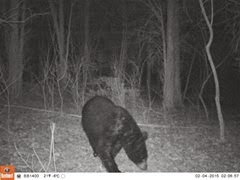
Another bear came by to say hello to one of my cameras.  It's a young one, as you may be able to tell by its small size.

This camera set comes from Bluemont, Virginia and was the one that I put up in a previous post (Into the Appalachians).


Now here is where I'm going to get a little analytical with these photos.

This bear had its picture taken at 11:10PM on April 14th.  The bears in my last post (Loudoun County Bears) had their pictures taken on the same date at just about exactly the same time.

I am estimating the populations of these animals by looking at the times of the pictures and how far away the cameras are from other cameras.

These bears cannot be the same bears since the cameras are miles apart from each other with a picture at the same time.

Loudoun County has way more bears than I ever would have thought.