Showing posts with label Virginia. Show all posts

Saturday, July 2, 2016

Paige and the Bears

If there is anyone who knows how to get Northern Virginia's bears on camera, it is Paige.

Mother bear and cub. Photo: Paige Critchley
Paige Critchley contacted me over a year ago about trail camera advice.  At that time,  she was taking on the task of using a trail camera to help a person locate a missing dog in her area.  I forwarded her some tips and told her to keep in contact with me.  What she probably didn't realize then, was that she was at the beginning of a new hobby and an addicting habit called camera trapping (using remote-sensored trail cameras).  It's a very healthy habit, and one that she has become an expert in.

Critchley is a local entrepreneur, a horse enthusiast, and a wildlife lover.  To me, she has also become a great friend and someone who shares the passion of photographing wildlife with trail cameras.  She spends a lot of her free time with her dog outdoors and with friends, but always seems to have trail cameras in the back of her mind.  "Using trail cameras always builds excitement," Critchley says "It's an activity that takes my mind off work."

She volunteered some of her time to run cameras for me in Loudoun County, Virginia and I got to see her interest rise.  Growing with her passion for this, is the number of cameras she personally owns and uses.  It started as one but has grown to 12 cameras now.
Black Bear.  Photo: Paige Critchley

While she describes coyotes as being her favorite animal to capture on camera, Critchley has gotten an incredible amount of bear photographs lately.

Bears aren't rare here in the suburbs of Northern Virginia, but they exist mostly in western Loudoun, parts of Fauquier, and parts of Prince William Counties. During certain times of the year, bear activity may greatly increase in more suburban areas, leading to problems in traffic.  This is due to an interest in new territory and mating habits of young males. With these trail cameras, we are able to keep records on bears and do small population surveys based on the photos.

"I have about 7 or 8 bears coming through 2 different trail camera locations, at the moment." Critchley says.  She adds "I even captured two bears in combat, possibly a mating ritual or territorial fight."

These black bears are not something to be fearful of in our area, but rather something to be aware of. They are omnivorous, meaning that both plants and animals make up their meals. Right now, black bears are feeding on ripened raspberries, wineberries, roots, and insects.  Throughout the year, their diet changes, but usually keeps with a mostly plant based diet, mixed in with a few animals.

Capturing an image of a bear tells a lot.  It can tell researchers where bears are, how many are in a certain area, and daytime patterns of an individual.  Capturing behavior is another thing, and tells a whole story.  The trail cameras have captured the combatting bears, young bears ripping down Critchley's cameras, different bear postures, and even bears stealing her cameras and using them to take their own selfies.
Every time another black bear touches this log, it adds a tiny bit of scent.  The scent draws in more bears and the cycle continues, sometimes for months.  Photo: Paige Critchley.
Critchley's fondness of wildlife doesn't just stop at bears.  In just over a year, she has captured a plethora of images, recording everything from deer to coyotes, and even bobcats.  All of her images are from the Washington D.C. metropolitan area and people are sometimes astounded by the fact that these animals are so close to our Nation's Capital.
A bobcat of Northern Virginia.  Photo: Paige Critchley

Thursday, May 26, 2016

Baby Foxes - Finally!

Not all nature is cute and fluffy, but these fox kits are!

Red foxes (Vulpes vulpes) have some of the most well-loved babies here in Northern Virginia.  Their playfulness captures the hearts of all of us, their big eyes are adored, and watching them becomes an activity, as well as an opportunity for a lot of families in the suburbs.

I had the opportunity to enjoy watching some of these baby foxes with Derek and Liz Smeds this year. They watched them from their house and I watched them from my computer screen, as I placed a trail camera right at the den entrance after they had notified me about the location of the den.

Derek had shared some photos of fox kits playing in the neighbor's yard a week or so before I had a chance to get out to them.  I was hooked immediately when I realized that the foxes were playing there very often and were occupying an old groundhog den.

It was exactly what I was looking for.

I met up with Liz at their house and quickly got in contact with the landowner a few doors down, where the den was.  Permission was granted for us to start a small camera trap survey of the animals. Everyone's excitement showed tremendously.

A camera was set up and we waited patiently for the first photos. In the mean time, Liz and Derek messaged me often about any behavior they were seeing.  They texted me every few days when they'd see them, sometimes explaining how close the foxes were. Liz says "We have always had wildlife in this neighborhood and enjoy seeing it."  I could tell.  The Smeds family was as enthusiastic about this as I was.

To everyone's amazement, the first time the camera was checked was a very successful one.  A lot of footage of the foxes appeared. Again and again, the camera provided phenomenal photos of the local foxes, each time providing better results than the last.

It was awesome!

Like human children, the fox kits played, fought, ate, and pooped a lot. These behaviors are typical of fox babies, and will continue until they turn into adults when a lot of their life is hunting and taking care of their own young.

The images were from only a few weeks ago, and since then, the camera has been removed to start a new project in the area with local beavers.

The foxes will grow up and move on too, patrolling our woods and eating undesired rodents.


I would like to personally thank Derek and Liz Smeds, their neighbors, and the community of Countryside, VA for allowing me to work on this little project.  It is much appreciated!

Saturday, March 12, 2016

Amphibian High-5!

It's that time of year again!  Amphibians are crossing roads to go to their breeding pools.

This American toad wanted a high five, as I moved it to safety from a road to the side, in the direction it was travelling.

High-fived a toad a few days ago.  Photo: Brian Balik
I'll be counting amphibians again this year and assisting other researchers when I can.  We're getting ready for fox kit season soon, so look forward to some results and photos from that in the next few months.

Sunday, January 10, 2016

Eagle Transport

Bald eagle, one of America's most majestic creatures sitting in a crate in my vehicle.

I've transported some really interesting creatures in the past few years, as I work in places where wild animals are kept as "animal ambassadors", have been trained to transport wildlife, and volunteer and work with projects that allow me to handle these animals.

Just when I think I've "seen it all", some really interesting opportunities always seem to arise.

One of the most recent examples of this happened a few days after Thanksgiving this past year.  

I heard through the "wildlife biologist grapevine" that an injured bald eagle from Virginia needed to be transported to a wildlife rehabilition center.  The eagle was reported injured by fishermen in central/Eastern Virginia and a Conservation Police Officer was tasked with restraining it for its own protection and getting it to a rehabilitation facility.

The logistics of this made it difficult, as a lot of mileage and time would be needed to get this eagle to the care it needed. A "middle man" became necessary to meet the Officer, intercept the eagle, and chauffeur it to the rehab center.
Carrying crate with eagle inside.

I quickly became this middle man.

Now, I've had a lot of precious cargo in my RAV4 before, but never a bald eagle, so this was a first, even for my standards.  I didn't have much in the way of plans for the evening and I knew it would only cost a few bucks to make the drive, so I was pretty excited to be able to not only help the animal, but all parties and agencies involved as well.

The Conservation Officer arrived promptly to my house with the injured eagle.  We exchanged hellos and some "how to's" and "do nots" were respectfully given to me, after all this was a federally protected bird. I agreed to make the drive one final time and was basically left to my own devices as long as this eagle made it to where it needed to go.

Also in my car were some members of the Sweeney family.   They are good friends of mine, and I wanted someone else to be there in case something went awry. I figured that the eagle would be fine for most of the ride in the very back of my SUV, but it wouldn't hurt to have some others checking on it once in a while, so that I could concentrate on driving.  They agreed to join me and their eyes lit up when they first saw the mature eagle.  It would be a good experience for everyone involved.

The first part of the drive went very smoothly.  We made our way westward and ultimately southwest to Waynesboro, Virginia.

As the Sweeney-filled, Brian-driven, bald eagle carrying Toyota Rav4 made its way down Route 340, a surprise almost stopped our vehicle completely.

A large black bear sprinted right across the road and my car came no more than 1 foot from hitting it. The passengers all screamed "BEAR!"

It was alive and well, running full speed through the road's lanes.

We saw the beast hurtle down into a wooded area off the road and eventually it was just a blur in the darkness.

After about 15 seconds of our bodies pumping adrenaline, we all exchanged laughs and agreed that this kind of experience would only happen to someone like me.

I'm glad we avoided having to take two animals to the Wildlife Center that evening.

The eagle arrived at the designated destination, hurt from its reported injury, but still breathing.  We meet with staff at the Wildlife Center of Virginia, people who came into work that late, just to intercept the eagle from me.  They do some amazing work at that facility and I highly support what they do and share.

I was happy that I did my part in this and am thrilled to have friends that also enjoy this type of adventure.

It was good to give back to wildlife, as it gives me so damn much.

Wednesday, December 2, 2015

Owl Banding in Maryland


One of the joys of being in the wildlife biology and naturalist community is being invited out to other people's projects and seeing what interesting endeavors they've been taking on.  It's a great way to network, learn about different species, and of course, enjoy each other's company.

Kerry Wixted, a professional biologist and friend, invited a few people (including some of us Virginians!) out to something really special that she works with a few hours away in Maryland.  She does some interesting work with Project Owlnet, a research project that is focused on Northern Saw Whet Owl (and other owl species) information, banding, and data.  

I couldn't say "no".  Really, this stuff is right in my wheelhouse, and I agreed to come and help her out for a night.

With us, we also had other D.C. area naturalists and biologists, including Natalie Sutton who is a good friend and works with me in Virginia.

Natalie and I arrived at the site after we got off work and the mist nets were already set up.  These nets are put up horizontally on vertical poles.  A wildlife calling device called a FoxPro is set up near the nets.  FoxPros are electronic speakers that people can download wildlife noises and calls onto.  Kerry had downloaded an owl call onto this one.  The FoxPro and net work in combination with each other and owls fly towards the caller, and eventually into the net.
Natalie Sutton holding a Northern Saw Whet Owl.
Net checks are done at certain intervals so that birds are not captured for long at all.  The first net check was happening right as Natalie and I arrived.  Weather and other abiotic factors can have a big impact on the success or amount of owls captured each night, and for the past few days, it had been really warm for the time of year.   We weren't really sure what to expect. The first net check was a successful one though.  Kerry had an owl ready to be observed and banded!

The bird was brought back to the banding station and Kerry worked very patiently and diligently to not only get the required data, but to do it in a way that was good for the bird as well.  She put a metal band around the bird's foot.  This is so that if the bird is captured again in the future, other biologists will know it is a recaptured bird, and they can compare this day's data, with the current data.

Kerry was taking data, as well as explaining to us about what she was doing.  A collection of numbers was being jotted down on a paper too.  We eventually determined that the bird was a male northern saw-whet owl.

Brian Balik (author) with a Northern Saw Whet Owl after banding.
Saw-whet owls are the smallest species of owl native to Maryland.  From what I've seen, they only stand about 15-21 centimeters tall, as adults.  I've never seen one up close before (though I'm pretty sure I've seen one or two from a distance), so this was quite an experience for me.

These owls spend most of their adult lives in trees, looking into the forest for prey animals such as mice and voles.

Once the bird was observed, it was time for us to quickly and carefully release it.  The bird eventually decided it was fine for itself to take off and all of us watched.  We saw the flap of the wings at first, and then eventually the whole body soar into the star-soaked night sky.

Friday, November 6, 2015

Increase Your Chances At Seeing Wildlife


I've spent almost the entirety of the past few years observing animals, studying them, and teaching people about them. One of the main questions people ask me, is "How can I see what you see?". Well, here are some of my secrets. These are my personal tips on how to see more animals while you are hiking or just outside, even for an hour.


  • Look Up.     Birds are the most obvious animals that you might see while looking up, though just over a week ago, a person in my hiking party spooked a roughed grouse from right under her feet, so always keep your eyes all over the place.  Believe it or not, some species that people usually see on the ground can easily be found in trees.  Black snakes and green snakes are animals that can easily "pop out" in your eyesight from above, as they are very good at climbing in trees.  Bears and groundhogs also commonly go up into trees, despite many people's beliefs about them.

  • Look Down.    Looking down gives you the opportunity to see more salamanders, frogs, chipmunks, and even animal tracks.  If you can find animal tracks, identify them, and take a mental note of what is around.  Look for the specific animal while continuing to walk.

  • Walk Slowly.    Some of you might be reading the above bullet points and are thinking "How can you both look up and down at the same time?"  Well, you can't, so walk slowly so you can repeatedly do each.  Walking slowly also can be a quieter type of walk, lessening the chances of you scaring wildlife.

  • Pish!    Pishing is making the sound "pish" with your mouth, repeatedly for a few seconds. This is a little naturalist and biologist trick to scare birds from their hiding places, making them fly out from thick leaves or brush.  This can be tricky though, as some birds will get too scared and fly off very fast and very far.

  • Look for both color differences and movement.   Black bears against a green background and red cardinals against white snow are some really easy examples of color differences you should look for.  It's easy, as a lot of animals stick right out against various backgrounds, even the most camouflaged ones.   Animals move, sometimes extremely slowly, but they move! Even the most camouflaged wildlife will move, providing a better opportunity for you to see them, as they move against these different backgrounds.

  • Get outside.  This one is pretty self-explanatory, but it's one of the most important.  Just walking a mile in your local park a few times a week can provide very interesting wildlife sightings.  Increase your chances and get another excuse to get outside.

  • Use binoculars.   Binoculars really help you hone on the wildlife you have detected using your regular eyesight.  They can also be used to scan large fields and meadows from a distance, limiting the chances of you scaring the wildlife when you first enter a field.

  • Use your peripheral vision.    Most animals that I see are seen first by my peripheral vision. This happens because this type of vision can detect movement very effectively.  Color differences are also picked up easier if you use your peripheral vision more.

  • Protect your eyes while in the woods.   If going off trail or walking on a property with no trail, I highly recommend wearing sunglasses or safety glasses.  I commonly wear shooting glasses, as they are easily accessible to me, and are very effective.  I've both been told this (by other biologists, as well as multiple conservation officers) and learned the hard way to always protect your eyes.  Going into the woods might mean that branches and thorns will be in the way of you.  This very easily leads down to a road of pain and misery.  Also, gnats have a harder chance of getting into your eyes if you wear sunglasses.  Protect those eyes!  You'll be glad you did, besides, if you have injured eyes, it's very hard to see wildlife.

  • Invest in a field guide.   Some field guides provide useful information on whereabouts of certain animals, especially at different times of the year.  It's worth a few dollars if you are outside all the time.

  • Get High!     Ascend quietly onto ridges and small peaks in a forest.  Be extremely silent as you are going uphill.  Once you get to the top, look down and look for movement. This is how I often see deer, bear, and turkeys.

Wednesday, October 28, 2015

Instagram Too!

I'm on Instagram (and have been for some time)!  I post a lot more photos on social media than I do on this blog, so check it out!

I cover all my trail camera's "best" photos of course, along with hikes, friends, animal sightings, fishing, kayaking, and general outdoor posts.

Follow me please by clicking here or by following wildlife_fever, and I'll follow you on Instagram as well.

Sunday, October 25, 2015

Colors

It's be an interesting fall in the outdoors for me.  My friends and I have had some pumpkin ales, a lot of outdoor outings, and an incredible amount of foliage around us.  In fact, I think this year has provided the most orange, red, and yellow that I've ever seen.  This blog is predominately about Northern Virginia's wildlife, trail cameras, and that sort of thing, but there can't a blog about the outdoors without mentioning the Mid-Atlantic's fall foliage. 

Enough of words, enjoy a few photos.

Shenandoah Mountains.  October, 2015

Chesapeake and Ohio Canal.  October, 2015


Friends in Shenandoah on an October hike with me.


Tuesday, September 22, 2015

Bobcats in Northern VA

People hardly believe they are in our area, but there are many tales (bobbed tales!) of these extremely well hidden creatures roaming the suburbs.  So let's finally break this one down for all the Northern VA suburbanites out there.

Yes, we do have native bobcats roaming Loudoun, Fairfax, and Prince William Counties.  They are not something to fear, but more of something to be aware of.  I've seen them on multiple outings while wildlifin' around the area.  Sterling, Leesburg, Bluemont, McLean, Great Falls, Haymarket, Manassas, and Falls Church are all places where I've either seen them in person or on trail cameras.

Bobcats are predators, but will most likely leave your pets alone.  They feast on rabbits, birds, snakes, moles, mice, shrews, and other small meals.  I've seen a family of bobcats raiding a trash dumpster outside of a business right next to a major highway in Fairfax County.  There have been some roadkilled ones as well.  Great Falls had two roadkilled (that I know of) just in the past 3 months.  There have been roadkills on Kirby Road near McLean, Virginia a few times in the past two years, and I've even heard about one killed on the road on Fairfax County Parkway.

So where's the pictures?

Well, here they are!!!

These are brought to you from the Centreville/Haymarket area with permissions from other camera owners and my own cameras.


Have you ever seen a bobcat in Northern Virginia?  Comment here and let me know!

Monday, September 14, 2015

Green With a Hint of Black Bear

We were both patient with each other (and ourselves).

Black bear climbing a tree in Virginia
He snorted a few times, probably saying "Human, let me do my thing!".  So I listened, and respected him, just as he did to me.

We didn't provoke each other.  Yelling, running, and bluffing was not necessary.

The only thing that was necessary was both of us seeing each other there and leaving each other alone.

The animal really only wanted some acorns in the tops of the trees, just as most bears in the area are doing right now in the year.  They're getting some extra calories, as it is still fairly hot during the day, and they know that winter will be here before long.

Saturday, September 5, 2015

Venomous Snakes of Late Summer

It's been one good summer, and to make it even better, I've had TONS of great animal sightings in its last few weeks.

Among these are a few coyotes, some bobcats, lots of bears, and even venomous snakes.


I saw this Eastern Timber Rattlesnake in the Shenandoah mountains last weekend.  These ones will put a hurtin' on you if they bite you, but from the stories I've heard from this area, they will usually give you the rattle sound as a warning before they strike.  Who knows though?  I sure haven't bothered any enough to find out.

It was good to keep a safe distance and not touch it, even though it looked pretty dead to me.

This other one is a venomous copperhead from Fairfax County.  Copperheads are some of my favorite snakes, and though their bite can easily hospitalize a human adult, I still try to get a few pictures of both live and dead ones.

I tried to highlight and focus on both the interesting pattern on the copperhead, as well as the bright yellow-green tail.   That yellow tail is a good indicator that this one is a juvenile.

Juvenile copperheads almost always have this feature, and is used as a caudal lure, luring prey to them when they wiggle it back and forth.

They are fascinating.  Even if I try to get a few pictures of a live one, I always look directly at the animal and try not to disturb it.

I don't kill these snakes, as they are just part of the nature around here, plus they are almost always seen by me in protected natural areas.

Venomous snakes are not something that should be "fooled" with.  They can kill you.  Though it is rare in the area that this happens, it still is possible, and knowing what venomous snakes look like can be very helpful in places where they are commonly found (parks, river banks, rocky outcroppings, woodpiles).  These snakes should not be feared, but people should be aware of where they most likely are going to be, what to do if you get bit, and more importantly, to not pick them up.

Thursday, August 27, 2015

"Tank"

Trail cameras are still running heavy in Purcellville and other parts of Western Loudoun by two of my favorite volunteers, Paige and Peter.  We've been getting all sorts of results, though bobcat and coyote activity have seemed to slow down recently out there.

The biggest excitement with the Purcellville cameras has been images of "Tank". He's a white-tailed deer buck that has been growing an impressive set of antlers. Peter named him, of course, and the name is not only fitting, but has stuck well for the past month or so.

Here is "Tank", one of the biggest bucks around this year.   It's hard to tell from this image, but there are (what we think and have seen in other images) 12 points on his antlers.  It'll be interesting to see if Peter is able to hunt this beast this year.


Tank is the closest deer, followed by two other impressive bucks behind him.

Tuesday, June 2, 2015

Mama Bear and Her Cub


Paige is one of the volunteers who spends some of her free time running some of my trail cameras and is even starting to build up her own trail camera arsenal.  We're always comparing results and trying to find new things and big ideas.  It's great, and I can't thank her enough for her time and effort in the outdoors.

We've been putting in a lot of work to capture footage of baby black bears on trail cameras in Loudoun and Fairfax lately, so these results were a big success in my book.

This will help with some sort of population density estimate or survey, but for now, I am just really enjoying these pictures.


This bear was not baited at all, so I feel good about getting these pictures as a naturalist and wildlife conservationist.  Sometimes, you just get a trail camera in the right spot, and that's exactly what this was.  In fact, it was only until Paige moved these cameras around to better spots, that we really got decent bear pictures.   I used my best judgement a few weeks ago with her on a "perfect" location, but she had better ideas, and it's because of that, that we got these amazing animals on cameras like this.

We are trying to figure out if the black bear above is the same as the black bear below on a different camera in the same area.

We are unsure as of now, but we'll figure it out by better comparing times, dates, and locations.


Black bears in Virginia will be gorging on berries pretty soon, specifically raspberries, wineberries, and blackberries in only a matter of a month or so.

We'll find a good wineberry patch to hang a few trail cams in early July for more bear results.

Friday, May 1, 2015

Virginia is For Fox Lovers


Nothing strikes the hearts of Northern Virginia's suburbanites more than baby red foxes.  It's incredible how much interest there is in these animals.

Foxes are cool, and lots of people are enthusiastic about seeing red foxes in their neighborhood, but when the bright eyed, curious babies come out in late April, people go absolutely wild for these things like you wouldn't believe.

It was a bit of a goal of mine to capture some of them of, at least one of my camera traps this year, as I did fairly well with footage last year (The Best Fox Kit Pictures So Far- 2014 ).  Emails have been pouring in with unconfirmed leads of the whereabouts of fox dens, and I have worked so hard with landowners, parks staff, and other naturalists to try to provide everyone with some interesting photos (and video!).  One lead from Northern Virginia was clearly the best one that I have ever had.  It's amazing, it's a secret location, and I can't thank the colleague and friend of mine who led me down the right path to this one, enough.

As previously stated in an earlier blog post (Fooled and Fooled Again), the amount of groundhog dens that were fooling me and my colleagues was getting high.

Discouraging, might be the best word to describe this whole situation of not finding any fox dens.

Amazed, would be the word to describe my thoughts when first seeing this footage.

It's only fitting that I release these now on the blog.

These were posted on Facebook, and one specific video almost went viral, being shared many times, and generating a huge interest in camera trapping and wildlife.

I have seen both the mother and father on camera and in person.  4 individual kits (fox babies) have been identified, so in total, they are a family of 6.  Each kit has a different personality, and it is quite an experience watching the videos of all of them nursing, playing, fighting, and yelling.

As you can see in the second picture above, the kits are only eating the milk provided by their mother.  This will last for a little while, until eventually they ween themselves onto a diet of rodents, birds, snakes, berries, carrion, and much, much more.

Pictures like these are ones that a Northern Virginia naturalist and camera trapper dreams of, and I thank you for visiting this site to enjoy them as well.

Wednesday, April 29, 2015

Bluebells and Turkeys

While a lot of the camera traps I use are for scientific surveys and research, I do really enjoy the ones that I set aside for my own personal use.  It's good to take a break from regular work and data entry, and just get out in the woods for some good ol' camera trapping creativity.

That was the mentality recently, when I took friend, naturalist, and professional photographer, Jeff Mauritzen along on a hike and paddle.   Him and I have been working on a few projects with all kinds of camera trapping and local wildlife, so it was a great experience for both of us to meet up and get outside.

Author in Virginia bluebells.  Photo:  Jeff Mauritzen
The best part of the day was meandering around a carpet of bluebell flowers that sprawled all over a forest floor.  There were thousands of them!

It was a humbling experience; one that almost took my breath away with the sight of so many flowers.

We took some photographs, walked carefully, and of course, got to work on a camera trap set.

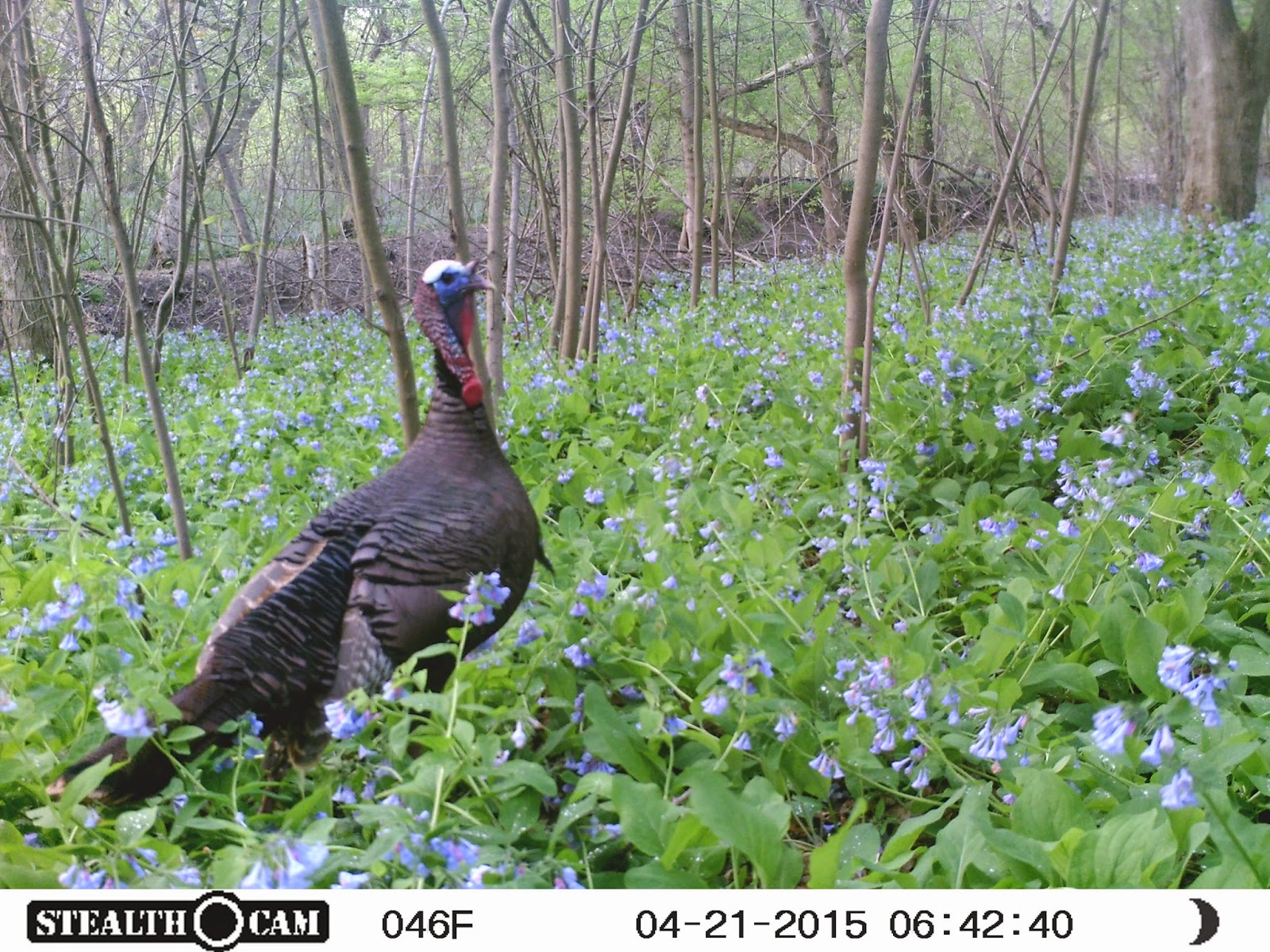
I already knew that no matter what animals we would capture on the camera trap, they would be beautified by being in a sea of bluebells, but was completely amazed when I got incredible pictures of wild turkeys.

One of the projects that Jeff and I have been working on is an article in National Wildlife Federation's Magazine, "National Wildlife".  We had an idea of a few camera trap setups to provide the magazine with photos, so it was really nice to get these turkeys in this setting.  I'm excited to get on board with this and hope to share even more photos of wild turkeys in an upcoming issue of the magazine.

For now, enjoy this picture of a turkey in the bluebells.

Wild turkeys are one of my favorite creatures to watch. Endless hours of entertainment can come out of sitting quietly where there is a turkey roost.  Turkeys fight with each other, putz around, and then go on "missions" to mate with each other.  As a naturalist, this is my television, as it's a wildlife version of the Kardashian's.

I did a little bit of a count and individualized multiple males (including two really beefy "Toms"), at least 7 hens, and also got a few pictures of white tailed deer.

The camera has since been taken down, and will be placed somewhere new.  What's next?

Follow along and find out!

-Big thanks to Jeff Mauritzen for taking amazing photos and coming along on my local excursions.  Click to see more of his work here:  Travel and Wildlife Photography .

Monday, April 13, 2015

Bears in Northern Virginia

Putting the terms "bear" and "Northern Virginia" in the same sentence always seems to stir people up.  It's really not at all what I intend to do, in fact, I would really prefer to do the exact opposite.

Like something out of a horror story, some people around here are absolutely terrified by black bears.  Other people are in shock to hear about them roaming around suburban neighborhoods in Loudoun and Fairfax counties.  There's a whole mix of emotions that come into play, and people sometimes come to me to ask what emotion they "are supposed to have" or how they should react.

I find the interest and intent that people have with their native and local black bears absolutely fascinating.

Author with black bear tracks.  Loudoun County, VA.  Photo Credit: Ed Felker
There a tons of wildlife agencies that may possibly handle, talk to you about, or give advice on what to do if you see a black bear, and for the protection of my jobs and my sanity, I will not be going into much detail here about those organizations.

What I will do though, is provide you with information about some bears that I've seen.  I'll show you pictures and tell you cool stories, and immerse you into the world of northern Virginia's largest living mammals.  I'll do this on this blog post, and more in the future.

Let's first look into a common question that people have for me; the question: "Where are the black bears around here?"

My answer:  "All over the place, as they can be anywhere and everywhere and have very large territories as compared to other local mammals"

Seriously though, I've seen black bear sign (scat, tracks, fur, and/or actual sightings) in every northern Virginia county that you could think of. 

One of the most interesting bear tracking episodes came out of Loudoun County, Virginia this past winter.  A bear was seen multiple times on private properties, crossing traffic, and really all over the place.  I'll keep the exact locations to myself for now, but this bear had a very specific territory in mind.   I spent a good amount of my spare time tracking it through woods and fields, and even managed to see it a few times.  One day, I followed the tracks for over 3 hours, and even then, there was no end to its walking in sight.  The tracks lead to and were on top of large fallen logs, across streams, onto an icy pond, straight over barbed wire, and even into a bedding area where it probably stayed during that same day.

To put it simply, this bear seemed to have almost no problem going over and across all these obstacles, as the gait in the tracks seemed to almost always be consistent over short distances.  In the long run though, I could tell where it "picked up" its pace and almost did a galloping-like motion and could also tell when it got near potential food sources, as it would stand on its hind legs, walk a few steps, then go back down to all fours.  I think that it did this as if it was smelling the air more closely each time it neared a garbage can or bird feeder.  Bears will often stand on their hind legs to get a better look at something with their eyes and to hone their sense of smell when their nose is a few feet higher when standing.

Speaking of bears eating, it is actually illegal to feed black bears in the entire state of Virginia.  For more information on this, visit this website Living with Black Bears in Virginia .  That site also has various other information for the state of Virginia regarding black bears. 

Curious young black bear looking around and doing "bear things" in Northern Virginia.

So with all this information in mind, I'll lead everyone to another common question that people ask me:  "If you can't feed black bears in Virginia legally, then how do you get them to come near the camera?".

This question has tons of answers, none of which lead me to feeding black bears.  A really good way of getting bears on camera trap is to just get lucky and have one walk in the field of view of the camera.  It's kind of an answer that most people who camera trap do not want to hear, but it really does work if you put out enough trail cameras or have a lot of patience.

Another answer to that question might be to set up a camera trap where other animals are living and eating.  For example, a recent camera trap bear sighting around here came from this incidental capture.  The camera was actually pointed at a tree to see what woodpeckers would come near the freshly carved woodpecker holes, and boy did the woodpeckers arrive.  Though, a bear did too.


Why is this? 

It's almost like the bear could have been targeting this tree just because the woodpecker might have had success in getting insects out of the tree too.  Do black bears know to specifically seek out fresh woodpecker sign so they can also get a bite of insects?  I'm not sure about that one, but hope to find the answer sometime.

If you ever see a bear or bear sign in northern Virginia, I would like to know.  It could really help me track these carnivores better, and ultimately might even give me some basis on making a more accurate estimate of the black bear population in these counties.

Look for holes in trees that are this size.
What I would really like to do next year, is do a large camera trap survey just on black bear dens.  I've heard rumors and know of a few in the area that are actually confirmed by various biologists, but would like to expand on what most people (me included) already know.

I'm looking for holes in trees that could easily fit a person, brush piles where you think a bear could be, old barns where a bear has gotten into, and of course, any place where you have actually seen a bear sleeping.  Even though it is months in advance, I would still like to know. 


Please and thank you!

Sunday, April 12, 2015

Wildflowers of Northern Virginia's Early Springtime

I left for a short hike today to check a camera trap (with minimal results) and eventually found myself taking a detour on some trails where I knew there were some interesting wildflowers.

Yesterday before work, I did the same and found a plethora of beautiful photo opportunities.  Although I have only been using my cell phone's camera to capture these, I feel that the photos have turned out pretty well.

These flowers are mostly ephemeral, which means that they only bloom and "come out" for a very short time.  It really depends on the species, but some of them are only in bloom for a period of multiple days to a few weeks.  There are so many more than the ones that I have seen and posted on here, but those will have to wait for another day.

I hope you all enjoy looking at these.


Virginia bluebells nearing peak bloom.  Fairfax County, VA
Virginia Bluebells (Mertensia virginica) are just about in full bloom in various locations in Loudoun and Fairfax counties.  They seem to be a real staple for people doing wildflower walks along the Potomac River and other flowing water bodies.  In some places, they come out in the tens of thousands (or more!) and can be a breathtaking sight. 

To see them in Northern Virginia, look near sandy/muddy areas in parks or private lands (with permission, of course).

Dutchman's Breeches.  Fairfax County, Virginia


Dutchman's Breeches  (Dicentra cuccularia) are some of the most interesting ones in the area.  Look at the shape of those blooms!

It's not a complete rarity in the area, as some people may believe, but to find it can be a bit tricky.

In a general sense, an easy way of finding these may be to look where bluebells are also blooming, as they tend to prefer similar soils and forests.  They can be found in other places though.  The "breeches" in the common name refers to the similar shape of sort of pants worn years ago.

Northern Virginia's beautiful sessile trillium.
Sessile Trillium (Trillium sessile) is another really interesting looking flower that inhabits Virginia. 

To me, it's interesting to see brown in a flower (pictured in the center of the flower), as a lot of other flower species on the ground that people commonly see are brightly colored.

I found a few here and there along the Potomac River a few days ago, but came upon a few large patches eventually after looking for a while.


Spring Beauty (Claytonia virginica)  is one that never seems to get past my eyes when I'm out and about in the woods this time of year.

It's all over un-mowed lawns, deep forests, and even near the Potomac River.  It can be hard to miss in places, as there are patches of it where individual flowers range in the thousands.  It's no wonder that it's called "spring beauty" as it is a wonderful sight to see after a long winter like the one we had this past year.  Each petal is streaked with a darker pink or purple color, and it can be fairly easy to identify.  Look for these in basically any wooded area in Loudoun or Fairfax, and you have a decent chance of finding them. 


Spring beauty flowers in bloom in Sterling, VA.

Thursday, April 9, 2015

Why Did the Turkey Cross the Road?

Just a few days before "spring gobbler season" opens up to licensed hunters in Virginia, and with youth turkey hunting already upon us, this one might really got me going yesterday. 

"Gobble gobble"

Sometime in the early afternoon yesterday, one of my buddies sent me a text saying "There's a turkey by the Toys R Us parking lot just walking around". 

A few minutes later, I got multiple emails and Facebook notifications saying similar things.  I was hooked immediately and was watching the situation unfold from my phone and Facebook newsfeed.

I used to work for that Toys "R" Us store in Loudoun County during my high school years, and though I do not hang my hat there anymore, I try to still keep in touch with some of my old friends and coworkers there. 

It's a good way of not burning bridges and once in a while, some interesting wildlife information is spread between all of us.

This was a perfect example of that spreading of wildlife information.  It's important to know and I find it fascinating.

I get texts and emails similar to this (though usually with different species) every few days or so from various friends and contacts all over northern Virginia.  Usually I just refer them to various wildlife agencies to ask for advice, but for this one, I knew it seemed to be under control already and had an idea of where the turkey had come from nearby.

For wild turkeys, it is basically breeding season right now.  They are fluttering all over with the males starting to really "strut their stuff" during the day.  The one pictured and in question is most likely a female (also called a hen).  She lacks a beard (bristled feathers near her neck and breast) that would usually be a giveaway that it is a male.

So why did the turkey cross the road?  Well, who knows.  Maybe she wandered off farm land and wooded land too far and just go lost.  Maybe she was being chased by male suitors all day.  I like to think that maybe she was going in the general direction of the Total Wine store very close to grab a six-pack of her favorite brew, but that's probably not the case.

Either way, I do not know the exact outcome of what happened to her but hope to find out shortly.

As for the multiple friends and former coworkers who tipped me on this information, I say a very big thank you for keeping in touch with me and for sharing this.

Tuesday, April 7, 2015

Fooled and Fooled Again

While a lot of the camera traps that I use are for scientific surveys and owned by parks, nature preserves, and various parks/wildlife agencies, I tend keep a bunch for myself that are owned by me.

These ones are moved often, as they do not fit into a scientific proposal or specific project.  It's a sort of freedom that I really enjoy.  With these though, I like to challenge myself to get really cool stuff coming across the cameras.

This year, I've been all about the fox dens.  Last year's fox kit pictures and blog posts turned out phenomenal and I'm really hoping I can get something similar this year.  It takes a lot of work and time to search for fox dens, but it could prove to be really useful in the end.  Emails and messages have been flying around like crazy and many miles have been walked, in search for the holes made by these small canids.

There always seems to be a bit of a debate as to whether a hole or den site belongs to a fox or a groundhog, and while I've spent the past few years studying them, reading up on them, and tagging along with others in the field with various animal dens, I still have not perfected the art of determining what is a fox den and what is a groundhog den.

The phrase "Brian, you should know this stuff."  commonly pops up into my head, upon visiting each den site.  It's interesting though and makes this sort of fun.

Young groundhog in a "prairie dog" type of stance in Lovettsville, VA.
Don't worry though, I know the "textbook" definition of a fox den and a groundhog den, but that is just what it is.  Generally, groundhog dens are a bit differently shaped than fox dens and dirt may be thrown out of each hole in a different pattern with each species.  They both can be commonly built on berms or small hillsides either in the middle of the woods or in meadows.

To me, the easy way to tell if a fox has been in a den is to put my face near it and take a whiff of the air.  If it smells like fox urine (a pungent smell that is similar to skunk spray), a fox has usually been there.  To make this even more complicated though, is to add the fact that a fox could have been hunting a baby groundhog, co-habitating (living with) the groundhog, or just marking the territory nearby.

I've been fooled with this time after time.  This year has been the epitome of me getting fooled by foxes and groundhogs, and just when I think I've got an active den with fox kits, a groundhog will appear.

It's a bit discouraging, but it's all part of camera trapping.
Resident groundhog from Loudoun County, VA from this past March.

Sunday, March 22, 2015

Technical Difficulties

The best camera trap photo opportunities sometimes seem to vanish with either technical difficulties or "user error".  By "user error", I mean the fact that sometimes I forget to reset cameras or even forget to turn them on at all.  I'm just human.  Mistakes happen.

This little mistake though is one that I cannot figure out yet.  I'm unsure if it is a memory card problem, "me problem", computer problem, or a camera trap problem.  I need to look more into it.

When viewing the images, only a portion of each image shows.  The rest of the picture seems to be sort of blurred out with a single color.  It's odd and I cannot figure it out.

Here are some examples.


Although I find these pictures fascinating and I can add the species to my data tables, they are not exactly the "perfect pictures" that I was hoping for.

That's the way it goes sometimes.  There's always somethin'.

I'm happy with those coyote pictures though.  At least they made it to the blog!