Showing posts with label loudoun animals. Show all posts

Sunday, June 23, 2013

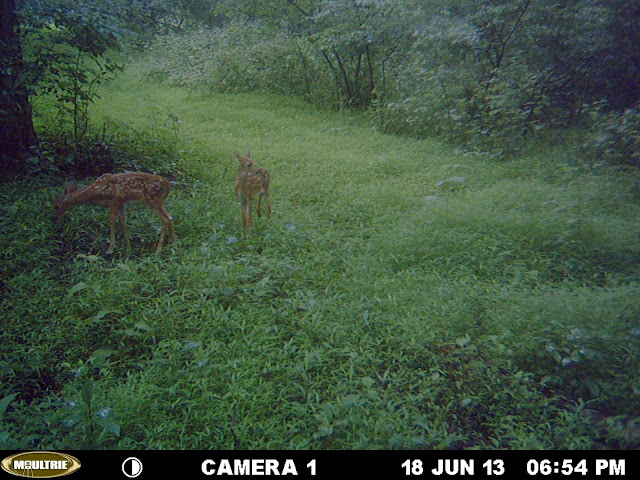
Fawns!


The fawns are out in full swing now.  Born fairly recently in this area, they are still dependent on their mother for food and protection.

These pictures come from Lucketts, Virginia where I put up a camera a few weeks ago.  Many thanks to the landowners who agreed to have a camera placed on their property.

In about another week or so, the raspberries will be out and animals should be all over these bushes.  Perfect for camera-trapping!

As usual, the batteries were checked, the SD card put back in, and the camera turned on.  I'll check this one again in about 3 weeks or so.


Thursday, May 2, 2013

Leesburg Bear Gets Into Garage

The power and strength of a black bear is incredible.

One local homeowner had a black bear rip through a garage door just to get some food that it smelled inside.  I wonder if it could have been one of the same bears that I have gotten on camera in the past few weeks.

Check out the story at http://www.nbcwashington.com/news/local/Bear-Crashes-Through-Leesburg-Garage-Door-205756511.html?_osource=SocialFlowFB_DCBrand .

This story comes courtesy of nbcwashington.com and NBC Universal.

Sunday, April 28, 2013

Textbook Coyote Territory


When walking, cam-trapping, or while doing basically any outdoor activity, I frequently use the word "textbook", followed by another phrase.

To me, this accurately describes an outdoor situation that someone would read about in a textbook.  For example, I always say,  "textbook bass fishing", when I catch a bass behind large rocks on a warm day, when the river is beginning to rise.

"Textbook snake grounds", is when I find a water snake basking on rocks right next to the river on a sunny day.

The picture above accurately depicts the scenery of something that I have deemed to be a perfect example of "Textbook Coyote Territory".

The meadow shown is perfect hunting grounds for a coyote that will consume rabbits, rats, squirrels, mice, voles, and even birds.  It's a very large meadow that I have the privilege of working on and researching what animals are present in the area.

Ponds, forests, and more meadows are in the immediate area, providing coyotes and other carnivores (such as foxes), with opportunities to den, mate, hunt, and live throughout the year.

As far as coyote territories get around here, it can't get too much better than this.

It is the same meadow that surrounds a coyote den that I took a picture of in Tracking Your Loudoun Coyotes and is very close to the area of another previous post, Busy Days.


Wednesday, April 24, 2013

Hawk Up Close

Two cameras are set up by this fox den which I have posted about before.  These cameras STILL have not provided any pictures of kits, so I'll have to be even more patient with this set.

Foxes, groundhogs, and squirrels are very common visitors here, but two pictures of another animal stuck out to me while checking the cams.

A hawk!

It paused here for just enough time to have two pictures taken of it.  I think it enjoys the company of a camera in the woods, because I can't think of many reason of why else it came down here.

Maybe it's a coincidence, to eat, to check out the camera, or just to rest on the ground.  Who knows!

Just another mystery in the woods.


Sunday, March 24, 2013

Busy Days

I've been busy, really busy.  Schoolwork, homework, studying, work, and volunteering is all part of my schedule.

Camera trapping never ceases though, as the cameras are hard at work as well.
Thanks to my girlfriend and fellow cam-trapper
for taking this picture and accompanying me this weekend.

I've been back and forth to my new camera trap sets in Leesburg, Virginia.  It gets really windy on some of Leesburg's hills and small mountains.

Autumn olive chokes the forests in these parts.  Although it is an invasive species, autumn olive does provide a lot of cover, and one thing you want in a forested area when hiding a camera-trap, is a great amount of cover.

Poison ivy is around here as well.  I can see the hairy stems, the spreading roots, and old growth of the plants.   It hasn't even grown leaves yet this year,  but that didn't stop it from leaving rashes on my body for the better part of last week.  Of course, there is no telling exactly where I got the poison ivy from since a great deal of my work, walks, and research is done outdoors.

The point is, is that poison ivy is nasty, and will still affect you even when it doesn't have its infamous "leaves of three".  Boots, jeans, long sleeves, hiking gaiters, and a shower afterwards are all necessary.

The good news though is that I have deployed a whole army of new cameras out and they are heavily covered and hidden in poison ivy patches where autumn olive also lives.

One of my newest camera trap sets has been at a fresh den site.  This den has three openings and seems well used.  Me and a few other people familiar with the area were wondering if it was a fox den or a groundhog's den.  We agreed to put a camera up and find out.

Turns out that it was indeed a fox den.  A pretty lookin' feral cat also came by.


There is a ridiculous amount of coyote scat located on the trail adjacent to the den.  There is also fox scat around as well, but the coyote scat is dramatically different in size.  It should only be a matter of time before a coyote gets curious or wants to take a whiff of the smell of the fox den.  During that time, I hope to get a picture of a coyote on this camera.

Also around here are many bluebird birdhouses lining meadows so they were flying all around. I also spotted an American Kestrel perched on a wire, and many vultures waiting for their next carrion meal.  All in all, camera trapping has been going well this week even though I personally have been very busy.

Friday, March 8, 2013

White-tailed Winters

White-tailed deer in northern Virginia are now just braving out the last few weeks of winter.  Loudoun County experienced snow storm just a few days ago.  Some parts of the county had a measly 3 inches, while the western stretches of the county saw around 10 inches of snow.


White-tailed deer don't seem to mind the snow and cold too much though.  Their winter coat is made up of hairs that are thicker than in summer.

These hairs are actually hollow.  Hollow hairs allow air to become trapped more easily within the deer's coat.  Once air becomes trapped, it quickly warms up due the great amount of body heat that the deer produces.

I've caught a lot of deer lately on my cameras at this location.  This camera is actually pointed at a fox den, but there is a deer trail adjacent to it.

Deer travel along this trail at least every 2 days and do basically the same thing every time in front of the camera.  They walk up with their noses pointed down, smelling the scents of other animals and for food.  When the camera makes a very quiet clicking noise, they bolt their necks up and move their heads and ears around to recognize any danger.


They then get curious to the camera, as cameras are not in their natural habitat.  They look at it with their bulging eyes for a few seconds and turn their heads one way or another.  Once they realize it is not dangerous to them, they put their heads down, sniff the ground, and walk away.


Tuesday, February 26, 2013

Fox Den Update #1


One of the fox dens that I have cameras at has seen some great action lately.  This camera is in Sterling, Va and is pointed at one of the openings of the den.

This den is a big one.  It contains a whole network of underground tunnels and 5 holes for entering and leaving.

There are fox kits in the area already, but I am unsure if this den houses any kits yet.  I have not seem them coming in or out of this den yet.

There have been many visitors to the den however, and excitement for more foxes continues.

One brave groundhog notices the fox hole and seems curious.

Curious groundhog checks things out further.  It quickly retreated after a few more seconds though.

A raccoon sniffs the area.  Raccoons also sniff and look around the den site during a few nights.

Squirrel!  A fox could easily jump out at any minute and try to take the squirrel.

A pair of foxes.  It may be hard to tell that there are two right next to each other, but they are both there.

Red fox notices the camera.


Red fox squats to mark the area.

Red fox entering the den.