Showing posts with label game camera. Show all posts

Tuesday, April 7, 2015

Fooled and Fooled Again

While a lot of the camera traps that I use are for scientific surveys and owned by parks, nature preserves, and various parks/wildlife agencies, I tend keep a bunch for myself that are owned by me.

These ones are moved often, as they do not fit into a scientific proposal or specific project.  It's a sort of freedom that I really enjoy.  With these though, I like to challenge myself to get really cool stuff coming across the cameras.

This year, I've been all about the fox dens.  Last year's fox kit pictures and blog posts turned out phenomenal and I'm really hoping I can get something similar this year.  It takes a lot of work and time to search for fox dens, but it could prove to be really useful in the end.  Emails and messages have been flying around like crazy and many miles have been walked, in search for the holes made by these small canids.

There always seems to be a bit of a debate as to whether a hole or den site belongs to a fox or a groundhog, and while I've spent the past few years studying them, reading up on them, and tagging along with others in the field with various animal dens, I still have not perfected the art of determining what is a fox den and what is a groundhog den.

The phrase "Brian, you should know this stuff."  commonly pops up into my head, upon visiting each den site.  It's interesting though and makes this sort of fun.

Young groundhog in a "prairie dog" type of stance in Lovettsville, VA.
Don't worry though, I know the "textbook" definition of a fox den and a groundhog den, but that is just what it is.  Generally, groundhog dens are a bit differently shaped than fox dens and dirt may be thrown out of each hole in a different pattern with each species.  They both can be commonly built on berms or small hillsides either in the middle of the woods or in meadows.

To me, the easy way to tell if a fox has been in a den is to put my face near it and take a whiff of the air.  If it smells like fox urine (a pungent smell that is similar to skunk spray), a fox has usually been there.  To make this even more complicated though, is to add the fact that a fox could have been hunting a baby groundhog, co-habitating (living with) the groundhog, or just marking the territory nearby.

I've been fooled with this time after time.  This year has been the epitome of me getting fooled by foxes and groundhogs, and just when I think I've got an active den with fox kits, a groundhog will appear.

It's a bit discouraging, but it's all part of camera trapping.
Resident groundhog from Loudoun County, VA from this past March.

Wednesday, September 24, 2014

"10 Point"

I commonly give nicknames to wildlife.  I've been told not to do this for the point of becoming attached to a specific individual and also because I'll most likely see their dead bodies splattered on the paved roads of Northern Virginia, but hey, nicknames make wildlife viewing a bit more exciting.

"White Legs", "Scarface",  and "1 Stripe" are just a few of the nicknames given to individual animals that either come up on trail cameras or are commonly seen by coworkers in my parks and wildlife jobs.

Here's another one for everyone that's been called  "10 Point".  10 Point is an impressive male, white-tailed deer.  It's easy to identify him because of his impressive rack that contains 10 tines.


Who knows whether or not he'll make it to the end of Northern Virginia's extensive hunting seasons.

Monday, August 25, 2014

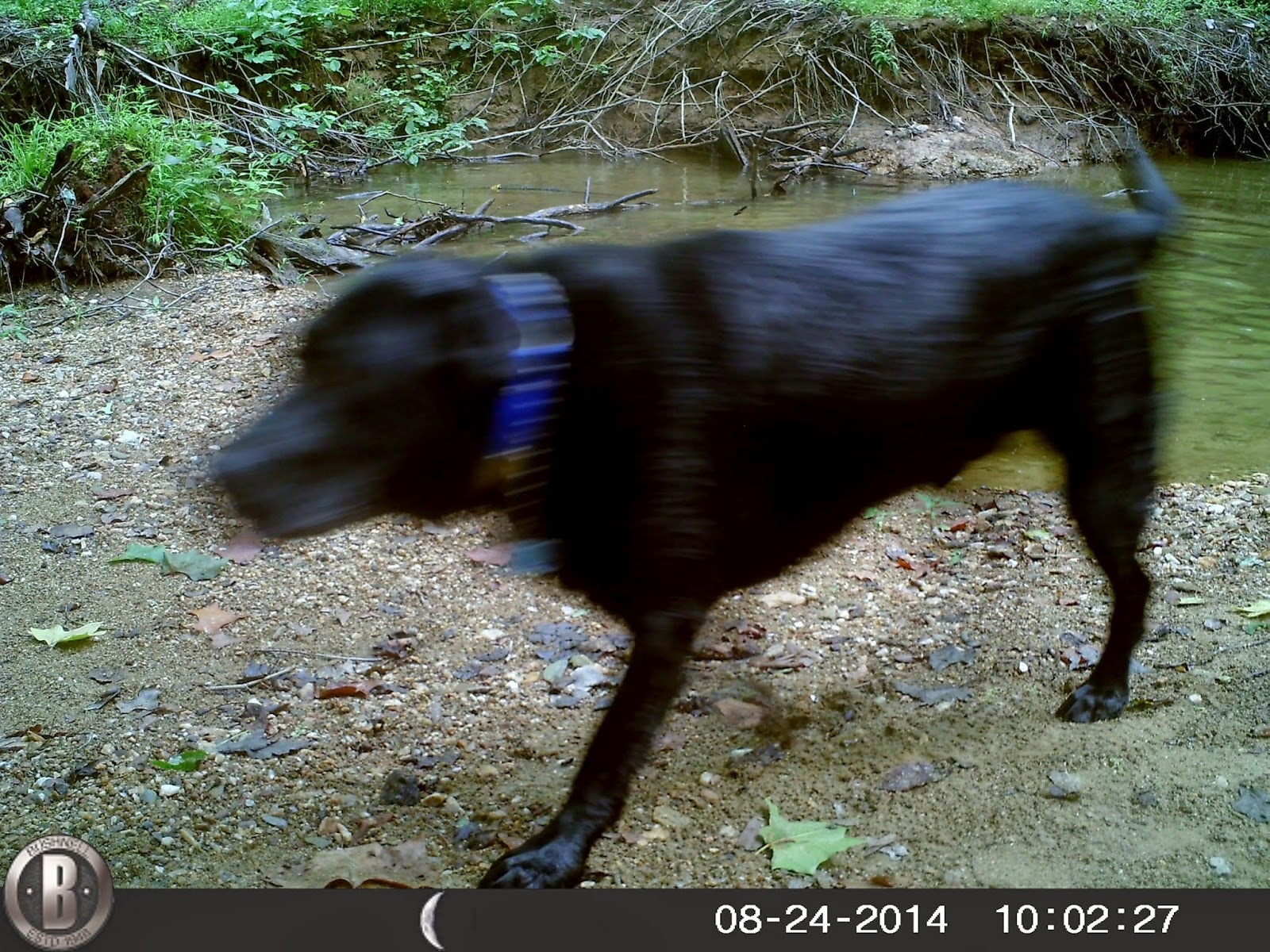
Woof Woof!

Clearly I underestimated the amount of human/dog activity at this place.


I was hoping that this camera would be safe from man and man's best friend, but boy was I surprised when an intern emailed me some pictures today.  The camera was in a protected nature preserve that I won't name (for now) well away from any trail.

It's time to move that camera!

Wednesday, July 9, 2014

The Ants Go Marching

A coworker helped me with some cameras today and found one completely covered in ants.

Upon closer inspection, ants had completely invaded the entire interior of the camera-trap.  We spent a good hour opening up the camera, unscrewing screws, cleaning it out, and putting it back together.

We completed our "Camera-Trap Surgery" in the field as we swatted away maybe 25 mosquitoes and picked off ticks of our legs.  The ants had made an entire food storage type of room in the camera along with an egg holding cell.  It was rough, but we managed to save the camera and found that no electrical components had been badly damaged.

We checked the SD card on a laptop in the field as well, but only found a few pictures of a red fox and raccoons.

But hey, you can't win with bears, coyotes, and other "crowd pleasers" every day.  It was still a good day out on the trails, and I thank him greatly for helping me today.

Monday, April 28, 2014

Red Fox Irony

Ironic how a day after I write a post titled "Where are the fox kits?", I check a camera and get some decent pictures of fox kits.

These were taken in Great Falls, Virginia and seem to be the first time the kits have ever ventured outside their den.  There has been a camera here for about 2 weeks, but yesterday, the babies came out to enjoy some good weather.

The date/time stamp was set wrong (my fault, sorry fellow blog readers), but I can assure you that these were taken yesterday, April 27th, 2014.


These kits are red foxes but they don't look resemble their parents completely.  Through the next weeks and months, their fur will become more orange, their bodies will fill out, and the entire animal will become an efficient machine that excels at catching mice and voles.

These ones are no bigger around the size of my shoe (size 10 in case you were wondering).

Another camera was put up in the opposing direction of the den to get more photos.

Friday, January 17, 2014

Opossum Vs. Skunk

A skunk is not something most creatures would want to mess with.  It's an experience that could lead to scratches, bites, and of course, a smell like no other.

There's only one clear picture of the ordeal, but it shows the real attitude of these two animals.  This is one brave opossum, folks.

The skunk seemed to be the winner and continued eating for 34 minutes after this.

Thursday, December 26, 2013

A Camera-Trapping Grinch

I'd love to have been able to share the most recent camera-trap photos but there are none to show  because of another missing camera.
It was placed in central New Jersey on Thanksgiving Day by myself and other family members.  The plan was to pick it up on Christmas Day.
Of course it wasn't there yesterday when we went to check it. 

It now probably lies in the hands of a criminal.
We walked around in both the daytime and once it got dark, to look for it in case somebody put it up somewhere different,  but we had no luck.

Thanks Camera-Trapping Grinches.

Tuesday, October 8, 2013

Log Travelers

Let's get the gross facts out of the way first.  This log was a place for marking for many species of animals.   Fox, raccoon, and other unidentifiable mammalian scat was all over this log.  Animals do this to mark their own territory, and it really can just pile up after time.

I found it just by walking around the woods in Sterling, Virginia while doing a few wildlife surveys months ago.

So what was a nature-oriented person with multiple camera-traps going to do?

You guessed it, I put a camera up to it and left it out for months.  I checked it today and was happy with the results.  These are all videos and can be started by just clicking.

Raccoon
Red Fox
Gray Squirrel
Another Red Fox

Monday, September 30, 2013

No Shortage of Virginia Bucks

I'm not tired of big antler pictures yet, and hope you aren't either.  It's hunting season where I live and a lot of folks around here are excited to see my buck pictures.

I can't tell you, the hunters, or most other people where exactly the bucks are or where they'll be, but one thing for sure is that I've seen so many of them this year.


These were taken in Fauquier County, Virginia with the help of a friend and colleague.  We're going for the bears, bobcats, and coyotes specifically, but white-tailed deer pictures are always welcomed. 

This blog will be seeing more of this camera's pictures pretty soon.  It's a new county of camera-trapping for me, and I'm excited to be able to use this camera out there.

Saturday, September 28, 2013

Gray Fox Territory

There's no mistaking this animal on a camera.  It is no doubt a gray fox.  The black stripe on the tail, the gray coat, and the size are all indicators of what carnivore this is.

Just like all other foxes around the area, grays eat small mammals that they find running around meadows and forests.  Grays have the ability to climb trees unlike most of foxes.  I wouldn't say they are as good at climbing as cats, but they do it from time to time.

This is one of my favorite camera locations.  It is decently far away from where I live and have other cameras, so I only get to check it once every 6 weeks, or even longer. 

The drive to get to it is nice, and the property owners love seeing the pictures, so it is well worth it for me to keep the camera there.  If you're curious to know where it is, all I can tell you is that the camera is located in Lucketts, Virginia.

Here's another picture (of the infrared variety) of a gray fox in the same location.

Deer also showed up a lot and have been the most common animal on this camera.


Tuesday, September 24, 2013

Buck in the Sun

Usually it's bad to face a camera-trap into the sun.  Pointing it west or east will give you a lot of washed out pictures due to the sun.  I made the mistake of pointing one camera this way, and only 1 picture was worth me taking the time to blog about.

I just thought this picture was cool and different.  The early morning sun behind the white-tailed buck isn't something I get to see often in camera-trap images.

There were still over 800 pictures of deer that were washed out and invaded by a rising or setting sun.  More thought was taken when resetting the camera.

It is now at the edge of this field in a shadier spot, not facing any sun.

Sunday, August 11, 2013

7 Raccoons

Usually I don't enjoy raccoon images that come up after every time camera-traps are checked since I get so many of them, but these images are unusual.  There are 7 raccoons in the pictures.  I've never seen this many on camera before.  

They're all hanging out and feasting on the remains of a deer that I found at that exact spot.  They could also be eating the massive amount of insects that are feasting on the deer remains.  Either way, it's interesting to see so many raccoons.


These pictures are only 2 of the 9,800 that I have to check soon.

Sunday, July 28, 2013

Thanks For The Extra Help

This one goes out to the people who have helped me out the most with my outdoor and wildlife endeavors. This blog has so much more in store for you and for the rest of the world

Thanks to my parents for giving me advice on where to put cameres.  Through many walks in the same lands that I camera-trap in, they see things that I don't see.  They have also given me materials, helped with the building of things, given great advice, and even gave me my own camera-trap as a Christmas gift last Christmas.

Thanks to all the volunteers who regularly check cameras, record data, and give me company on hikes and walks to the cameras.  It's really nice getting out with everyone on the trails but also seeing the excitement through emails when we share photos and data.

Thanks to my fellow employees for telling me about every animal they see on a daily basis and for being interested in what I am doing.  Thanks to them for the great advice on where to put cameras, for helping me drag canoes and row-boats to good camera-trap areas, and for giving me even more connections to local public land managers where I am able to do this research in.

Thanks to some of my professors in college who have wildlife, biology, or anatomy backgrounds.  The experience that they bring to my research and hobby of camera-trapping is infectious and helps drastically.

Thanks to homeowners that border the areas where cameras are located.  These people live right there with the animals that I see.  Without their tips and stories, camera-trapping would be a little less interesting and more difficult.  The best stories come from  the people who have had their garbage cans raided by bears, trash thrown by raccoons, and driveways bombarded with scat of all types.

Thanks to the homeowners who let me put up cameras on their property.  Most of the work I do with the cameras is in local parks and public lands, but for my own cameras, I like to search around the area and ask people I know if I can put on up on their land just to see what's lurking where they live.

Thanks to the park managers who give me permission to use cameras on the properties they manage.  Going to all these parks is a thrilling experience that I will remember for the rest of my life.  Thanks to them for being so interested in what I'm doing, for the advice, the park stories that range from bear sightings to risque teenager encounters in the woods, and for the permissions to use vehicles to access the cameras easier.  It's a great experience to hike around to all the cameras so that I can see more things along the way, but in a time crunch or a day that takes me to 3 or more parks, a vehicle for trails is necessary.  I have checked cameras by means of kayaks, canoes, a powerboat, an atv, numerous golf carts, John Deere gators, trail vehicles, cars, vans, pickup trucks, and even a mountain bike that one of the parks owns.

Thanks to other camera-trappers and wildlife researchers who have brought a whole wealth of information regarding trail cameras, animals, lands, weather, terrain, and general research techniques.

Thanks to other bloggers in the wildlife and outdoors fields.  It's tough to keep up with so many different blogs but I have a select few that I read on an almost daily basis.  Also thanks to local bloggers, whether you write about wildlife or not, I have such an interest in what you have to say about the community that I live in.

Thanks to my grandparents and family who support the blog and are regular visitors.  Thanks to my friends as well, I hope you all have begun to catch some type of wildlife fever with me.

And thanks to you, the blog reader.  Without you, why would I even be writing all this?  Thanks for supporting the blog, for the comments, the advice, the arguments you bring to the table, the interest, and the views to this website.  Writing this blog for the past few months has been an incredible experience and I'm glad that I get to share it with you and the world.

I can't wait to see what the camera-traps and outdoors have in store next for the me.  Keep checking back and you will see what most people in the area don't get to see at all.

Saturday, July 20, 2013

Another Den and A View of the Falls

Camera-trapping didn't take long at all today because within the first 5 minutes of trekking through the woods, I found this:
Possible fox den?

This picture doesn't do much justice for the size of the hole but in reality, the hole is about 8 inches wide by 10 inches tall.  My money is on it being a fox hole but it could also be a small coyote den, a groundhog den, or something completely different.  Whatever lives in it will hopefully show up on the camera that I placed near it.

Since finding this hole and placing the camera only took a few minutes, there was time to explore a little bit before I had to go home.

I went to an area in the woods that I haven't had too much time to explore yet to look for more dens and tracks.

There weren't any dens in the ground except for the first one, but there were many holes in trees in this area of the forest.  Basically about one-fourth of all the trees in this area were standing but dead or rotting.  Beech trees, oaks, hickories, and a few walnuts make up the forest here.  It's the perfect flying squirrel habitat.  I took a few pictures of the holes in the trees and made note of exactly where I was.  I'll have to rig up a flying squirrel cam for these holes.
Who lives in these holes? Flyers? Squirrels? Owls?


When I got to the car, I still had some energy left in me so I figured I would drive a mile or two to Great Falls National Park.

Great Falls National Park is very close to where I work, so I am a frequent visitor.  A few of the rangers have gotten to know my name and an obligatory conversation about park wildlife is always sparked when I say hello.  It's one of my favorite places to unwind, and even though the waterfall observation decks can get packed with tourists, the park has many trails on which I walk at least once a week.

Today though, I just wanted to view the falls to see what they looked like with the current water conditions. The large waterfall of the Potomac River is the park's main attraction and the views of it never disappoint.  I take a picture every time I see the falls.  This afternoon was no exception.
 

Vultures are always flying overhead, herons are watching fish swim by, and squirrels are picking at the food scraps left by tourists.  The park is so close to my house and I'm glad I am able to get to it so easily.

Tuesday, July 16, 2013

Fields of Gold


This blog is not about to turn into a daily outdoors journal for the D.C. area, even though I do record some photos and happenings of my experiences outside in this blog.  With this post (and the kayak ones), it would be a shame not to share some of these pictures.

Many of the trail cameras are still working hard getting me those pictures that I always post on here, but I have taken a few days off of checking the images.

During this lull of camera-trap images, I've gone kayaking, hiking, and touring the area with friends and family.  My most recent excursion led me north into Maryland to see large sunflower fields planted in McKee-Beshers Wildlife Management Area.

It was a long drive (about 50 minutes) for the amount of time spent there, but seeing fields bursting with color to this extent is something I had to do at least once.  It also gave me an excuse to do something interesting on my day off of work and camera checking.

Tomorrow, I'm back at work, back at camera-trapping, and back to the daily grind.  I can hardly wait to see what results the camera-traps will bring next.


Saturday, July 6, 2013

Bluemont Camera Gets Taken Down

The camera that was in Bluemont is now sitting on my counter at home.  It needs new batteries, a few tests, and a new location.

It did well in the mountains, enduring all of the spring's heavy winds and rains. 

There's nothing wrong with it though.  It's just time for a move.

This is the camera that provided me with a few bear pictures (see More Bears), and many pictures of raccoons.


The woods around are now full of fruits, especially raspberries and wineberries.  The main mission was to take down this camera, but a pit stop into the berry bushes seemed also necessary.

I gorged and had more than my fair share.  A bag was also needed to take more home.

It was a game of duck and dodge as I was working carefully to avoid thorns, flies, and poison ivy while picking.  The big scare though came when the bushes started rumbling about 15 yards away from me.

Just being in these bushes full of food puts me a little on edge in bear territory.

A deer huffed and darted towards an even lower thicket.  I'm glad it wasn't a bear that close to me.  Berry picking resumed, and after a fair amount were in my stomach and bag, I scrambled out of the thorny bushes and headed up a rocky slope to get to where the car was parked.


Friday, July 5, 2013

"How do you keep track of all the cameras?"

It's one of the most commonly asked questions I get regarding the cameras besides the usual, "Where are the bears?" and "Ever get anyone doing anything their not supposed to be doing on camera?".  

I'd figure maybe a few blog readers would be wondering the same thing.

The answer is a mix of a lot of methods. It does get tricky trying to remember where all the cameras are at all times since they get moved a lot.

The first thing I always do is write it down with a pen or pencil.  Trail names, trail features, and landmarks are important here.  I also look at my GPS and write down the coordinates.

I also have an app. on my Android called "GPS Share" that allows me to access the phone's GPS, extract a coordinate, and text message it to anyone.  For a few places I camera-trap at, I send these via email to managers and people who need to know where my cameras are.  A backup email is also sent to my email address.

The GPS Share app. is a free one that works well.  It's quick, easy, and is basically all I need for what I'm doing.

Another method used to keep track of the cameras is logging and flagging a waypoint on my phone's GPS.  Basically, what this means is that I am able to save each camera's location on my GPS map.  I get a phone ringtone when I walk within 20 yards of the camera-trap and a different ringtone noise when I walk within 10 yards of the camera-trap.  This way, if I really forget where a camera is, I can always pull out my phone and have a good idea of the range that it is in.

Do you use any of these methods in the woods with camera-traps?  Are there any better Android apps that I should use instead?

Wednesday, June 12, 2013

The Fundamentals of Camera Trapping


Here's a list of Camera Trapping Fundamentals that I've been waiting to post for a while now.  I've learned these lessons recently and hope that they can be useful to others.

1.  Get Away From People-  Most people that see the camera just wave to it or ignore it.  Some choose to moon it, flick it off, or pee in front of it, and a select few will steal it.  Minimize your chances of these incidents by going off trail, putting your camera 8 feet up (or higher) in a tree, or by monitoring lands for a week or so before you even put a camera up.  Don't be naive to the fact that if you camera-trap for long enough, you will have at least one get stolen.  It happens.

2. Get Away From Dogs-  Dogs are naturally curious and will want to know exactly what your camera is doing on a tree.  They will sniff your footprints out and go right up to your camera when they are not on a leash.  If they sit at your camera for long enough, the dog owners may want to see what the dog is looking at, therefore leading another person figuring out where the camera is.  Minimize dog encounters by placing camera traps away from trails, and across small streams from trails.  Look for dog prints off-trail too.  If you see dog prints, keep moving.

3.  Find Dens-  Animal dens and holes have harbored in some of my favorite and unexpected pictures of animals. Find dens by walking around the woods, following animals tracks, and using your nose.  Dens reek of fresh kills, animal urine, and other scents.  It is time consuming, you will get muddy, but the chance to photograph newly born animal young should be worth the time.  All sorts of animals will come up to the den throughout the night as well, not just the animals that live in them.

Broke my own rules on this camera by using a dark colored strap that's easy to see.
4.  Don't Use Straps, Cables, Or Locks-  These devices are usually dark colored or shiny and are made to secure your camera.   They stick right out in the woods to even the most naive hikers, trappers, and hunters.  I find it much better to take the time to hide the cameras rather than to just lock them up on a tree.

Natural shapes in the woods are not usually 90 degree angles, perfectly horizontal, or at all uniform.  If you do choose to use straps, cables, or locks, you will get more people coming up to your cameras, but then they will be more secure.  I've had cameras "perfectly placed" with these, only to have people take saws to trees, just to get the cameras off, so I rarely use locking cables anymore.  If a person really wants the camera, they will take it no matter what kind of lock is on it.

5.  Go Where The Animals Are-  Deer trails and game trails are sure fire ways to see what's walking around.  Follow them far and deep into the woods.  Coyotes, bobcats, deer, and turkey all use deer trails.  Water sources are also good, especially from July-September.  Some great results that I have gotten have been on the banks of rivers and streams.  Animals frequently use them as highways and so should you.

Find scat and tracks at trail intersections and on scent marked trees.

6.  Know Your Camera-  Test your camera for a few minutes during the day, and even for one whole night.  Getting to know the trigger speed, flash, and depth of field are all key into figuring out how it will do when it is set up in the field.  Know how long batteries will last and get at least a 4 gig SD card so you have some idea of when you should check your camera again, whether it be days or even months.  Know how strong your LED or incandescent flash is for those night pictures.  Some flashes are very strong and if you place the camera in the wrong place, all you will get is washed out pictures from the flash.

7.  Don't Let The Sun Ruin Your Pictures-  The sun rises in the east and sets in the west (at least in a general way).  Do not point your camera in these directions or you will get a washed out or extremely bright picture of the sun during sunset or sunrise.  Instead, point your camera north, south, or in a very shady location.

8.  Work Quickly-  When checking SD cards, setting the camera, or replacing batteries, don't rush, but move quickly.  The less time spent at the site, the less of your scent will be spread.  Try not to touch branches of trees and don't break sticks when you step on them.  You are in the wild with wild animals, act like it.  Don't leave any trash behind and get out fast.

9.  Have A Checklist Ready When Checking Cams-  It's important.  Do it.  On my checklist is changing batteries, making sure SD card is not full, make sure the SD card is set and in the camera, make sure camera is turned on, make sure nothing is obstructing the camera's lens, take a test picture, listen to the camera click to see if it is working, make sure nothing is left behind, and before leaving, make sure the camera is turned on again.

10.  Know Who Owns the Land-  Don't go on federal property to place a camera without permission.  Know where you are and who holds the rights to the land you are on.  While it is tempting to place a camera in National Parks to photograph that prize bobcat or bear that you saw while hiking, don't do it.  There are steep fines and punishments for doing anything like this on government land.  Don't be that guy in the woods that ruins "it" for everyone.

Monday, May 27, 2013

In Search of the Piebalds

Two piebald deer live within a very short range of where some of my cameras are placed and where I work.  

They are masters at avoiding the cameras though.

When I first saw them last year, I thought the two white-colored mammals were goats, but you better believe they were piebald deer.  Today, they were both together on the side of the road near an entrance to my place of work, working their tongues and teeth on a tasty patch of grass.  I halted the car and did a weird little jig to get my cell phone out of my pocket for a picture.  In that time, the deer had put their heads up and trotted off into the green curtain of the forest.

I assume they are not big fans of the local paparazzi, especially that of the camera-trapper kind.

They are actually white-tailed deer but with a coat of white, brown, and tan patches.  A genetic variation causes this coloring and is quite rare in deer.  In fact, these are the only piebald deer that I have ever seen.  

I have learned the term "piebald" for this color variation, but have also heard to them referred to as pinto and calico patterned.

It's time to rethink the location of a trail-cam, place it closer to where I have seen these deer multiple times, and actually get them on camera now.

Thursday, May 16, 2013

An Unusual Fox Tail


Fox tails are usually bushy masses of white, black, gray, and orange fur.  Not this fox's tail though.  This one looks like it could belong to a rat.

I'm unsure as to what the cause of this odd looking tail is, but I have a few ideas in mind.

It could be malnutrition, mange, disease, hormone imbalances, or maybe it has pulled fur out of its tail to add warmth to a den (yes, some foxes do this in the same way that some birds pull out down and feathers for the same reason).


Here's a picture of a different fox in the same location with a bushier tail.  What a beauty!