Showing posts with label fairfax. Show all posts

Thursday, May 26, 2016

Baby Foxes - Finally!

Not all nature is cute and fluffy, but these fox kits are!

Red foxes (Vulpes vulpes) have some of the most well-loved babies here in Northern Virginia.  Their playfulness captures the hearts of all of us, their big eyes are adored, and watching them becomes an activity, as well as an opportunity for a lot of families in the suburbs.

I had the opportunity to enjoy watching some of these baby foxes with Derek and Liz Smeds this year. They watched them from their house and I watched them from my computer screen, as I placed a trail camera right at the den entrance after they had notified me about the location of the den.

Derek had shared some photos of fox kits playing in the neighbor's yard a week or so before I had a chance to get out to them.  I was hooked immediately when I realized that the foxes were playing there very often and were occupying an old groundhog den.

It was exactly what I was looking for.

I met up with Liz at their house and quickly got in contact with the landowner a few doors down, where the den was.  Permission was granted for us to start a small camera trap survey of the animals. Everyone's excitement showed tremendously.

A camera was set up and we waited patiently for the first photos. In the mean time, Liz and Derek messaged me often about any behavior they were seeing.  They texted me every few days when they'd see them, sometimes explaining how close the foxes were. Liz says "We have always had wildlife in this neighborhood and enjoy seeing it."  I could tell.  The Smeds family was as enthusiastic about this as I was.

To everyone's amazement, the first time the camera was checked was a very successful one.  A lot of footage of the foxes appeared. Again and again, the camera provided phenomenal photos of the local foxes, each time providing better results than the last.

It was awesome!

Like human children, the fox kits played, fought, ate, and pooped a lot. These behaviors are typical of fox babies, and will continue until they turn into adults when a lot of their life is hunting and taking care of their own young.

The images were from only a few weeks ago, and since then, the camera has been removed to start a new project in the area with local beavers.

The foxes will grow up and move on too, patrolling our woods and eating undesired rodents.


I would like to personally thank Derek and Liz Smeds, their neighbors, and the community of Countryside, VA for allowing me to work on this little project.  It is much appreciated!

Saturday, March 12, 2016

Amphibian High-5!

It's that time of year again!  Amphibians are crossing roads to go to their breeding pools.

This American toad wanted a high five, as I moved it to safety from a road to the side, in the direction it was travelling.

High-fived a toad a few days ago.  Photo: Brian Balik
I'll be counting amphibians again this year and assisting other researchers when I can.  We're getting ready for fox kit season soon, so look forward to some results and photos from that in the next few months.

Sunday, November 1, 2015

Squirrel Selfies

Gray Squirrels are one of the most photogenic and "up in your face" mammals I've encountered in Virginia.

They're so. . . squirrely.

Seriously, these squirrels get right up in both mine and my camera traps' face.  Just this past week, I was hunting with a friend when a squirrel came by.  At first, it made leaves rustle like a 200lb white-tail, only for me to turn my head and see a small, furry bodied rodent pouncing around in the leaf litter.  The squirrel came closer and closer.  My friend said "Here it comes. . . " and I bombarded him with whispers of "shut up, let's see how close it gets before it realizes. .  .keep quiet".

The squirrel ended up not even 2 feet away from me.  Literally it was right there, face to face with two camouflaged humans and it didn't even realize it.   Eventually, I blinked and the squirrel darted away.   They're curious little mammals and will love any kind of well intentioned attention.

They also get right up into the eyeballs of trail cameras.  They know something is "human" about it, but seem to have to go right up to it anyway.

Wednesday, October 28, 2015

Instagram Too!

I'm on Instagram (and have been for some time)!  I post a lot more photos on social media than I do on this blog, so check it out!

I cover all my trail camera's "best" photos of course, along with hikes, friends, animal sightings, fishing, kayaking, and general outdoor posts.

Follow me please by clicking here or by following wildlife_fever, and I'll follow you on Instagram as well.

Wednesday, October 21, 2015

Peace Like A River

Being a professional naturalist has given me the opportunities to either ride in or drive many kinds of vehicles.  I've been on ATV's, agency pick-up trucks equipped with infrared and night vision scopes, airplanes, motor boats, mountain bikes, John Deere gators, and even a helicopter.  These things make work in parks/wildlife easier, depending on where work needs to be done. Sometimes, not all wildlife is best enjoyed by a fast trail vehicle or the coolest aircraft.  Sometimes, it's all about something meaningful.

Potomac River sunrise
This past spring, I noticed a stretch of forest with bald eagle nests, a heron rookery, and a cormorant rookery. These rookeries are places where flocks of birds come to nest and congregate.   It just sounded like a little slice of wildlife watching heaven to me.  I had to get out there to see the birds and to try to photograph some of them.  The forest was only accessible by boat, and the boat I was dying to take out was in my backyard straddled upon a few sawhorses, on dry land.

The boat's name is Peace Like A River, and for the past 2 years, she had only touched a body of water a few times.  I wanted to change that. 

My desire to take her on the water increased when I was flipping through a small photo album of my grandfather's, from years ago.  This album was basically the story of how that canoe (and a few others) were built by him and of the adventures my mom and uncle had in those canoes, as children.  In between the pages of these photos are blueprints and plans that were used to construct Peace Like A River.  It doesn't seem easy to build one of these things, so it goes without saying that I'm thankful for having one so accessible to me.
Author's grandfather in Peace Like A River.
She's got an incredible amount of character in her wooden body.  She rides smooth, and although some maneuvers can be wobbly at times, she'll make every ride an enjoyable one.  It's even more enjoyable when you think about her history and character.


Author as a child (middle) with family on the Potomac River.
My siblings and I, as young kids, used to really enjoy going for rides in the boat.  My father would do most of the paddling work because as a kid, my main job used to be focused on not flipping the boat or leaning outside of it.  We'd fish from the canoe mostly, and often take breaks for lunch on the islands.  As I child, this was seen as an excuse to explore, an excuse that I still haven't let go of today as an adult.


As I was thinking of a plan to take the boat out and to see the bird rookeries, I figured I'd invite my friend Jeff.  He's a professional photographer with works and ties to National Geographic.  I found it fitting, as we try to find excuses to get out in our local parks anyway.  Plus, he takes amazing photos. He agreed and my excitement to go increased immensely. We paddled on the Potomac near where the birds were nesting.  We didn't disturb them at all, and Jeff got some really good photos of cormorants and herons. The "drop zone" of bird poop was quickly determined by us, so we knew to keep a bit of a distance from the animals.  The nests were probably between 40 and 70 feet in the air, and when a bird needed to poop, they didn't think twice about sending it straight down from that height.  It was an interesting experience, and I'll never forget the commotion of nesting cormorants and herons.

Cormorant rookery (nesting site).  Photo:  Jeff Mauritzen

Peace Like A River was originally a northerner, being built in New Jersey and taken out on bodies of water in Pennsylvania and New Jersey. 

She now resides in Virginia, and her most travelled body of water these days is the Potomac River, turning her into Southern Belle with northern roots.

Brian Balik (author) in Peace Like A River, searching for birds.  Photo:  Jeff Mauritzen
 
-Big thanks to Jeff Mauritzen for taking amazing photos and coming along on my local excursions.  Click to see more of his work here:  Travel and Wildlife Photography .

Tuesday, September 22, 2015

Bobcats in Northern VA

People hardly believe they are in our area, but there are many tales (bobbed tales!) of these extremely well hidden creatures roaming the suburbs.  So let's finally break this one down for all the Northern VA suburbanites out there.

Yes, we do have native bobcats roaming Loudoun, Fairfax, and Prince William Counties.  They are not something to fear, but more of something to be aware of.  I've seen them on multiple outings while wildlifin' around the area.  Sterling, Leesburg, Bluemont, McLean, Great Falls, Haymarket, Manassas, and Falls Church are all places where I've either seen them in person or on trail cameras.

Bobcats are predators, but will most likely leave your pets alone.  They feast on rabbits, birds, snakes, moles, mice, shrews, and other small meals.  I've seen a family of bobcats raiding a trash dumpster outside of a business right next to a major highway in Fairfax County.  There have been some roadkilled ones as well.  Great Falls had two roadkilled (that I know of) just in the past 3 months.  There have been roadkills on Kirby Road near McLean, Virginia a few times in the past two years, and I've even heard about one killed on the road on Fairfax County Parkway.

So where's the pictures?

Well, here they are!!!

These are brought to you from the Centreville/Haymarket area with permissions from other camera owners and my own cameras.


Have you ever seen a bobcat in Northern Virginia?  Comment here and let me know!

Monday, September 14, 2015

Green With a Hint of Black Bear

We were both patient with each other (and ourselves).

Black bear climbing a tree in Virginia
He snorted a few times, probably saying "Human, let me do my thing!".  So I listened, and respected him, just as he did to me.

We didn't provoke each other.  Yelling, running, and bluffing was not necessary.

The only thing that was necessary was both of us seeing each other there and leaving each other alone.

The animal really only wanted some acorns in the tops of the trees, just as most bears in the area are doing right now in the year.  They're getting some extra calories, as it is still fairly hot during the day, and they know that winter will be here before long.

Saturday, September 5, 2015

Venomous Snakes of Late Summer

It's been one good summer, and to make it even better, I've had TONS of great animal sightings in its last few weeks.

Among these are a few coyotes, some bobcats, lots of bears, and even venomous snakes.


I saw this Eastern Timber Rattlesnake in the Shenandoah mountains last weekend.  These ones will put a hurtin' on you if they bite you, but from the stories I've heard from this area, they will usually give you the rattle sound as a warning before they strike.  Who knows though?  I sure haven't bothered any enough to find out.

It was good to keep a safe distance and not touch it, even though it looked pretty dead to me.

This other one is a venomous copperhead from Fairfax County.  Copperheads are some of my favorite snakes, and though their bite can easily hospitalize a human adult, I still try to get a few pictures of both live and dead ones.

I tried to highlight and focus on both the interesting pattern on the copperhead, as well as the bright yellow-green tail.   That yellow tail is a good indicator that this one is a juvenile.

Juvenile copperheads almost always have this feature, and is used as a caudal lure, luring prey to them when they wiggle it back and forth.

They are fascinating.  Even if I try to get a few pictures of a live one, I always look directly at the animal and try not to disturb it.

I don't kill these snakes, as they are just part of the nature around here, plus they are almost always seen by me in protected natural areas.

Venomous snakes are not something that should be "fooled" with.  They can kill you.  Though it is rare in the area that this happens, it still is possible, and knowing what venomous snakes look like can be very helpful in places where they are commonly found (parks, river banks, rocky outcroppings, woodpiles).  These snakes should not be feared, but people should be aware of where they most likely are going to be, what to do if you get bit, and more importantly, to not pick them up.

Saturday, June 20, 2015

Watch Them Grow

Antlers are one of the most fascinating things to watch grow on camera traps.  Each week, the deciduous growths on white-tailed deer bucks get bigger and bigger, sometimes growing more points as the summer goes on.

My buddy Peter and I have been using camera traps recently to do a bit of a deer survey on his property in Loudoun County.  We'll be counting deer for at least the next few weeks, and hopefully we will capture a coyote or two on camera as well.


The antlers almost never look the same in spring as they do the following winter.  They just grow so fast, in all sorts of shapes and directions.  I'm fascinated by that.

Peter was really excited to get this buck on camera, as he is both an avid conservationist and a hunter.  If we keep recapturing the same individual, I hope to put a video compilation together of all the images, showing the growth of the antlers throughout the summer.


That's a bit far in advance though, and completely depends on this buck coming up at least once a week, but you never know what could happen.
We also captured a fawn (baby white-tailed deer) on camera a few times, though it has only been photogenic once or twice during the day.


Tuesday, June 2, 2015

Mama Bear and Her Cub


Paige is one of the volunteers who spends some of her free time running some of my trail cameras and is even starting to build up her own trail camera arsenal.  We're always comparing results and trying to find new things and big ideas.  It's great, and I can't thank her enough for her time and effort in the outdoors.

We've been putting in a lot of work to capture footage of baby black bears on trail cameras in Loudoun and Fairfax lately, so these results were a big success in my book.

This will help with some sort of population density estimate or survey, but for now, I am just really enjoying these pictures.


This bear was not baited at all, so I feel good about getting these pictures as a naturalist and wildlife conservationist.  Sometimes, you just get a trail camera in the right spot, and that's exactly what this was.  In fact, it was only until Paige moved these cameras around to better spots, that we really got decent bear pictures.   I used my best judgement a few weeks ago with her on a "perfect" location, but she had better ideas, and it's because of that, that we got these amazing animals on cameras like this.

We are trying to figure out if the black bear above is the same as the black bear below on a different camera in the same area.

We are unsure as of now, but we'll figure it out by better comparing times, dates, and locations.


Black bears in Virginia will be gorging on berries pretty soon, specifically raspberries, wineberries, and blackberries in only a matter of a month or so.

We'll find a good wineberry patch to hang a few trail cams in early July for more bear results.

Friday, May 1, 2015

Virginia is For Fox Lovers


Nothing strikes the hearts of Northern Virginia's suburbanites more than baby red foxes.  It's incredible how much interest there is in these animals.

Foxes are cool, and lots of people are enthusiastic about seeing red foxes in their neighborhood, but when the bright eyed, curious babies come out in late April, people go absolutely wild for these things like you wouldn't believe.

It was a bit of a goal of mine to capture some of them of, at least one of my camera traps this year, as I did fairly well with footage last year (The Best Fox Kit Pictures So Far- 2014 ).  Emails have been pouring in with unconfirmed leads of the whereabouts of fox dens, and I have worked so hard with landowners, parks staff, and other naturalists to try to provide everyone with some interesting photos (and video!).  One lead from Northern Virginia was clearly the best one that I have ever had.  It's amazing, it's a secret location, and I can't thank the colleague and friend of mine who led me down the right path to this one, enough.

As previously stated in an earlier blog post (Fooled and Fooled Again), the amount of groundhog dens that were fooling me and my colleagues was getting high.

Discouraging, might be the best word to describe this whole situation of not finding any fox dens.

Amazed, would be the word to describe my thoughts when first seeing this footage.

It's only fitting that I release these now on the blog.

These were posted on Facebook, and one specific video almost went viral, being shared many times, and generating a huge interest in camera trapping and wildlife.

I have seen both the mother and father on camera and in person.  4 individual kits (fox babies) have been identified, so in total, they are a family of 6.  Each kit has a different personality, and it is quite an experience watching the videos of all of them nursing, playing, fighting, and yelling.

As you can see in the second picture above, the kits are only eating the milk provided by their mother.  This will last for a little while, until eventually they ween themselves onto a diet of rodents, birds, snakes, berries, carrion, and much, much more.

Pictures like these are ones that a Northern Virginia naturalist and camera trapper dreams of, and I thank you for visiting this site to enjoy them as well.

Wednesday, April 29, 2015

Bluebells and Turkeys

While a lot of the camera traps I use are for scientific surveys and research, I do really enjoy the ones that I set aside for my own personal use.  It's good to take a break from regular work and data entry, and just get out in the woods for some good ol' camera trapping creativity.

That was the mentality recently, when I took friend, naturalist, and professional photographer, Jeff Mauritzen along on a hike and paddle.   Him and I have been working on a few projects with all kinds of camera trapping and local wildlife, so it was a great experience for both of us to meet up and get outside.

Author in Virginia bluebells.  Photo:  Jeff Mauritzen
The best part of the day was meandering around a carpet of bluebell flowers that sprawled all over a forest floor.  There were thousands of them!

It was a humbling experience; one that almost took my breath away with the sight of so many flowers.

We took some photographs, walked carefully, and of course, got to work on a camera trap set.

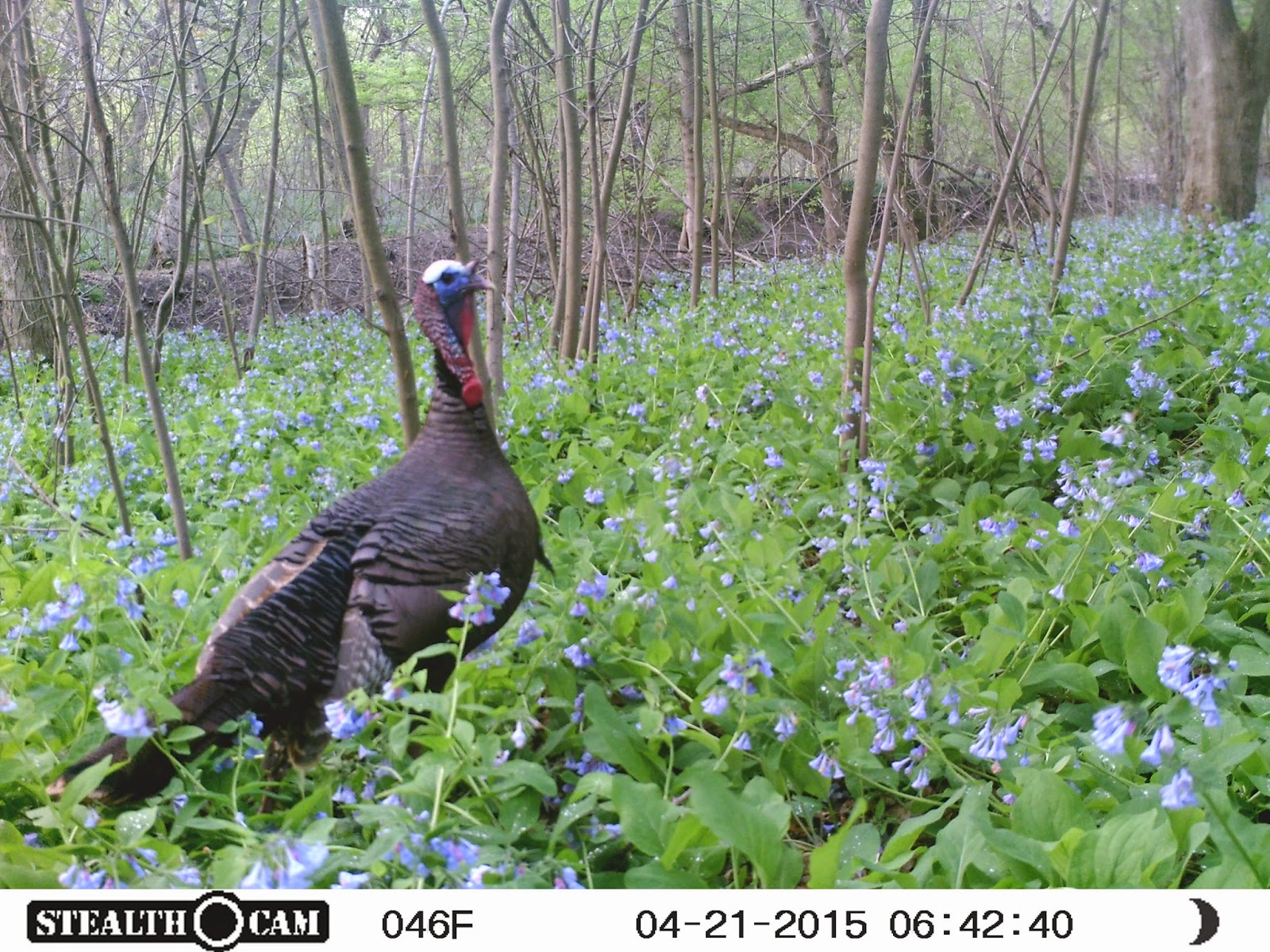
I already knew that no matter what animals we would capture on the camera trap, they would be beautified by being in a sea of bluebells, but was completely amazed when I got incredible pictures of wild turkeys.

One of the projects that Jeff and I have been working on is an article in National Wildlife Federation's Magazine, "National Wildlife".  We had an idea of a few camera trap setups to provide the magazine with photos, so it was really nice to get these turkeys in this setting.  I'm excited to get on board with this and hope to share even more photos of wild turkeys in an upcoming issue of the magazine.

For now, enjoy this picture of a turkey in the bluebells.

Wild turkeys are one of my favorite creatures to watch. Endless hours of entertainment can come out of sitting quietly where there is a turkey roost.  Turkeys fight with each other, putz around, and then go on "missions" to mate with each other.  As a naturalist, this is my television, as it's a wildlife version of the Kardashian's.

I did a little bit of a count and individualized multiple males (including two really beefy "Toms"), at least 7 hens, and also got a few pictures of white tailed deer.

The camera has since been taken down, and will be placed somewhere new.  What's next?

Follow along and find out!

-Big thanks to Jeff Mauritzen for taking amazing photos and coming along on my local excursions.  Click to see more of his work here:  Travel and Wildlife Photography .

Monday, April 13, 2015

Bears in Northern Virginia

Putting the terms "bear" and "Northern Virginia" in the same sentence always seems to stir people up.  It's really not at all what I intend to do, in fact, I would really prefer to do the exact opposite.

Like something out of a horror story, some people around here are absolutely terrified by black bears.  Other people are in shock to hear about them roaming around suburban neighborhoods in Loudoun and Fairfax counties.  There's a whole mix of emotions that come into play, and people sometimes come to me to ask what emotion they "are supposed to have" or how they should react.

I find the interest and intent that people have with their native and local black bears absolutely fascinating.

Author with black bear tracks.  Loudoun County, VA.  Photo Credit: Ed Felker
There a tons of wildlife agencies that may possibly handle, talk to you about, or give advice on what to do if you see a black bear, and for the protection of my jobs and my sanity, I will not be going into much detail here about those organizations.

What I will do though, is provide you with information about some bears that I've seen.  I'll show you pictures and tell you cool stories, and immerse you into the world of northern Virginia's largest living mammals.  I'll do this on this blog post, and more in the future.

Let's first look into a common question that people have for me; the question: "Where are the black bears around here?"

My answer:  "All over the place, as they can be anywhere and everywhere and have very large territories as compared to other local mammals"

Seriously though, I've seen black bear sign (scat, tracks, fur, and/or actual sightings) in every northern Virginia county that you could think of. 

One of the most interesting bear tracking episodes came out of Loudoun County, Virginia this past winter.  A bear was seen multiple times on private properties, crossing traffic, and really all over the place.  I'll keep the exact locations to myself for now, but this bear had a very specific territory in mind.   I spent a good amount of my spare time tracking it through woods and fields, and even managed to see it a few times.  One day, I followed the tracks for over 3 hours, and even then, there was no end to its walking in sight.  The tracks lead to and were on top of large fallen logs, across streams, onto an icy pond, straight over barbed wire, and even into a bedding area where it probably stayed during that same day.

To put it simply, this bear seemed to have almost no problem going over and across all these obstacles, as the gait in the tracks seemed to almost always be consistent over short distances.  In the long run though, I could tell where it "picked up" its pace and almost did a galloping-like motion and could also tell when it got near potential food sources, as it would stand on its hind legs, walk a few steps, then go back down to all fours.  I think that it did this as if it was smelling the air more closely each time it neared a garbage can or bird feeder.  Bears will often stand on their hind legs to get a better look at something with their eyes and to hone their sense of smell when their nose is a few feet higher when standing.

Speaking of bears eating, it is actually illegal to feed black bears in the entire state of Virginia.  For more information on this, visit this website Living with Black Bears in Virginia .  That site also has various other information for the state of Virginia regarding black bears. 

Curious young black bear looking around and doing "bear things" in Northern Virginia.

So with all this information in mind, I'll lead everyone to another common question that people ask me:  "If you can't feed black bears in Virginia legally, then how do you get them to come near the camera?".

This question has tons of answers, none of which lead me to feeding black bears.  A really good way of getting bears on camera trap is to just get lucky and have one walk in the field of view of the camera.  It's kind of an answer that most people who camera trap do not want to hear, but it really does work if you put out enough trail cameras or have a lot of patience.

Another answer to that question might be to set up a camera trap where other animals are living and eating.  For example, a recent camera trap bear sighting around here came from this incidental capture.  The camera was actually pointed at a tree to see what woodpeckers would come near the freshly carved woodpecker holes, and boy did the woodpeckers arrive.  Though, a bear did too.


Why is this? 

It's almost like the bear could have been targeting this tree just because the woodpecker might have had success in getting insects out of the tree too.  Do black bears know to specifically seek out fresh woodpecker sign so they can also get a bite of insects?  I'm not sure about that one, but hope to find the answer sometime.

If you ever see a bear or bear sign in northern Virginia, I would like to know.  It could really help me track these carnivores better, and ultimately might even give me some basis on making a more accurate estimate of the black bear population in these counties.

Look for holes in trees that are this size.
What I would really like to do next year, is do a large camera trap survey just on black bear dens.  I've heard rumors and know of a few in the area that are actually confirmed by various biologists, but would like to expand on what most people (me included) already know.

I'm looking for holes in trees that could easily fit a person, brush piles where you think a bear could be, old barns where a bear has gotten into, and of course, any place where you have actually seen a bear sleeping.  Even though it is months in advance, I would still like to know. 


Please and thank you!

Sunday, April 12, 2015

Wildflowers of Northern Virginia's Early Springtime

I left for a short hike today to check a camera trap (with minimal results) and eventually found myself taking a detour on some trails where I knew there were some interesting wildflowers.

Yesterday before work, I did the same and found a plethora of beautiful photo opportunities.  Although I have only been using my cell phone's camera to capture these, I feel that the photos have turned out pretty well.

These flowers are mostly ephemeral, which means that they only bloom and "come out" for a very short time.  It really depends on the species, but some of them are only in bloom for a period of multiple days to a few weeks.  There are so many more than the ones that I have seen and posted on here, but those will have to wait for another day.

I hope you all enjoy looking at these.


Virginia bluebells nearing peak bloom.  Fairfax County, VA
Virginia Bluebells (Mertensia virginica) are just about in full bloom in various locations in Loudoun and Fairfax counties.  They seem to be a real staple for people doing wildflower walks along the Potomac River and other flowing water bodies.  In some places, they come out in the tens of thousands (or more!) and can be a breathtaking sight. 

To see them in Northern Virginia, look near sandy/muddy areas in parks or private lands (with permission, of course).

Dutchman's Breeches.  Fairfax County, Virginia


Dutchman's Breeches  (Dicentra cuccularia) are some of the most interesting ones in the area.  Look at the shape of those blooms!

It's not a complete rarity in the area, as some people may believe, but to find it can be a bit tricky.

In a general sense, an easy way of finding these may be to look where bluebells are also blooming, as they tend to prefer similar soils and forests.  They can be found in other places though.  The "breeches" in the common name refers to the similar shape of sort of pants worn years ago.

Northern Virginia's beautiful sessile trillium.
Sessile Trillium (Trillium sessile) is another really interesting looking flower that inhabits Virginia. 

To me, it's interesting to see brown in a flower (pictured in the center of the flower), as a lot of other flower species on the ground that people commonly see are brightly colored.

I found a few here and there along the Potomac River a few days ago, but came upon a few large patches eventually after looking for a while.


Spring Beauty (Claytonia virginica)  is one that never seems to get past my eyes when I'm out and about in the woods this time of year.

It's all over un-mowed lawns, deep forests, and even near the Potomac River.  It can be hard to miss in places, as there are patches of it where individual flowers range in the thousands.  It's no wonder that it's called "spring beauty" as it is a wonderful sight to see after a long winter like the one we had this past year.  Each petal is streaked with a darker pink or purple color, and it can be fairly easy to identify.  Look for these in basically any wooded area in Loudoun or Fairfax, and you have a decent chance of finding them. 


Spring beauty flowers in bloom in Sterling, VA.

Thursday, February 26, 2015

Tracking Wildlife Through Social Media

Facebook, Twitter, and all the rest of them have a place in the lives of everyone who uses them. From the completely addicted Facebook user, to the Weekend Twitter Warrior, everyone seems to be connected with them these days.  I was thinking about this a few days ago and was going through my head to classify myself or put myself under the category of some kind of social media demographic.

I never found out the real answer to my own question, but I did realize that my Facebook usage is unlike most people's.  I use Facebook and Twitter to track wildlife.  I do it all the time by just being connected.

Facebook has "Groups" and "Pages" for those of you who are unfamiliar with the website.  You can join these groups and see exactly what people post to the public.  Groups range from hobbyist groups, to family groups, and even classmates in a specific college class or study groups.  Pages are a bit different, but with a similar concept.  We'll leave pages for another day.

Black bear reported to the public on Facebook
What intrigues me though, are Facebook groups that cover people of a certain geographic area. Homeowners associations and neighborhood watch groups are a perfect place for a bit of interesting wildlife tracking.

People post all kinds of important information on the whereabouts of all sorts of species.  Most posts regarding wildlife have to do with what comes up to bird feeders, "too many deer", red fox appearances, and the occasional coyote post from around the area.  Once in a while black bears and bobcats are talked about, and very rarely, someone will post something about a mountain lion.

All of these sightings are important to me.  It helps me out with my trail camera surveys and gives me an opportunity to talk to private property owners about what is really around here.  What usually happens in situations where I see people posting about wildlife sightings, is that I will comment that I'm interested and take it from there.  Sometimes this leads to me trusting the people enough to get the chance at putting up a trail camera on  their property.

I find it fascinating to not only see what people see, but also to see what they completely miss.  It's incredible how many animals seem to "go under the radar" of lots of people.  I have known about bears, bobcats, and whole packs of coyotes that visit people's yards.  Some visit almost every single night, and people never even know.

A good way to skip through posts not having to deal with wildlife is to go on the specific Facebook group and hit the "search" bar up top.  I type in words such as "coyote", "bear", and "wildlife" and all kinds of stuff may come up.  This is usually done once a week on my areas' that I cover on wildlife sightings and trail cameras.  It is something that is free and doesn't take much time at all.  For those two reasons, it is well worth it for me to do this.

A large portion of the work I do covers sightings and opportunities that come directly from my bosses in the parks and wildlife careers.  Tracking wildlife through social media is an opportunity that takes me off the beaten path of professional animal sightings and is a whole "science" in itself.  It's amazing.

Tuesday, February 3, 2015

Northern Virginia Coyotes: Part II

Fairfax County coyote.  Photo Courtesy:  Renee Grebe
Last month, this blog got a lot of views from a post titled "Northern Virginia Coyotes", and from that, a lot of people contacted me and inquired about coyotes.  I was astonished at how many people have seen them around here, and learned a lot from discussing all things canines with them.

Fellow bloggers, naturalists, wildlifers, Facebook friends, and other hunters have sent me what they've seen.
Some of them have agreed to allow me to post their information and images onto here, which I greatly appreciate.  

Let's take a look some photos others have gotten around here.  First and foremost, direct your attention to the picture above at the top of this blog post.  This was taken by Renee Grebe.  Renee Grebe is an avid wildlife enthusiast in Northern Virginia and has taken some amazing photos of coyotes in the immediate Washington D.C. metropolitan area.  Amazing!

Below are more pictures from Renee and other people, some I've worked with doing trail cameras on their properties, others who I have just gotten in contact with.  I hope you all enjoy these as much as I do, as they are purely from in or around D.C.'s infamous beltway traffic.

Here's one from Sterling, Virginia right at Cascades Parkway.

That above picture has a coyote that may be suffering from mange.  It looks a bit skinny and possibly missing fur.

Below are some trail camera picture's from a property in Prince William County last month. 


Below these is one from one of my buddies named Cameron.  I've got trail cameras on his property, and he has agreed to let me use some of his trail camera pictures as well.  It's much appreciated, and I'm always glad to do small deals like that.

...and of course, another one of Renee's phenomenal coyote pictures.
Coyote sitting in Fairfax, Virginia.  Look at that face!  Photo Courtesty:  Renee Grebe
As for me though, I've also been getting some good coyote pictures lately.  Below are a few that I just got last night.


It doesn't just end here though with photographs for research.  There's a project that I have just recently gotten involved in with Princeton University and various parks departments and authorities around here.  
Doing some coyote sampling for the genetics projects.
We're collecting samples to send away to have various northern Virginia coyotes tested and determined for wolf and dog genetics.

I'm very excited to be part of the collection of this research and am curious to where the project will take us.

As always, if you know of any coyotes around, let me know by commenting below so that they may be added to camera-trap research or other survey projects.


Tuesday, January 27, 2015

Antler Shedding

It's that time of year again for our white-tailed deer.  The bucks are starting to shed their antlers and they are available for mice to chew on, for dogs to play with, and for some of us to collect.

So why do antlers drop in January, February, and March?  Well, to answer that question, we've got to think back to the previous year.

In late October, most of November, and early December the deer here are in rut.  This means that they capable of mating with females.  Antlers are used to display dominance and to fight off other bucks that may provide competition to the mating "rights" of a group of does.

The rut ends before the New Year starts and the antlers become less of a necessity for bucks.  Since they take extra energy to grow and walk around with, deer shed or drop their antlers to save energy and because they really aren't needed any more.

New antlers begin to grow and the process is repeated, year after year.

It's legal in Virginia to collect them and possess them (as long as you have landowner permission to do so), so I always like to find a few to collect.  Maybe I'll even make some new knife handles again this year

There is an importance to leave some for the animals though.  Mice, squirrels, and other rodents chew on antlers to sharpen their teeth and to gain important vitamins and minerals that can become extremely scarce in the winter from their regular food sources.

Monday, January 26, 2015

White Legs in 2015

White Legs is still alive and seems well in 2015.  The familiar face and white legs on this red fox are always a welcomed sight.

Red foxes are in their mating season right now in Virginia.  Their normal mating season here occurs in mostly January and February.  Will White Legs be the proud parent of another piebald red fox?


Friday, January 16, 2015

Snow Day Cold Case

It's a sort of "Whodunnit?" and most definitely still a cold case.

I doubt  that you would find this story in the mystery section of a bookstore though.

The victim was a mourning dove, whose feathers were sprawled over the freshly fallen snow on a property in Leesburg.

I discovered the scene while doing some animal tracking and of course, camera-trapping last week.

The mourning dove was probably picked off by bird, as there were no other tracks in the snow.

This could most likely rule our foxes, raccoons, bobcats, and coyotes, but who knows for sure.  Top suspects could be hawks, owls, or falcons.  I wish I had recorded the acrobatics of a bird of prey taking down this bird, but I was there a few hours too late.  Oh well.

As always, it's a fight to stay alive for wildlife, and in winter, things get even tougher.


Tuesday, January 13, 2015

Camera-Trapping Program

I'll make this one short and sweet!

In March of this year, Loudoun Wildlife Conservancy will be hosting program titled "Wildlife Camera-Trapping Program and Field Trip".

Location:  Morven Park,  Leesburg, Virginia
Date:  March 7, 2015
Time:  2 P.M.
What to bring:  Hiking boots or shoes that can get muddy.

You are all invited come to this FREE program where I will be speaking about local camera-trapping projects, ecology, citizen science, and northern Virginia's natural world.

There will of course be an outdoor field portion of this program.

Did I mention it's FREE?!

You can sign up here :  Wildlife Camera-Trapping Program .

Hope to see you there!