Showing posts with label coyote. Show all posts

Friday, November 6, 2015

Increase Your Chances At Seeing Wildlife


I've spent almost the entirety of the past few years observing animals, studying them, and teaching people about them. One of the main questions people ask me, is "How can I see what you see?". Well, here are some of my secrets. These are my personal tips on how to see more animals while you are hiking or just outside, even for an hour.


  • Look Up.     Birds are the most obvious animals that you might see while looking up, though just over a week ago, a person in my hiking party spooked a roughed grouse from right under her feet, so always keep your eyes all over the place.  Believe it or not, some species that people usually see on the ground can easily be found in trees.  Black snakes and green snakes are animals that can easily "pop out" in your eyesight from above, as they are very good at climbing in trees.  Bears and groundhogs also commonly go up into trees, despite many people's beliefs about them.

  • Look Down.    Looking down gives you the opportunity to see more salamanders, frogs, chipmunks, and even animal tracks.  If you can find animal tracks, identify them, and take a mental note of what is around.  Look for the specific animal while continuing to walk.

  • Walk Slowly.    Some of you might be reading the above bullet points and are thinking "How can you both look up and down at the same time?"  Well, you can't, so walk slowly so you can repeatedly do each.  Walking slowly also can be a quieter type of walk, lessening the chances of you scaring wildlife.

  • Pish!    Pishing is making the sound "pish" with your mouth, repeatedly for a few seconds. This is a little naturalist and biologist trick to scare birds from their hiding places, making them fly out from thick leaves or brush.  This can be tricky though, as some birds will get too scared and fly off very fast and very far.

  • Look for both color differences and movement.   Black bears against a green background and red cardinals against white snow are some really easy examples of color differences you should look for.  It's easy, as a lot of animals stick right out against various backgrounds, even the most camouflaged ones.   Animals move, sometimes extremely slowly, but they move! Even the most camouflaged wildlife will move, providing a better opportunity for you to see them, as they move against these different backgrounds.

  • Get outside.  This one is pretty self-explanatory, but it's one of the most important.  Just walking a mile in your local park a few times a week can provide very interesting wildlife sightings.  Increase your chances and get another excuse to get outside.

  • Use binoculars.   Binoculars really help you hone on the wildlife you have detected using your regular eyesight.  They can also be used to scan large fields and meadows from a distance, limiting the chances of you scaring the wildlife when you first enter a field.

  • Use your peripheral vision.    Most animals that I see are seen first by my peripheral vision. This happens because this type of vision can detect movement very effectively.  Color differences are also picked up easier if you use your peripheral vision more.

  • Protect your eyes while in the woods.   If going off trail or walking on a property with no trail, I highly recommend wearing sunglasses or safety glasses.  I commonly wear shooting glasses, as they are easily accessible to me, and are very effective.  I've both been told this (by other biologists, as well as multiple conservation officers) and learned the hard way to always protect your eyes.  Going into the woods might mean that branches and thorns will be in the way of you.  This very easily leads down to a road of pain and misery.  Also, gnats have a harder chance of getting into your eyes if you wear sunglasses.  Protect those eyes!  You'll be glad you did, besides, if you have injured eyes, it's very hard to see wildlife.

  • Invest in a field guide.   Some field guides provide useful information on whereabouts of certain animals, especially at different times of the year.  It's worth a few dollars if you are outside all the time.

  • Get High!     Ascend quietly onto ridges and small peaks in a forest.  Be extremely silent as you are going uphill.  Once you get to the top, look down and look for movement. This is how I often see deer, bear, and turkeys.

Sunday, March 22, 2015

Technical Difficulties

The best camera trap photo opportunities sometimes seem to vanish with either technical difficulties or "user error".  By "user error", I mean the fact that sometimes I forget to reset cameras or even forget to turn them on at all.  I'm just human.  Mistakes happen.

This little mistake though is one that I cannot figure out yet.  I'm unsure if it is a memory card problem, "me problem", computer problem, or a camera trap problem.  I need to look more into it.

When viewing the images, only a portion of each image shows.  The rest of the picture seems to be sort of blurred out with a single color.  It's odd and I cannot figure it out.

Here are some examples.


Although I find these pictures fascinating and I can add the species to my data tables, they are not exactly the "perfect pictures" that I was hoping for.

That's the way it goes sometimes.  There's always somethin'.

I'm happy with those coyote pictures though.  At least they made it to the blog!

Tuesday, February 3, 2015

Northern Virginia Coyotes: Part II

Fairfax County coyote.  Photo Courtesy:  Renee Grebe
Last month, this blog got a lot of views from a post titled "Northern Virginia Coyotes", and from that, a lot of people contacted me and inquired about coyotes.  I was astonished at how many people have seen them around here, and learned a lot from discussing all things canines with them.

Fellow bloggers, naturalists, wildlifers, Facebook friends, and other hunters have sent me what they've seen.
Some of them have agreed to allow me to post their information and images onto here, which I greatly appreciate.  

Let's take a look some photos others have gotten around here.  First and foremost, direct your attention to the picture above at the top of this blog post.  This was taken by Renee Grebe.  Renee Grebe is an avid wildlife enthusiast in Northern Virginia and has taken some amazing photos of coyotes in the immediate Washington D.C. metropolitan area.  Amazing!

Below are more pictures from Renee and other people, some I've worked with doing trail cameras on their properties, others who I have just gotten in contact with.  I hope you all enjoy these as much as I do, as they are purely from in or around D.C.'s infamous beltway traffic.

Here's one from Sterling, Virginia right at Cascades Parkway.

That above picture has a coyote that may be suffering from mange.  It looks a bit skinny and possibly missing fur.

Below are some trail camera picture's from a property in Prince William County last month. 


Below these is one from one of my buddies named Cameron.  I've got trail cameras on his property, and he has agreed to let me use some of his trail camera pictures as well.  It's much appreciated, and I'm always glad to do small deals like that.

...and of course, another one of Renee's phenomenal coyote pictures.
Coyote sitting in Fairfax, Virginia.  Look at that face!  Photo Courtesty:  Renee Grebe
As for me though, I've also been getting some good coyote pictures lately.  Below are a few that I just got last night.


It doesn't just end here though with photographs for research.  There's a project that I have just recently gotten involved in with Princeton University and various parks departments and authorities around here.  
Doing some coyote sampling for the genetics projects.
We're collecting samples to send away to have various northern Virginia coyotes tested and determined for wolf and dog genetics.

I'm very excited to be part of the collection of this research and am curious to where the project will take us.

As always, if you know of any coyotes around, let me know by commenting below so that they may be added to camera-trap research or other survey projects.


Sunday, January 11, 2015

Northern Virginia Coyotes

If I were to survey an audience of Northern Virginians asking what the most often seen mammals in the area are, white-tailed deer, gray squirrel, and raccoons might be at the top of that list.

Following these, other mammals often seen might be foxes, bats, rats, mice, and groundhogs.

One mammal though, would most likely be at the bottom of this list.  
Large eastern coyote camera-trapped in Great Falls, Virginia.
Photo: Brian Balik/The Nature Conservancy

That is the Eastern Coyote (Canis latrans).

Eastern Coyotes are seldom seen critters.  They lurk around being extremely cautious of their surroundings.  They use our parks as stomping grounds, our creeks as drinking holes, and our stream valleys and golf courses as travel corridors.

I've spent a lot of time in the past few years studying them, tracking them, and surveying them with many camera-traps.  From park naturalist jobs to volunteering for the Smithsonian National Institution, I've seen them in most towns of northern Virginia.

Great Falls, McLean, Langley, Sterling, Reston, Leesburg, Lovettsville, Purcellville, Alexandria, Centreville, Chantilly, Springfield, Manassas, and Burke are all places where I have seen or heard living coyotes, seen them as roadkill, or even caught them on camera-traps.  

They've been confirmed by naturalists in Arlington County (see link: Coyote Hit By Car Near Arlington Cemetery )  and studied by professional biologists in Quantico (see link: Quantico Coyote Study).

They are in Northern Virginia whether you believe it or not.

Coyotes are a big part of my job and just about every time I'm involved in a conversation about coyotes, the discussion leads to coy-wolves.  "Do we have coy-wolves?", "I saw a coy-wolf on my street.", and "I heard a story about a dog being attacked by a coy-wolf." always seem to be uttered.

Well, the truth is, is that the coyotes that we have around here are the eastern coyote, or a subspecies of coyote.  It is not exactly the same as the coyotes depicted in the Western United States but they are closely related.

To most people's surprise, the Eastern Coyote is, in most part, the same animal as the Coy-wolf.  I say "in most part" because there could be some outliers or other samples that have not yet been studied.

Many area biologists say that area studies have shown that almost all of the coyotes we have here are made up of about 60% coyote, 30% wolf, and 10% dog.  I'm still looking for exact published papers to confirm this. 

What this all means though, is that is correct to say that we have coyotes, coy-wolves, and eastern Coyotes in Northern Virginia.

To everyone reading this, I very highly recommend watching the PBS Nature documentary titled "Meet The Coywolf".  It's free to watch online in the U.S.  Click on this link to watch it : Meet the Coywolf .

The professionals in this documentary go in depth (definitely more than I will on this blog post) about the history, biology, and ecology of the coy-wolf.

One of my best camera-traps almost misses the chance at capturing a coyote in Fairfax County.  Photo:  Brian Balik


When I first started doing research on these canines, I was told by many other professionals to first seek out their scat, tracks, and dens.  That way, I could better find places to scout and place camera-traps.
Possible coyote scat.  Loudoun County, VA.
Photo: Brian Balik

This lead me down the wrong direction though.
Here's why:

Coyote scat can look almost exactly like fox scat or raccoon scat, depending on the size of the coyote, the time of year, and the contents of the scat.  There is a big difference in these scats though, but for my projects, I didn't have the time to do this kind of survey.  Every time I would find scat, I would second guess myself, put out a camera anyway, and not get any pictures of coyotes.

Coyote tracks are so similar to dog tracks, that even the highest qualified biologists can sometimes not even tell if they are of coyote or a domestic dog (like Fido that lives in your house).  Many books will tell you that coyote tracks are a little thinner and "sharper" than dog tracks, but most of the tracks that I've seen of dogs can be of hundreds of shapes and sizes.  This is so incredibly subjective to how fast the dog was walking, dog breed, and the weight of that individual dog.

Possible coyote den.  Leesburg Virginia.  Photo: Brian Balik
Dens are tricky to survey, and although I've found a lot of "confirmed" coyote dens, most of them were not in use of the time of surveying.
So while most other professionals were telling me to look for these signs, then put out the trail cameras (camera-traps), I did the exact opposite.

The best way that I've ever tracked these animals was just to go out in the woods or fields, not specifically looking for any coyote activity at all.
Anywhere and everywhere, I figured I would do mouth calling, calling with reed coyote callers, and of course, my favorite, the camera-trap.

The results were phenomenal and to everyone's amazement, they have shown up.

A pair of coyotes.  Picture taken in Centreville, Virginia.  Photo:  Brian Balik
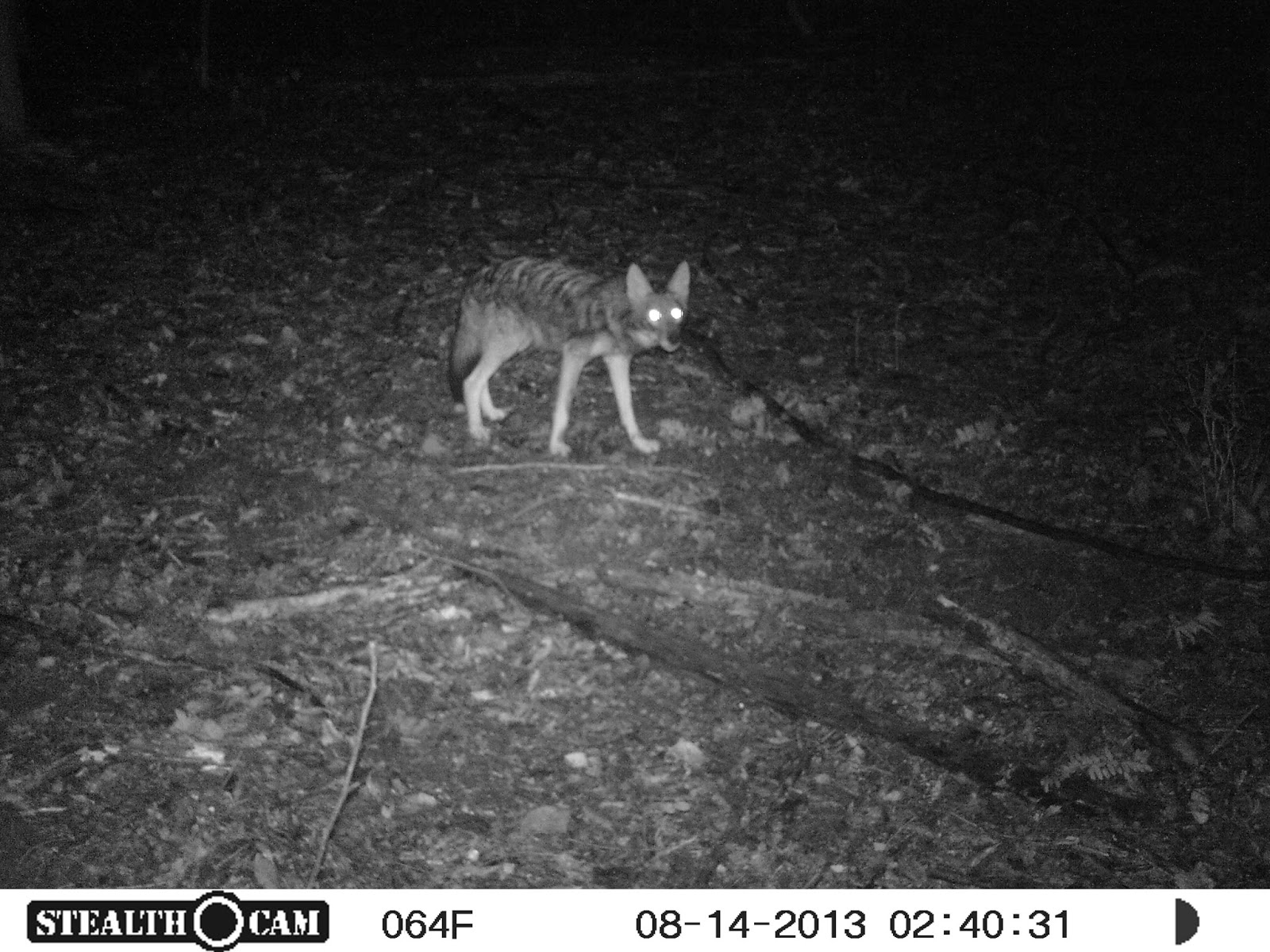
Fairfax County Coyote taken in the summer of 2013.  Photo:  Brian Balik


Fairfax County Coyote taken in the Summer of 2013 (2). Photo:  Brian Balik.

Now while you may enjoy photos like this, some people do not enjoy coyote sightings to any extent.  To some farmers (especially of chickens, ducks, geese, and goats) coyotes are not a welcomed sight.  One thing to realize about coyotes in Virginia is that they are considered a "nuisance species" by the Virginia Department of Game and Inland Fisheries.  Source: VDGIF-Coyotes .

People ask me all the time about this and why they are a nuisance species. I tell them that they could be considered this for a couple of reasons.  They eat livestock, eggs, grain, and food that some farmers depend on for their income and life.  More coyotes may mean more of a problem to a farm.

Coyotes were also never around northern Virginia until just recently.  An article from the Washington Post indicates that the first sighting ever of a coyote in Loudoun County was in 1992 (see link to access the archived Wash. Post article:  Washington Post: Coyote Article ). 

People seem astonished when they realize that coyotes were not naturally living here when Jamestown was settled or when George Washington lived in Mount Vernon.  They were fairly new to the area when Lorena Bobbit did, well, you know.

Whether you like them around or not, the Eastern Coyote calls northern Virginia its home.  I've found out that the best nights to go out and see one are near a full moon, when there's a little snow on the ground, and the temperatures are cold.

This way, the snow reflects the moonshine and you can see what is around.

To hear a coyote, get up really early or stay out around midnight in Loudoun or Fairfax.  Make a call with your voice that resembles a wolf-howling but a lot more high-pitched.  Even higher pitched than a beagle waiting for breakfast.

You may hear one or see one, and if you do, please let me know.  I'd love to add that coyote to my camera-trapping projects.

Thank you.

Wednesday, November 26, 2014

Late Night Coyote Post

I've been hiking, driving, and tracking animals into weird hours of the night in the past few days with various parks/wildlife agencies and doing calls on both public and private properties.  Deer being hit by cars, bear sightings, coyote rumors, and a lot of raccoons getting into trash cans have taken up my time lately.

Coffee has been my best friend during this time.

One more half-day and then I get a food-filled, family-oriented break, but definitely not before I post this one.

It's a link regarding a confirmed coyote in Arlington County, Virginia.  My colleague and fellow blogger, Alonso Abugattas confirmed the sighting and I'm glad there was a bit of media coverage on it.

Check it out below!
http://www.arlnow.com/2014/11/25/coyote-hit-with-car-near-arlington-cemetery/


Sunday, August 3, 2014

More Fairfax Coyotes

This one is a full-grown adult coyote that looks beefy, muscular, and pretty furry.


It may have some genetics of wolf in it, making it a hybrid or coy-wolf, but there's no telling from just a camera-trap image.

Either way,  it's a big one.

What's odd is that this coyote came by the camera very quickly (on both the second and the third nights), when usually coyotes appear on trail cam around the 5th night or later.

I put up a few more cameras in the area, so I'll check back in a few days to see what else is around.

Tuesday, July 29, 2014

That "Old Lady Getting Murdered" Kind of Noise

Cicadas, other insects, and frogs make up a good percentage of the natural noise that a person might hear outside at night around Northern Virginia.  Owls, domestic cats, bats, and other birds are also common.

BUT, There are two very specific animals that might make a person cringe or wonder at night though.  These animals are foxes and coyotes.  We have both here in Northern Va, and they are all over the place.  I highly doubt there is a single town or city in Loudoun, Fairfax, Prince William, or Arlington where both of these animals do not exist.

They have come up on trail cameras, people have put videos of them on YouTube, 911 calls are made when some people see them, and early morning commuters sometimes catch a quick glimpse of both of these critters.

So at night, how do you tell the difference between a coyote noise and a fox noise?  

Well, it can be tricky, but for the most part a coyote will yip and howl with an extremely high pitched noise for a mammal.  They sound like they are singing to each other.  Coyotes will "let loose" a noise that is incredibly loud and may sound similar to domestic dogs howling with high notes.  They can also bark, howl, and whine. 

Foxes usually do a noise around here that I've heard described to me as an "Old lady getting murdered".  I agree, although I have never heard an old lady getting murdered.  While foxes do bark, howl, and whine, the noise that I usually hear is a raspy whine that is close to a scream. 

Speaking of foxes, here's a recent one that came up on a trail camera that I set up in Leesburg, VA. 

 I wonder if this one whines like an old lady getting murdered.


Monday, March 10, 2014

A Shenandoah Hike and a Fairfax County Camera Check

Today was a great day for hiking and camera checking.  The trails of Shenandoah National Park were calling my name and I had to get out there on this day off of work and school.  There was still some snow on the ground from previous storms but today was about 58 degrees and decently sunny.

It was a great hike that led us down the trail to a great basalt rock formation. . .

. . .and a large ice formation left over from this winter's coldest days.

It was a good day to just get out and enjoy the outdoors.

Another highlight of the day came from when checking a camera-trap in Chantilly after the hike.

Cats, dogs, coyotes, cardinals, humans, red foxes, and raccoons all came by the camera.

Here's the best picture of a Chantilly Coyote.


Wednesday, March 5, 2014

Denning Season

It's denning season for the canids of Virginia.  That means that I'll be spending some time tracking fox, coyote, and other footprints through the mud and snow to help me find these dens.  When I find one, a camera will be going up.

Here's a good one that I found yesterday.  You can tell by the amount of footprints and kicked dirt around it that it is very active.

I used extreme care and caution not to get too close or disturb the animals that may be living in there.

Here's to hoping for pups or kits of fox or coyote this spring!

Thursday, December 26, 2013

Fur Bearer Mystery

What animal does this brownish, gray fur belong to?

It's from a camera in Virginia a few weeks ago.

Raccoon, deer, squirrel, coyote, domestic dog, and domestic cat are my top suspects.   What do you think?

Monday, October 28, 2013

Coyotes In Fauquier County, Virginia

At the beginning of the hunting season, I wasn't exactly sure if I should keep all cameras up or not, due to the fact that there would be an increase in human activity off-trail in the places where my cameras are.

I took a few down, a few did get stolen, and I moved some around.  Two of the cameras that I was using in Great Falls, Virginia were taken down and lent to a friend to take to two pieces of property in Fauquier County.

The locations she chose did not disappoint.  I posted images from one of the cameras in a previous post.  You can see that here:  No Shortage of Virginia Bucks .

Now it is time to reveal more photos of the wildlife of Fauquier County, Virginia. 

More specifically, coyotes that roam in the night!

The first one is a bit blurry, as the coyote is moving quickly.


Someone recently asked me what the trick to seeing coyotes around here was, I told them to get a trail camera or to be up really early in the morning near coyote habitats (the edges of deep woods where the woods hits meadows, stream valleys, and large open meadows).

It seems like there is a lot more of those kinds of areas in Northern Virginia than people think.

We have the Capital Beltway which encircles the greater D.C. area, many housing developments, and a complete chaos of a rush-hour.

In all of that though, there really are many places where coyotes, bears, foxes, and birds dominate the area.  The local parks are some of the best places along with many private properties that are large open fields.

Most people that have contacted me about seeing coyotes get lucky and see them crossing a road early in the morning.

Coyotes have been seen all over, and I can confirm that there are many around.  If you want to see one in Northern Virginia, get out in these places, keep quiet, and be patient.


Thursday, October 10, 2013

Rainy Day Picture Viewing

It's a typical rainy, fall day here in northern Virginia.  I've been up all morning homeworking and getting things done.  Now, it's time to blog!

I've had a bit of time to catch up on viewing the camera-trap images from the past few months. 

Here's one that's a bit tough.  This image comes from the town of Great Falls, Virginia.

I think it's a coyote because of the size, the lighter-colored legs, the presence of thick fur, and because of the short, black-tipped tail.

Here's an image of a raccoon in the same, general area.  Use this for the size comparison.

What do you think?

I'm pretty confident with my coyote answer, but I could be wrong.

Thursday, August 15, 2013

Fairfax Coyote

 This post isn't about the writing or the experiences, but rather just the pictures.  All you really need to know is that the animal is a definite coyote, the place is in Great Falls, Virginia, and that I am really excited.


Wednesday, August 14, 2013

Landscapes of Leesburg, Moving Cameras, and Bear Claw Marks

The pictures below show some of the landscapes and habitats that make up the wildest parts of Leesburg, Virginia located in Loudoun County.

One area in particular (which I will keep somewhat a secret for now) offers grasslands full of shrubs, deep forests, and meadows that contain beautiful goldenrod flowers.


It really is a cam-trappers and wildlife enthusiast's heaven.  There are bears that filter in an out, coyotes screaming across the meadows, and hawks that patrol the skies.

I've got a lot of cameras in these areas and have had a few there for some time now.  Hopefully more animals will get a photo or two taken of them.

The cameras that were up here were taken to different spots today to see if that makes any difference in the results.  While placing the cameras in their newest spots, I found myself staring at this beech tree.
Yeah, those are bear claw markings!  Although it is the same species of tree and in the same general area as a tree that I posted about months ago (see: Bear Claw Markings ), it is definitely a different tree with a different set of black bear marks on it.

Results from the cameras that I put all over Leesburg should pour in shortly, but for now, it's time for me to get some rest for tomorrow when I do it all over again in a different place.

Wednesday, July 24, 2013

Most Likely a Fox, Right?

17 out of 19 people so far say that this young mammal is a fox.  The other 2 people say a young coyote in its summer coat.  These people are all wildlife biologists, wildlife conservation specialists, or outdoor park managers who have lots of experience with both animals, so I enjoy their input and find it very interesting.

Personally, I've got my money on it being a young fox.  The tail does seem to have darker edges and a dark tip, which is common of a coyote though.  An attempt to persuade me to calling it a coyote was made based on the size and shape of the ears, and how a coyote would be this skinny in summer due to it losing a lot of its winter coat, but I hold my ground and still call it a fox.

Whatever it is, its a skinny one and was captured on camera in Fairfax County, Virginia.  The camera was reset and is still at the exact same spot.


Do you agree with me and say that this animal is a fox? Or do lean towards it being a coyote?

Saturday, July 20, 2013

Another Den and A View of the Falls

Camera-trapping didn't take long at all today because within the first 5 minutes of trekking through the woods, I found this:
Possible fox den?

This picture doesn't do much justice for the size of the hole but in reality, the hole is about 8 inches wide by 10 inches tall.  My money is on it being a fox hole but it could also be a small coyote den, a groundhog den, or something completely different.  Whatever lives in it will hopefully show up on the camera that I placed near it.

Since finding this hole and placing the camera only took a few minutes, there was time to explore a little bit before I had to go home.

I went to an area in the woods that I haven't had too much time to explore yet to look for more dens and tracks.

There weren't any dens in the ground except for the first one, but there were many holes in trees in this area of the forest.  Basically about one-fourth of all the trees in this area were standing but dead or rotting.  Beech trees, oaks, hickories, and a few walnuts make up the forest here.  It's the perfect flying squirrel habitat.  I took a few pictures of the holes in the trees and made note of exactly where I was.  I'll have to rig up a flying squirrel cam for these holes.
Who lives in these holes? Flyers? Squirrels? Owls?


When I got to the car, I still had some energy left in me so I figured I would drive a mile or two to Great Falls National Park.

Great Falls National Park is very close to where I work, so I am a frequent visitor.  A few of the rangers have gotten to know my name and an obligatory conversation about park wildlife is always sparked when I say hello.  It's one of my favorite places to unwind, and even though the waterfall observation decks can get packed with tourists, the park has many trails on which I walk at least once a week.

Today though, I just wanted to view the falls to see what they looked like with the current water conditions. The large waterfall of the Potomac River is the park's main attraction and the views of it never disappoint.  I take a picture every time I see the falls.  This afternoon was no exception.
 

Vultures are always flying overhead, herons are watching fish swim by, and squirrels are picking at the food scraps left by tourists.  The park is so close to my house and I'm glad I am able to get to it so easily.

Sunday, April 28, 2013

Textbook Coyote Territory


When walking, cam-trapping, or while doing basically any outdoor activity, I frequently use the word "textbook", followed by another phrase.

To me, this accurately describes an outdoor situation that someone would read about in a textbook.  For example, I always say,  "textbook bass fishing", when I catch a bass behind large rocks on a warm day, when the river is beginning to rise.

"Textbook snake grounds", is when I find a water snake basking on rocks right next to the river on a sunny day.

The picture above accurately depicts the scenery of something that I have deemed to be a perfect example of "Textbook Coyote Territory".

The meadow shown is perfect hunting grounds for a coyote that will consume rabbits, rats, squirrels, mice, voles, and even birds.  It's a very large meadow that I have the privilege of working on and researching what animals are present in the area.

Ponds, forests, and more meadows are in the immediate area, providing coyotes and other carnivores (such as foxes), with opportunities to den, mate, hunt, and live throughout the year.

As far as coyote territories get around here, it can't get too much better than this.

It is the same meadow that surrounds a coyote den that I took a picture of in Tracking Your Loudoun Coyotes and is very close to the area of another previous post, Busy Days.


Friday, February 8, 2013

Tracking Your Loudoun Coyotes

Why can't I get a good picture of a coyote coming out of or going inside this den?

Is this an abnormally large fox den or is it a coyote den that is inactive?

I'm going to keep the location of this den a secret but I can assure you that it is located in Loudoun County, Virginia.

The hole, as you can see is bigger in diameter than my backpack is in width.  The smell of carrion meat and carnivore urine bleeds out of this den.

I hope to have some answers as to what really lives in here, in a few weeks.  I already wasn't thinking when I put my backpack around it as I left some of my scent there.  As I have learned with coyotes, any human scent left at the scene is too much scent.  Way too much scent.  But here's to wishful thinking that this site will bring some good results.

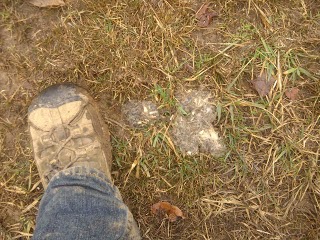
I'll leave you with a picture of week old, rained on, smushed coyote scat that I found near this location.

My muddy boot for size reference as I forgot to bring a tape measure.