Showing posts with label wildlife camera. Show all posts

Sunday, February 15, 2015

Bears and Batteries

When the cold sets in like it is right now, most of my camera traps don't work.  This happens for various reasons, but mostly because some kinds of batteries tend to freeze up a bit and the fact the even the camera's internal electronics get frozen if there's a trace of moisture inside of them.

Regardless, they usually kick right back in when there's a bit of a thaw.  For now though, it's just a sort of waiting game until the batteries continue to work again.

In other Northern Virginia wildlife news, there has been a huge increase in the amount of bear related sightings, emails, and inquiries to me in the past two weeks.

Mostly, this has happened in Loudoun County, specifically Potomac Falls, Sterling, Lowes Island, Cascades, and the Great Falls Forest neighborhoods.  So here's a little bear information for everyone.

Whether or not this is the same bear as what people have been asking about, is still a bit of a mystery to me.  Either way, it's exciting to see bears roaming around.

I caught one of them on a camera trap recently.   Take a look!
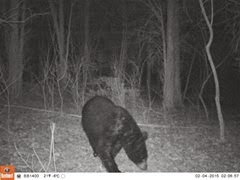


In typical "bear fashion", it came near the camera, sniffed around, got a bit curious, and went on as usual.  That's what I like to see though.  The bear just seemed to get curious about the camera, my human scent, and whatever I touched.   There was no food put down.  In this way, the bear was never rewarded for just coming by and there was barely (bearly?) any human interaction other than a trail camera being around.   Feeding this bear would not only have been illegal, but also wrong on many levels.   Doing so may have led to unhealthy behaviors and unwanted human/wildlife interactions.

It didn't just leave pictures though.  It left some scat in a very obvious place, and I had to take a picture to send to various naturalists and biologists to identify.

There's no doubt in my mind that this is bear scat.  It's large (over 8 inches long with a large mass), not human-like, seems to contain seed/nuts, and is the biggest piece of s*** that I've seen in this general area in a long time.  I've seen dog, human, coyote, and various other scats around, but nothing really compares to this one in Sterling.


So why is there a dollar bill in the picture?  Well, a dollar bill, in a pinch can act as a sort of ruler or object to compare to.  Other people may use knives, pens, and their shoes, but I like to use dollar bills.  They are almost exactly 6 inches long and when you don't have an actual ruler, they can easily be used as a measuring tool.

Monday, December 29, 2014

Fight! Fight! Fight!

Like two fat kids fighting over the last piece of pie, these two hawks were all about getting the last bite of a good meal.  This meal was that of a dead deer though, in Leesburg, VA.

The real point of putting the camera-trap over a deer body was to see if any coyotes were around.  They were not.

Black vultures, crows, ravens, and hawks filled up multiple SD cards here though with over 25,000 images taken over a period of three weeks.

Check out the hawk acrobatics below!


In usual "Brian Fashion" the time/date stamp was set incorrectly.

Wednesday, September 24, 2014

"10 Point"

I commonly give nicknames to wildlife.  I've been told not to do this for the point of becoming attached to a specific individual and also because I'll most likely see their dead bodies splattered on the paved roads of Northern Virginia, but hey, nicknames make wildlife viewing a bit more exciting.

"White Legs", "Scarface",  and "1 Stripe" are just a few of the nicknames given to individual animals that either come up on trail cameras or are commonly seen by coworkers in my parks and wildlife jobs.

Here's another one for everyone that's been called  "10 Point".  10 Point is an impressive male, white-tailed deer.  It's easy to identify him because of his impressive rack that contains 10 tines.


Who knows whether or not he'll make it to the end of Northern Virginia's extensive hunting seasons.

Friday, January 17, 2014

Opossum Vs. Skunk

A skunk is not something most creatures would want to mess with.  It's an experience that could lead to scratches, bites, and of course, a smell like no other.

There's only one clear picture of the ordeal, but it shows the real attitude of these two animals.  This is one brave opossum, folks.

The skunk seemed to be the winner and continued eating for 34 minutes after this.

Tuesday, December 31, 2013

Wetland Paparazzi

There are multiple cameras placed in a small wetlands area in northern Virginia now.  I've had this place in mind for camera-traps for months, but just recently braved the wet conditions explore within it.

Under the 4-6 inches of standing water is another 6-inches of rotting swamp-like vegetation mixed with a thick mud.

Cattails are the dominating plants around here, and do not make for easy travelling.  They choke your view of what's ahead and spear their way up the back of your coat if you're not careful.  They're not all that sharp, but can be a real pain.

What's worse though, is the multi-flora rose at the edge of the wetlands. It pricks every inch of your jeans like a sharp Velcro and sometimes won't let go.

I doubt any other person has walked around in this spot recently.

There were a few spots with blown down cattails and mud where I was able to identify a few animal tracks.

Raccoons, deer, fox, and some kind of mustelid were present.

Cameras will be checked next week to hopefully see what kind of mustelid is travelling in this wetland.

Friday, October 11, 2013

A Friend of White Legs

"We got white legs!!!!" was the text I received from another fellow camera-trapper in Great Falls, Virginia.  Excitement was evident.

We had in fact, camera-trapped White Legs, the red fox.  The saga continues!

Read the other posts about White Legs here:  White Legs . White Legs Returns

This time, White Legs met up with a friend.  You can see another fox there in the background.  Could this be just a friendly meet up?  Or is one of the foxes a female, pushing our chances of fox kits up this upcoming spring?

White Legs made a good amount of appearances at the camera this time.  Everyone seems to know and love this fox.

My co-workers enjoy the images, my volunteers and interns love checking the camera where it always seems to be, and the human neighbors just can't seem to get enough of White Legs. 

Everyone is under strict orders not to feed this fox to see it.  It's illegal to feed foxes in Virginia anyway, but everyone around the home of White Legs still has gone through a 2 minute long speech on why they shouldn't feed it.

This one is one of my favorites so far.

Enjoy your Friday, folks!

Wednesday, October 9, 2013

Owling Again

The young camera-trapper in action in a bacteria infested silo.  Photo credit:  Chelsea Millis
I've taken a few trips to see the barn owls in Leesburg in the past few weeks.

They don't get close enough for me to get a good picture, and will fly away as soon as I make eye contact with them.

I have taken a few friends to see the owls and to try to get good pictures of them, but even they have trouble with their DSLR cameras. 

My camera-traps in the bottoms of these barns and silos have not gotten any pictures of the owls.  A new method will have to be found and thought of.

It's tough.

Sunday, July 28, 2013

Thanks For The Extra Help

This one goes out to the people who have helped me out the most with my outdoor and wildlife endeavors. This blog has so much more in store for you and for the rest of the world

Thanks to my parents for giving me advice on where to put cameres.  Through many walks in the same lands that I camera-trap in, they see things that I don't see.  They have also given me materials, helped with the building of things, given great advice, and even gave me my own camera-trap as a Christmas gift last Christmas.

Thanks to all the volunteers who regularly check cameras, record data, and give me company on hikes and walks to the cameras.  It's really nice getting out with everyone on the trails but also seeing the excitement through emails when we share photos and data.

Thanks to my fellow employees for telling me about every animal they see on a daily basis and for being interested in what I am doing.  Thanks to them for the great advice on where to put cameras, for helping me drag canoes and row-boats to good camera-trap areas, and for giving me even more connections to local public land managers where I am able to do this research in.

Thanks to some of my professors in college who have wildlife, biology, or anatomy backgrounds.  The experience that they bring to my research and hobby of camera-trapping is infectious and helps drastically.

Thanks to homeowners that border the areas where cameras are located.  These people live right there with the animals that I see.  Without their tips and stories, camera-trapping would be a little less interesting and more difficult.  The best stories come from  the people who have had their garbage cans raided by bears, trash thrown by raccoons, and driveways bombarded with scat of all types.

Thanks to the homeowners who let me put up cameras on their property.  Most of the work I do with the cameras is in local parks and public lands, but for my own cameras, I like to search around the area and ask people I know if I can put on up on their land just to see what's lurking where they live.

Thanks to the park managers who give me permission to use cameras on the properties they manage.  Going to all these parks is a thrilling experience that I will remember for the rest of my life.  Thanks to them for being so interested in what I'm doing, for the advice, the park stories that range from bear sightings to risque teenager encounters in the woods, and for the permissions to use vehicles to access the cameras easier.  It's a great experience to hike around to all the cameras so that I can see more things along the way, but in a time crunch or a day that takes me to 3 or more parks, a vehicle for trails is necessary.  I have checked cameras by means of kayaks, canoes, a powerboat, an atv, numerous golf carts, John Deere gators, trail vehicles, cars, vans, pickup trucks, and even a mountain bike that one of the parks owns.

Thanks to other camera-trappers and wildlife researchers who have brought a whole wealth of information regarding trail cameras, animals, lands, weather, terrain, and general research techniques.

Thanks to other bloggers in the wildlife and outdoors fields.  It's tough to keep up with so many different blogs but I have a select few that I read on an almost daily basis.  Also thanks to local bloggers, whether you write about wildlife or not, I have such an interest in what you have to say about the community that I live in.

Thanks to my grandparents and family who support the blog and are regular visitors.  Thanks to my friends as well, I hope you all have begun to catch some type of wildlife fever with me.

And thanks to you, the blog reader.  Without you, why would I even be writing all this?  Thanks for supporting the blog, for the comments, the advice, the arguments you bring to the table, the interest, and the views to this website.  Writing this blog for the past few months has been an incredible experience and I'm glad that I get to share it with you and the world.

I can't wait to see what the camera-traps and outdoors have in store next for the me.  Keep checking back and you will see what most people in the area don't get to see at all.

Friday, July 5, 2013

"How do you keep track of all the cameras?"

It's one of the most commonly asked questions I get regarding the cameras besides the usual, "Where are the bears?" and "Ever get anyone doing anything their not supposed to be doing on camera?".  

I'd figure maybe a few blog readers would be wondering the same thing.

The answer is a mix of a lot of methods. It does get tricky trying to remember where all the cameras are at all times since they get moved a lot.

The first thing I always do is write it down with a pen or pencil.  Trail names, trail features, and landmarks are important here.  I also look at my GPS and write down the coordinates.

I also have an app. on my Android called "GPS Share" that allows me to access the phone's GPS, extract a coordinate, and text message it to anyone.  For a few places I camera-trap at, I send these via email to managers and people who need to know where my cameras are.  A backup email is also sent to my email address.

The GPS Share app. is a free one that works well.  It's quick, easy, and is basically all I need for what I'm doing.

Another method used to keep track of the cameras is logging and flagging a waypoint on my phone's GPS.  Basically, what this means is that I am able to save each camera's location on my GPS map.  I get a phone ringtone when I walk within 20 yards of the camera-trap and a different ringtone noise when I walk within 10 yards of the camera-trap.  This way, if I really forget where a camera is, I can always pull out my phone and have a good idea of the range that it is in.

Do you use any of these methods in the woods with camera-traps?  Are there any better Android apps that I should use instead?