White Legs is still alive and seems well in 2015. The familiar face and white legs on this red fox are always a welcomed sight.
Red foxes are in their mating season right now in Virginia. Their normal mating season here occurs in mostly January and February. Will White Legs be the proud parent of another piebald red fox?
Discussions and banter of Northern Virginia's Wildlife and Large-Scale Trail Camera Projects
Monday, January 26, 2015
Friday, January 16, 2015
Snow Day Cold Case
It's a sort of "Whodunnit?" and most definitely still a cold case.I doubt that you would find this story in the mystery section of a bookstore though.
The victim was a mourning dove, whose feathers were sprawled over the freshly fallen snow on a property in Leesburg.
I discovered the scene while doing some animal tracking and of course, camera-trapping last week.
The mourning dove was probably picked off by bird, as there were no other tracks in the snow.
This could most likely rule our foxes, raccoons, bobcats, and coyotes, but who knows for sure. Top suspects could be hawks, owls, or falcons. I wish I had recorded the acrobatics of a bird of prey taking down this bird, but I was there a few hours too late. Oh well.
As always, it's a fight to stay alive for wildlife, and in winter, things get even tougher.
Labels:
animals,
bird,
birding,
birds,
birds of prey,
fairfax,
falcon,
hawk,
hawks,
loudoun,
loudoun county,
northern va,
northern virginia,
nova,
owl,
owls,
predator,
prey,
Virginia,
wildlife
Tuesday, January 13, 2015
Camera-Trapping Program
I'll make this one short and sweet!
In March of this year, Loudoun Wildlife Conservancy will be hosting program titled "Wildlife Camera-Trapping Program and Field Trip".
Location: Morven Park, Leesburg, Virginia
Date: March 7, 2015
Time: 2 P.M.
What to bring: Hiking boots or shoes that can get muddy.
You are all invited come to this FREE program where I will be speaking about local camera-trapping projects, ecology, citizen science, and northern Virginia's natural world.
There will of course be an outdoor field portion of this program.
Did I mention it's FREE?!
You can sign up here : Wildlife Camera-Trapping Program .
Hope to see you there!
In March of this year, Loudoun Wildlife Conservancy will be hosting program titled "Wildlife Camera-Trapping Program and Field Trip".
Location: Morven Park, Leesburg, Virginia
Date: March 7, 2015
Time: 2 P.M.
What to bring: Hiking boots or shoes that can get muddy.
You are all invited come to this FREE program where I will be speaking about local camera-trapping projects, ecology, citizen science, and northern Virginia's natural world.
There will of course be an outdoor field portion of this program.
Did I mention it's FREE?!
You can sign up here : Wildlife Camera-Trapping Program .
Hope to see you there!
Sunday, January 11, 2015
Northern Virginia Coyotes
If I were to survey an audience of Northern Virginians asking what the most often seen mammals in the area are, white-tailed deer, gray squirrel, and raccoons might be at the top of that list.
Following these, other mammals often seen might be foxes, bats, rats, mice, and groundhogs.
One mammal though, would most likely be at the bottom of this list.
![]() |
| Large eastern coyote camera-trapped in Great Falls, Virginia. Photo: Brian Balik/The Nature Conservancy |
That is the Eastern Coyote (Canis latrans).
Eastern Coyotes are seldom seen critters. They lurk around being extremely cautious of their surroundings. They use our parks as stomping grounds, our creeks as drinking holes, and our stream valleys and golf courses as travel corridors.
I've spent a lot of time in the past few years studying them, tracking them, and surveying them with many camera-traps. From park naturalist jobs to volunteering for the Smithsonian National Institution, I've seen them in most towns of northern Virginia.
Great Falls, McLean, Langley, Sterling, Reston, Leesburg, Lovettsville, Purcellville, Alexandria, Centreville, Chantilly, Springfield, Manassas, and Burke are all places where I have seen or heard living coyotes, seen them as roadkill, or even caught them on camera-traps.
They've been confirmed by naturalists in Arlington County (see link: Coyote Hit By Car Near Arlington Cemetery ) and studied by professional biologists in Quantico (see link: Quantico Coyote Study).
They are in Northern Virginia whether you believe it or not.
Coyotes are a big part of my job and just about every time I'm involved in a conversation about coyotes, the discussion leads to coy-wolves. "Do we have coy-wolves?", "I saw a coy-wolf on my street.", and "I heard a story about a dog being attacked by a coy-wolf." always seem to be uttered.
They are in Northern Virginia whether you believe it or not.
Coyotes are a big part of my job and just about every time I'm involved in a conversation about coyotes, the discussion leads to coy-wolves. "Do we have coy-wolves?", "I saw a coy-wolf on my street.", and "I heard a story about a dog being attacked by a coy-wolf." always seem to be uttered.
Well, the truth is, is that the coyotes that we have around here are the eastern coyote, or a subspecies of coyote. It is not exactly the same as the coyotes depicted in the Western United States but they are closely related.
To most people's surprise, the Eastern Coyote is, in most part, the same animal as the Coy-wolf. I say "in most part" because there could be some outliers or other samples that have not yet been studied.
Many area biologists say that area studies have shown that almost all of the coyotes we have here are made up of about 60% coyote, 30% wolf, and 10% dog. I'm still looking for exact published papers to confirm this.
What this all means though, is that is correct to say that we have coyotes, coy-wolves, and eastern Coyotes in Northern Virginia.
To everyone reading this, I very highly recommend watching the PBS Nature documentary titled "Meet The Coywolf". It's free to watch online in the U.S. Click on this link to watch it : Meet the Coywolf .
The professionals in this documentary go in depth (definitely more than I will on this blog post) about the history, biology, and ecology of the coy-wolf.
To everyone reading this, I very highly recommend watching the PBS Nature documentary titled "Meet The Coywolf". It's free to watch online in the U.S. Click on this link to watch it : Meet the Coywolf .
The professionals in this documentary go in depth (definitely more than I will on this blog post) about the history, biology, and ecology of the coy-wolf.
| One of my best camera-traps almost misses the chance at capturing a coyote in Fairfax County. Photo: Brian Balik |
When I first started doing research on these canines, I was told by many other professionals to first seek out their scat, tracks, and dens. That way, I could better find places to scout and place camera-traps.
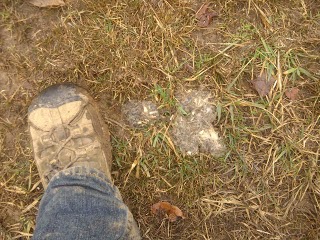
This lead me down the wrong direction though.
Here's why:
Coyote scat can look almost exactly like fox scat or raccoon scat, depending on the size of the coyote, the time of year, and the contents of the scat. There is a big difference in these scats though, but for my projects, I didn't have the time to do this kind of survey. Every time I would find scat, I would second guess myself, put out a camera anyway, and not get any pictures of coyotes.
Coyote tracks are so similar to dog tracks, that even the highest qualified biologists can sometimes not even tell if they are of coyote or a domestic dog (like Fido that lives in your house). Many books will tell you that coyote tracks are a little thinner and "sharper" than dog tracks, but most of the tracks that I've seen of dogs can be of hundreds of shapes and sizes. This is so incredibly subjective to how fast the dog was walking, dog breed, and the weight of that individual dog.
Dens are tricky to survey, and although I've found a lot of "confirmed" coyote dens, most of them were not in use of the time of surveying.
So while most other professionals were telling me to look for these signs, then put out the trail cameras (camera-traps), I did the exact opposite.
The best way that I've ever tracked these animals was just to go out in the woods or fields, not specifically looking for any coyote activity at all.
Anywhere and everywhere, I figured I would do mouth calling, calling with reed coyote callers, and of course, my favorite, the camera-trap.
The results were phenomenal and to everyone's amazement, they have shown up.
![]() |
| Possible coyote scat. Loudoun County, VA. Photo: Brian Balik |
This lead me down the wrong direction though.
Here's why:
Coyote scat can look almost exactly like fox scat or raccoon scat, depending on the size of the coyote, the time of year, and the contents of the scat. There is a big difference in these scats though, but for my projects, I didn't have the time to do this kind of survey. Every time I would find scat, I would second guess myself, put out a camera anyway, and not get any pictures of coyotes.
Coyote tracks are so similar to dog tracks, that even the highest qualified biologists can sometimes not even tell if they are of coyote or a domestic dog (like Fido that lives in your house). Many books will tell you that coyote tracks are a little thinner and "sharper" than dog tracks, but most of the tracks that I've seen of dogs can be of hundreds of shapes and sizes. This is so incredibly subjective to how fast the dog was walking, dog breed, and the weight of that individual dog.
![]() |
| Possible coyote den. Leesburg Virginia. Photo: Brian Balik |
So while most other professionals were telling me to look for these signs, then put out the trail cameras (camera-traps), I did the exact opposite.
The best way that I've ever tracked these animals was just to go out in the woods or fields, not specifically looking for any coyote activity at all.
Anywhere and everywhere, I figured I would do mouth calling, calling with reed coyote callers, and of course, my favorite, the camera-trap.
The results were phenomenal and to everyone's amazement, they have shown up.
![]() |
| A pair of coyotes. Picture taken in Centreville, Virginia. Photo: Brian Balik |
| Fairfax County Coyote taken in the summer of 2013. Photo: Brian Balik |
| Fairfax County Coyote taken in the Summer of 2013 (2). Photo: Brian Balik.
Now while you may enjoy photos like this, some people do not enjoy coyote sightings to any extent. To some farmers (especially of chickens, ducks, geese, and goats) coyotes are not a welcomed sight. One thing to realize about coyotes in Virginia is that they are considered a "nuisance species" by the Virginia Department of Game and Inland Fisheries. Source: VDGIF-Coyotes .
People ask me all the time about this and why they are a nuisance species. I tell them that they could be considered this for a couple of reasons. They eat livestock, eggs, grain, and food that some farmers depend on for their income and life. More coyotes may mean more of a problem to a farm.
Coyotes were also never around northern Virginia until just recently. An article from the Washington Post indicates that the first sighting ever of a coyote in Loudoun County was in 1992 (see link to access the archived Wash. Post article: Washington Post: Coyote Article ).
People seem astonished when they realize that coyotes were not naturally living here when Jamestown was settled or when George Washington lived in Mount Vernon. They were fairly new to the area when Lorena Bobbit did, well, you know.
Whether you like them around or not, the Eastern Coyote calls northern Virginia its home. I've found out that the best nights to go out and see one are near a full moon, when there's a little snow on the ground, and the temperatures are cold.
This way, the snow reflects the moonshine and you can see what is around.
To hear a coyote, get up really early or stay out around midnight in Loudoun or Fairfax. Make a call with your voice that resembles a wolf-howling but a lot more high-pitched. Even higher pitched than a beagle waiting for breakfast.
You may hear one or see one, and if you do, please let me know. I'd love to add that coyote to my camera-trapping projects.
Thank you.
|
Monday, December 29, 2014
Fight! Fight! Fight!
Like two fat kids fighting over the last piece of pie, these two hawks were all about getting the last bite of a good meal. This meal was that of a dead deer though, in Leesburg, VA.
The real point of putting the camera-trap over a deer body was to see if any coyotes were around. They were not.
Black vultures, crows, ravens, and hawks filled up multiple SD cards here though with over 25,000 images taken over a period of three weeks.
Check out the hawk acrobatics below!
In usual "Brian Fashion" the time/date stamp was set incorrectly.
The real point of putting the camera-trap over a deer body was to see if any coyotes were around. They were not.
Black vultures, crows, ravens, and hawks filled up multiple SD cards here though with over 25,000 images taken over a period of three weeks.
Check out the hawk acrobatics below!
In usual "Brian Fashion" the time/date stamp was set incorrectly.
Labels:
a case of wildlife fever,
blog,
brian balik,
camera trap,
deer,
hawk,
leesburg,
loudoun,
scavenge,
scavenger,
trail cam,
trail camera,
Virginia,
white tail,
white tailed deer,
wildlife,
wildlife camera,
wildlife fever
Monday, December 1, 2014
One Antlered Deer
Here's an interesting white-tailed deer missing one of his antlers.
It's early for bucks to be losing their deciduous antlers. Really early. In most cases around here, they drop their antlers during the last week of January to the last week of March. It's interesting, for sure, but stranger things have happened in the outdoors.
Labels:
animals,
antler,
buck,
deer,
doe,
fairfax,
hunt,
hunting,
loudoun,
management,
single antler,
solo,
tailed,
tysons,
vienna,
white,
white tail,
white tailed,
white-tailed deer,
wildlife
Wednesday, November 26, 2014
Late Night Coyote Post
I've been hiking, driving, and tracking animals into weird hours of the night in the past few days with various parks/wildlife agencies and doing calls on both public and private properties. Deer being hit by cars, bear sightings, coyote rumors, and a lot of raccoons getting into trash cans have taken up my time lately.
Coffee has been my best friend during this time.
One more half-day and then I get a food-filled, family-oriented break, but definitely not before I post this one.
It's a link regarding a confirmed coyote in Arlington County, Virginia. My colleague and fellow blogger, Alonso Abugattas confirmed the sighting and I'm glad there was a bit of media coverage on it.
Check it out below!
http://www.arlnow.com/2014/11/25/coyote-hit-with-car-near-arlington-cemetery/
Coffee has been my best friend during this time.
One more half-day and then I get a food-filled, family-oriented break, but definitely not before I post this one.
It's a link regarding a confirmed coyote in Arlington County, Virginia. My colleague and fellow blogger, Alonso Abugattas confirmed the sighting and I'm glad there was a bit of media coverage on it.
Check it out below!
http://www.arlnow.com/2014/11/25/coyote-hit-with-car-near-arlington-cemetery/
Tuesday, November 11, 2014
'Tis the Season
The fall rut has started in Fairfax and Loudoun Counties in Virginia. What this means is that the deer are biologically ready to start mating and bucks are chasing does all day long.
What this also means is that deer are moving around a hell of a lot, and are getting creamed on the roads. This deer was (at least I presume) hit by a car and dropped dead. Of course I did the only thing I could think of, and put a camera-trap up to it.
Foxes, raccoons, and possums picked at it at night, and birds had their way with the meat during the day.
I really enjoy looking at images of hawks that scavenge on the dead deer, and was lucky enough to get images of them during this camera-trap stakeout.
Ignore those time/date stamps. I forgot to set them correctly.
Enjoy!
Hawks can scavenge on carcasses during anytime of the year, but on my cameras, the show up a lot more on deer carcasses during the winter than on deer carcasses of the hot months.
'Tis the season for deer carcass cameras, birding, hunting, the deer rut, and winter sports. We're in for it until April, folks.
Labels:
blog,
camera,
camera trap,
deer,
fairfax,
hawk,
hawks,
loudoun,
northern va,
northern virginia,
nova,
rut,
trail camera,
va,
Virginia,
white tail deer,
white tailed deer,
wildlife
Subscribe to:
Posts (Atom)


